
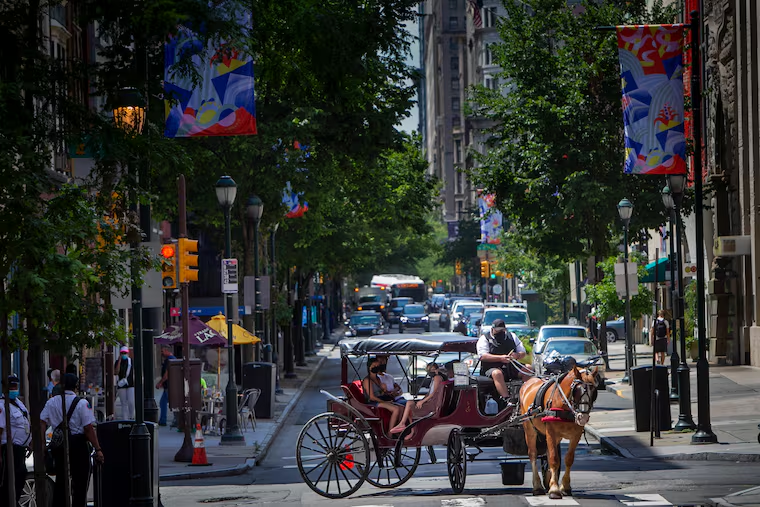
For generations, horse-drawn carriages have been marketed as symbols of nostalgia, romance, and tradition. Tourists have climbed aboard for leisurely rides through historic districts, city streets, and popular attractions while photographs captured what appeared to be a charming connection to the past. Yet behind the carefully curated image, animal welfare advocates have spent decades raising a far more difficult question: What is the true cost of forcing horses to work in modern urban environments built for automobiles, buses, trucks, and millions of people?
Philadelphia has now delivered one of the strongest answers yet.
The Philadelphia City Council has officially approved a comprehensive ban on horse-drawn carriage operations throughout the city, making it illegal for both commercial and noncommercial operators to use horses to pull carriages, wagons, sleds, or sleighs within city limits. The law takes full effect on June 26, 2026, and violators face penalties of up to $1,000 per day.
The decision represents far more than a local ordinance. It marks another significant milestone in a growing international movement that challenges the continued use of horses as working attractions in dense urban environments. Philadelphia now joins an expanding list of major cities that have concluded the risks to both animals and public safety outweigh any perceived cultural or tourism value.
Animal advocates have argued for years that horse-drawn carriage operations place horses into situations fundamentally incompatible with their nature and physical well-being. Horses are herd animals evolved to roam open landscapes, graze naturally, and move freely within social groups. Urban streets offer the exact opposite environment. Constant traffic noise, air pollution, concrete surfaces, crowded intersections, unpredictable vehicle movements, extreme weather conditions, and long working hours create conditions many welfare organizations describe as inherently stressful and potentially dangerous.
The debate surrounding horse-drawn carriage operations has intensified dramatically in recent years as several high-profile incidents have captured public attention. Videos and photographs showing exhausted horses collapsing in city streets have circulated widely online, sparking renewed scrutiny of an industry that critics say relies on outdated assumptions about animal labor. Each incident has fueled a broader conversation about whether traditional practices should continue simply because they have existed for generations.
For Philadelphia, the issue became increasingly difficult to ignore. Although the city’s last officially recognized commercial carriage business ceased operations several years ago, noncommercial operators began reappearing in popular tourist areas, prompting concerns that the practice could quietly re-establish itself. City leaders ultimately chose to act decisively rather than leave the possibility open for future expansion.
The timing is notable. Across North America and Europe, public attitudes toward animal welfare continue to evolve. Practices once considered normal are increasingly being reexamined through the lens of ethics, science, and modern understanding of animal behavior. Circuses featuring wild animals have largely disappeared. Marine mammal performances face growing criticism. Roadside zoos and private wildlife ownership are under greater scrutiny than ever before. Horse-drawn carriage operations have increasingly become part of that larger discussion.
Supporters of carriage bans frequently point to the inherent risks involved regardless of how well individual animals are treated. Even under ideal management conditions, horses remain prey animals with powerful flight instincts. Sudden noises, vehicle horns, emergency sirens, construction equipment, crowds, and unexpected movements can trigger panic responses with potentially catastrophic consequences. When a frightened horse is harnessed to a carriage in a crowded city environment, both animal and human lives can be placed at risk within seconds.
Advocates also note that injuries are not limited to horses. Pedestrians, passengers, drivers, and carriage operators themselves can become victims when accidents occur. Every collision, runaway incident, or medical emergency involving a carriage horse reinforces concerns that the practice introduces unnecessary risks into already congested urban settings.
Recent tragedies have further amplified calls for reform. Animal welfare organizations have cited incidents involving horse collapses, severe injuries, and fatalities as evidence that regulatory oversight alone may not adequately protect animals working under demanding city conditions. Many activists argue that no amount of regulation can eliminate the fundamental challenges posed by traffic, pavement, heat, noise, and environmental stressors.
The passage of Philadelphia’s ban arrives as pressure continues to mount in other major cities where horse-drawn carriage operations remain active. Campaigns advocating for stronger protections have intensified, with supporters arguing that modern cities should seek transportation and tourism alternatives that do not rely on animal labor. Electric vehicles, bicycle-powered attractions, and other innovations increasingly offer ways to preserve sightseeing experiences without placing horses into potentially dangerous environments.
At the heart of the debate is a broader ethical question about humanity’s relationship with animals. Society continues to reconsider which traditions deserve preservation and which should be left behind. Not every historical practice survives changing standards of knowledge and compassion. As understanding evolves, communities are often forced to confront whether longstanding customs still align with contemporary values.
Philadelphia’s decision reflects a growing belief that respect for animals requires more than providing food, water, and shelter. It demands evaluating whether certain forms of human entertainment or commerce justify the physical and psychological burdens placed upon animals in the first place. For many advocates, the answer has become increasingly clear.
The significance of this moment extends beyond a single city ordinance. It signals a cultural shift that continues to gain momentum across the globe. More municipalities are examining animal welfare policies. More lawmakers are considering restrictions on practices once viewed as untouchable. More citizens are asking difficult questions about how animals are used for recreation, tourism, and profit.
Whether one views horse-drawn carriages as a beloved tradition or an outdated practice, the conversation is no longer confined to isolated advocacy circles. It has entered city halls, legislative chambers, and public debate nationwide. Philadelphia’s action demonstrates that governments are increasingly willing to take decisive steps when concerns about animal welfare intersect with public safety.
For advocates who have spent years campaigning for change, the ban represents validation of a simple principle: animals should not be forced to endure unnecessary risks for human entertainment. For cities still debating the issue, Philadelphia may provide a blueprint for what the future looks like.
As June 26 approaches and the new law officially takes effect, Philadelphia becomes part of a growing movement redefining how modern cities coexist with animals. The image of horse-drawn carriages rolling through crowded streets may be fading into history, but the larger conversation about compassion, responsibility, and animal welfare is only gaining strength.
The question facing other cities is no longer whether this debate exists. The question is whether they are prepared to have it.
The urgency behind Philadelphia’s decision becomes even clearer when viewed against the backdrop of recent incidents in New York City, where advocates continue pushing for the passage of Ryder’s Law and an immediate suspension of horse-drawn carriage operations.
Animal welfare organizations argue that the debate is no longer theoretical. They point to recent tragedies that have reignited public scrutiny of the industry, including reports that one horse and one person died within an eight-day period connected to carriage-related incidents. For campaigners, those events underscore what they describe as the unavoidable dangers of forcing horses to navigate congested urban streets filled with traffic, construction, noise, and unpredictable conditions.
The message from advocates has become increasingly direct: horses and people will continue to be injured or killed unless cities move beyond incremental reforms and adopt complete bans. Calls for emergency action have intensified, particularly in New York City, where supporters of Ryder’s Law argue that stronger protections are needed immediately rather than after another preventable tragedy occurs.
For many activists, Philadelphia’s decision represents more than a local ordinance. It serves as evidence that major cities can move away from horse-drawn carriage operations entirely while still preserving tourism, history, and cultural identity. The question now is whether other municipalities facing similar debates will follow Philadelphia’s lead before additional accidents force the issue.