

Do not support SeaWorld or the Miami Seaquarium.
Whales are highly intelligent, wide-ranging, deeply social animals built to travel the open ocean. Nothing about a concrete tank comes close — and the record of premature deaths, injuries, and psychological harm at these parks reflects exactly that.
Lolita (Tokitae), 1966–2023
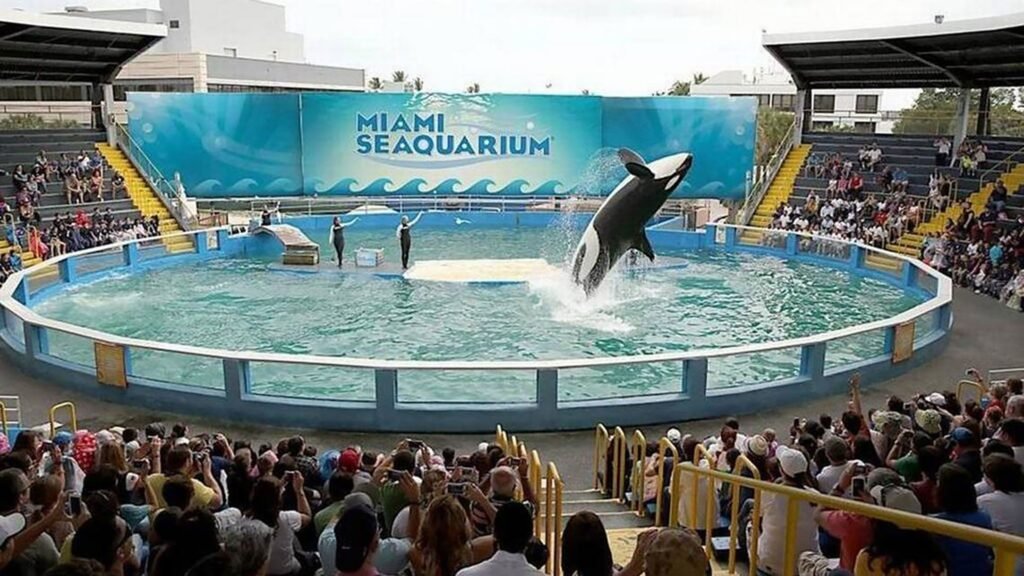
Lolita — also known as Tokitae, and as Sk’aliCh’elh-tenaut by the Lummi Nation she was taken from — was captured off the coast of Washington State in 1970 and held at the Miami Seaquarium for more than 50 years, the last survivor of that era’s captures. In March 2023, after decades of campaigning, an agreement was finally reached to move her to a seaside sanctuary in her native waters.
She died on August 18, 2023, of renal failure, just months before that move could happen. She never made it home.
Her death doesn’t end the reason for this page — it’s the reason the fight continues for the whales still living exactly the way she did. Tilikum, the orca involved in the death of SeaWorld trainer Dawn Brancheau, died in captivity in 2017 after 33 years in concrete tanks. Both are remembered every “Day of the Dead,” alongside every other animal who has died at a marine park.
SeaWorld’s orcas, then and now
Every orca currently at a SeaWorld park either was taken from the ocean during the captures of the late 1960s and ’70s, or was born into that same system afterward.
SeaWorld currently holds captive orcas at its parks in Orlando, San Diego, and San Antonio, with more at its partner facility, Loro Parque, in Tenerife, Spain. None of these animals chose confinement, and none of them can choose to leave. The alternative already exists in concept: certified seaside sanctuaries, sectioned-off natural coastal waters that give captive whales far more space, natural stimulation, and a real chance at something closer to a natural lifespan, without the demands of daily performance.


What a tank actually does to a whale built for the ocean
Pool sizes at marine parks are frequently comparable to a large residential swimming pool — a fraction of a percent of the range a wild whale would use.
Physical health
Dorsal fin collapse, dental damage from chewing concrete and metal, and skin problems are common in captivity and rare in the wild — direct consequences of confinement and stress.
Social disruption
Wild whales live in tight-knit family pods for life. Captive whales are frequently separated from relatives and housed with unfamiliar individuals, producing social stress and conflict.
Psychological toll
Boredom, frustration, and behaviors consistent with depression are documented in captive whales, including repetitive circling, logging motionless at the surface for hours, and self-injurious behavior.
Frustration and aggression
Captive whales and dolphins have attacked tankmates, trainers, and visitors — behavior essentially unknown between wild orcas and humans in the wild.
Take action to move captive orcas to seaside sanctuaries
Don’t buy a ticket. Beyond that, two direct actions carry real weight.
1. Urge SeaWorld to relocate its orcas
A personal letter to SeaWorld’s Chairman of the Board carries more weight than an email. Remind him that these are sentient animals, not depreciating assets on a balance sheet, and that certified seaside sanctuaries are a real, available alternative.
SeaWorld Entertainment, Inc.
6240 Sea Harbor Drive
Orlando, Florida 32821
2. Press federal regulators under the Animal Welfare Act
Write to the U.S. Secretary of Agriculture urging new regulations requiring relocation of captive orcas to certified seaside sanctuaries. The Global Federation of Animal Sanctuaries maintains published standards for what a certified sanctuary actually requires.
U.S. Department of Agriculture
1400 Independence Avenue, S.W.
Washington, D.C. 20250