
BenTzur was tied to a tree. Ori was found in a basement. Neither had ever walked on grass. After a 50-hour journey across three countries in the middle of a war, they finally did.
From a Basement and a Backyard to African Soil
BenTzur was tied to a tree. Ori was found in a basement. Neither had ever walked on grass. After a 50-hour journey across three countries in the middle of a war, they finally did.
BenTzur had been tied to a tree in a backyard in Israel on a short rope. Ori had been found in the basement of a house. Both lions were 16 months old when they were seized by Israeli authorities, both had been torn from their mothers when they were tiny enough to be cradled, and both had spent the early months of their lives being passed from person to person as status accessories for social media photographs. What they had never done, at any point in those 16 months, was walk on grass. They did that for the first time on a winter morning in South Africa’s Free State, and the people who had spent months getting them there watched them stride through the golden dry grass and understood exactly what they had been working toward.
1 How Two Lions Ended Up in Israeli Homes
The illegal wildlife trade does not look the same in 2025 as it did two decades ago. It still involves the same criminal supply chains, the same brutal extraction of young animals from their mothers in source countries, and the same network of breeders, brokers, and buyers operating across jurisdictions with inconsistent enforcement. What has changed is the demand driver. The contemporary market for exotic cubs, particularly lion and tiger cubs, is substantially fueled by social media, specifically by the cultural currency that comes from being photographed holding an apex predator, sharing that image with a large following, and receiving the validation that the engagement numbers provide. The cubs in those photographs are almost always very young, because young cubs are photogenic and manageable and because that is the stage of an animal’s life when close human contact for photo purposes is physically possible. They do not remain young. They grow into animals that are expensive, dangerous, and thoroughly unsuited to the domestic environments where they have been kept. And then they get disposed of.
BenTzur and Ori were products of this market. They had been acquired as cubs by private individuals in Israel, kept in conditions that no regulatory standard for animal welfare would permit, and handled repeatedly by people whose interest in them was photographic rather than caretaking. When Israel’s Nature and Parks Authority conducted a crackdown on illegally trafficked exotic animals, the two young lions were among those seized. They were healthy enough to survive what had been done to them, but they carried all of the developmental consequences of early separation from their mothers, malnutrition in their earliest weeks, and the genetic problems that result from the inbreeding practices common in the captive exotic cub trade. Those consequences mean that BenTzur and Ori can never be released into wild lion populations. But they could be given a life significantly better than a basement and a backyard, and Animal Defenders International was going to make sure they got it.
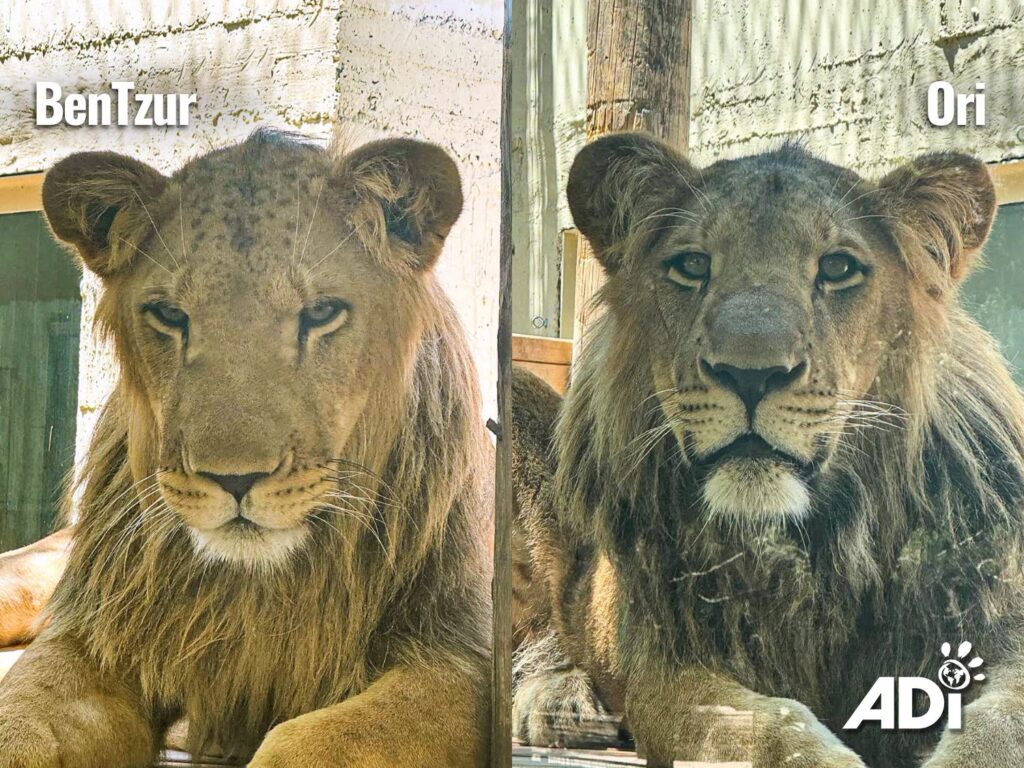
Found tethered in a backyard on a short rope, with no shelter, no appropriate socialization, and no conditions suited to his species. Seized at approximately 16 months old by Israel’s Nature and Parks Authority during a trafficking enforcement action.
Discovered confined in the basement of a private residence. Like BenTzur, he had been acquired as a cub for social media purposes, kept in conditions incompatible with his welfare, and surrendered under enforcement pressure when authorities intervened.
2 The Social Media Pipeline That Produced This Situation
The trophy pet phenomenon is not a niche problem. Animal Defenders International President Jan Creamer has described the scale of it directly: lions and tigers are taken from their mothers when they should still be nursing, kept in cruel and wholly unnatural conditions as status symbols for people who treat them as fashion accessories, and then discarded when the owner’s interest wanes or the animal becomes too large and expensive and dangerous to manage. ADI had encountered this pattern before BenTzur and Ori were seized. Six young lions it had previously rescued in Kuwait had been trophy pets abandoned in the desert to die or left tied to lamp posts in the city. The Israeli seizure was a variation on a pattern that repeats across every region where social media culture intersects with inadequate wildlife trafficking enforcement.
The specific harm of the social media dimension is that it operates in the open. The breeding operations that produce exotic cubs for the trophy pet market are underground. The trafficking networks that move them across borders are covert. But the end use, the photographs and videos of people handling cubs that generate the demand, is public and largely unmoderated. Platforms that would remove content depicting certain categories of violence or exploitation have been slow to treat exotic animal handling as the animal welfare violation it is, and the cultural normalization that results from millions of people seeing lion cubs treated as accessories in aspirational lifestyle content creates the demand that sustains the entire supply chain behind it.
3 Stranded by War: The Months of Waiting
Once BenTzur and Ori were seized and ADI had committed to taking responsibility for them, the plan was straightforward: get them to the ADI Wildlife Sanctuary in South Africa’s Free State, where the organization maintains a large-scale rescue and rehabilitation facility for big cats and other animals rescued from exploitation. The execution of that plan was considerably less straightforward, because the conflict that erupted in the Middle East had grounded most commercial and cargo flights out of Israel, and transporting two young lions requires exactly the kind of cargo capacity that was suddenly scarce and expensive.
ADI founders Jan Creamer and Tim Phillips spent months navigating the flight availability problem while the lions waited in Israel. Aviation fuel costs had risen sharply in the conflict period, the logistics of routing a cargo flight with live animals through multiple intermediate stops were complex, and every delay extended the period during which BenTzur and Ori remained in conditions that were better than what they had come from but still not what they needed. When a cargo flight route finally became available, ADI took it, and Creamer and Phillips flew with the lions personally to monitor them throughout the journey.
🗺 The 50-Hour Journey Home
4 Arrival: What Happened When the Crates Opened
The ADI team had prepared for the specific logistical challenge of two young lions arriving from the intense heat of an Israeli summer into the mid-winter cold of South Africa’s Free State. The animals were kept in a heated house on their first night and given a light meal to allow them to rest and acclimate before any further transition. What the team observed in those first hours was revealing: BenTzur and Ori, who had traveled for 50 hours across four countries and arrived in a completely unfamiliar environment, rubbed heads, vocalized to each other, and curled up together on a bed of hay to sleep. Their bond with each other, formed across months of shared captivity and shared rescue, was intact and visible from the moment they were settled.
The other lions already resident at the ADI sanctuary made their presence known immediately. The roars that came from across the facility were the first lion vocalizations that BenTzur and Ori had ever heard from their own species, because they had been removed from their mothers before any natural exposure to pride communication would have occurred. Jan Creamer observed that you could see the recognition in the two young lions as those sounds reached them: something in their biology responding to what they were hearing even though they had never consciously experienced it, the ancient social architecture of a species communicating across a space that was, for the first time in their lives, actually theirs to inhabit.
5 The First Morning on Grass
On their first morning at the sanctuary, the doors of the house opened and BenTzur and Ori stepped out. They had never stood on grass before that moment. The mid-winter grass of South Africa’s Free State is dry and golden at that time of year, the kind of terrain that looks like it belongs to lions because it does, the landscape that the species evolved in and that their biology still recognizes even after generations of human interference have produced individuals that cannot survive in it without human support.
The two young lions were cautious at first. The texture under their paws was unfamiliar, the scale of the space was unlike anything they had previously experienced, and the sights and sounds coming from the surrounding environment were entirely new. Then something shifted. They began to walk. Not tentatively but with increasing purpose, moving through the habitat together, using the behavioral mapping instinct that adult lions use to learn a new territory: checking the platforms, investigating the dens, noting the perimeter, building a mental picture of where everything was and how it related to everything else. By the end of their third circuit of the 2.5-acre enclosure, they had it memorized. They climbed to the top of the platforms and lay there, looking out across the sanctuary, listening to the roars of their neighbors.
Initial caution on unfamiliar grass, then growing confidence as natural exploratory instincts engaged. Both lions moved together through the enclosure.
Systematic mapping of the full 2.5-acre habitat, investigating platforms, dens, and enrichment objects with the methodical attention of animals learning their territory.
By the end of their third pass through the enclosure, BenTzur and Ori knew where everything was. They climbed to the highest platform and settled to observe and listen.
Rapid adaptation to routine. Both lions respond to carer voices, come into the house for feeding, and have taken to enrichment toys including giant robust-a-balls and catnip sacks.
6 Why They Can’t Go Back — and Why That Doesn’t Diminish What They Have
BenTzur and Ori will never be released into a wild lion population. This is not a failure of the rescue. It is a consequence of what was done to them before the rescue happened. The inbreeding that characterizes the captive exotic cub trade produces genetic problems that compromise long-term health and reproductive fitness in ways that make integration into wild populations medically irresponsible. The malnutrition of their earliest weeks, when they should have been developing on their mothers’ milk and were instead being passed between human handlers, left developmental consequences. And their close, sustained contact with humans from the earliest days of their lives means that the behavioral and social patterning that wild lions develop through their natural upbringing simply did not occur in the same way for these two animals.
None of that means that what BenTzur and Ori have now is anything other than profoundly better than what they had. They have 2.5 acres of species-appropriate habitat. They have enrichment and appropriate veterinary care and nutrition. They have each other. They have the sounds and smells of other lions at close enough range that their biology can engage with them. They have caretakers who will know them as individuals for the next 20 years, whose voices they have already learned to associate with safety and feeding and the particular consistency of care that creates the best possible version of a sanctuary life for animals who came from the worst possible version of an owner’s life. That is not the wild. But it is, by any honest measure, a life worth living, and it was not guaranteed to either of them when they were tied to a tree and shut in a basement in Israel.
7 The Bigger Picture: ADI and the Ongoing War Against the Trophy Pet Trade
The ADI Wildlife Sanctuary in South Africa’s Free State operates as the long-term care facility for big cats and other animals rescued by Animal Defenders International from exploitation around the world. ADI’s enforcement and rescue work spans decades and multiple continents, and the organization has developed particular expertise in the rescue of big cats from the specific categories of exploitation that produce animals like BenTzur and Ori: the circus industry, the trophy hunting pipeline, the exotic pet trade, and the social media-driven trophy pet market that is its most recent and most rapidly growing variant.
The Kuwait rescue that ADI references in connection with BenTzur and Ori’s case involved six young lions who had been abandoned after their novelty as trophy pets had worn out, some left in the desert to die and others tied to lamp posts in the city. The pattern is consistent across geographies and across the specific mechanisms of the trade: young animals are acquired for human gratification, they grow into adults that their owners cannot manage, and they are disposed of in ways that range from surrender to abandonment to active cruelty. The social media dimension accelerates this cycle by expanding the market beyond the people who have always wanted exotic pets to include people who want the photograph without the long-term consequences of what owning the animal actually involves. The cub exists as content. The adult lion is a problem.
What the Trophy Pet Trade Actually Costs These Animals
Cubs are removed from their mothers before natural weaning, typically within the first few days or weeks of life, specifically because younger animals are smaller, more manageable, and more photogenic for handling purposes. The nutritional consequences of early maternal separation are significant and in many cases permanent. The psychological consequences of development without natural social contact with their own species are equally significant. The genetic consequences of the inbreeding that characterizes captive exotic breeding operations compound both. By the time a trophy pet lion is large enough to be dangerous, it has already been compromised by everything that was done to it in the months when it was small enough to be a social media prop.
ADI’s advocacy work aims to address the social media dimension of this problem at the regulatory level, pushing platforms and governments to treat the display of exotic animals in private settings as the wildlife trafficking-adjacent activity it frequently is, and to apply the same content standards to exotic animal handling that are applied to other categories of harmful content. The immediate rescue mission, in cases like BenTzur and Ori, is to get the animals to safety. The longer-term mission is to reduce the demand that makes the rescue necessary in the first place.
BenTzur and Ori Need Your Support for the Next 20 Years
The rescue operation was expensive, with months of waiting, limited flight options, rising aviation fuel costs, and the construction of a large secure habitat and heated house. ADI is now asking for support to cover the ongoing cost of food, veterinary care, and a dedicated care team for BenTzur and Ori across what will hopefully be a full two decades of sanctuary life. These two animals survived the trophy pet trade, a basement, a backyard, a war, and a 50-hour journey. The next chapter belongs to them, and it needs funding.
Support BenTzur and Ori