
Kitten Season Never Ends.
Neither Does Hope For Paws.
Six kittens named after a Tex-Mex menu. One video editor back in the US. Thousands of lives saved because a community of supporters refused to look away.
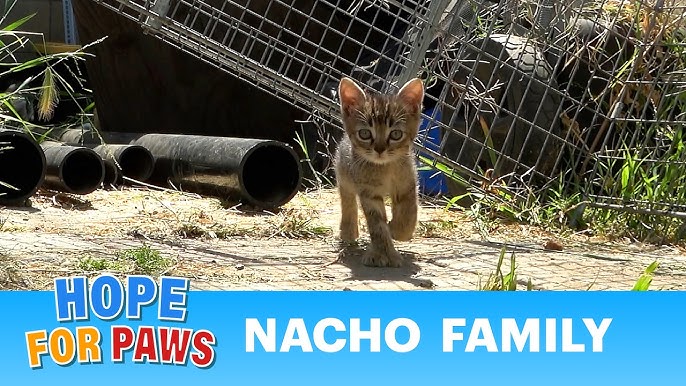
Beans. Jalapeño. Pico de Gallo. Queso Fundido. Guacamole. Cilantro. Six names that belong on the specials board of a very good taqueria, assigned instead to six kittens who were headed for the streets before Hope For Paws intervened. Without a rescue, each of them would have faced the particular cruelty of feral cat life in an urban environment: an average lifespan of two years, scarcity, exposure, and the kind of chronic vulnerability that comes from being small, unprotected, and entirely dependent on finding food in places that were not designed to provide it. Instead, all six are in permanent homes. That outcome is not luck. It is the direct result of a community of supporters who fund the work that makes it possible.
Meet Beans, Jalapeño, Pico, Queso, Guacamole, and Cilantro
Video editor Justin is back in the US, and this is the first of many new rescue videos on the way.
The Six Who Made It
The names came from a theme, as Hope For Paws litter names often do, and this particular theme is one of the better ones. A Tex-Mex menu is a solid organizational principle for a litter of six, and the names stick in a way that generic kitten names do not. More importantly, all six animals named after ingredients and condiments are now living the permanent home lives that their origins on the street made extremely unlikely without human intervention.
The anchor of any good Tex-Mex spread and, apparently, a good rescue litter too. Beans found a permanent home through Hope For Paws’ network of placement partners.
Named for the heat, presumably because someone on the rescue team has a sense of humor worth respecting. Now living somewhere considerably calmer than a street.
A full three-word name for a kitten is an ambitious commitment, and Pico has grown into it. Permanent home secured.
The most melted name in the litter, which is either a reference to temperament or just a very good joke. Either way: adopted.
Green, smooth, and universally beloved. The name tracks. Guacamole is in a forever home where the avocado jokes presumably continue.
The most divisive ingredient on the menu, and possibly the most charming kitten in the litter. Cilantro’s adopter is clearly on the right side of that debate.
The Two-Year Clock That Feral Cats Run Against
The statistic that Hope For Paws returns to repeatedly in its communications about the stakes of kitten rescue is the one that deserves the most attention: feral and stray cats living without human care in an urban environment survive for an average of two years. Two years is not a lifespan. It is a crisis span, a period defined by constant resource scarcity, exposure to predators and traffic, disease without treatment, and the compounding vulnerability of an animal that is small enough to be prey but large enough to need more food than the environment reliably provides.
Kittens born to feral mothers face this reality from the earliest days of their lives. The mother cat, herself surviving on the margins, cannot provide the level of nutrition and protection that domesticated cat mothers with human support provide. Many kittens born outdoors to feral mothers do not survive their first weeks. Those that do inherit the behavioral patterns of feral life: deep wariness of humans, a flight response calibrated to treat any human approach as a threat, and the absence of the early socialization window that makes a kitten genuinely adoptable. Rescuing kittens young enough that that window has not closed is a time-sensitive operation every spring and summer, and doing it effectively requires the organizational capacity that Hope For Paws has spent 18 years building.
What Kitten Season Actually Means
The biology behind the surge
Cats are seasonally polyestrous, meaning they cycle through multiple heat periods during the longer daylight months of the year. In most of the continental United States, this produces a dramatic spike in births between February and October, with peak litter arrival in spring and early summer. A single unspayed female cat can produce three litters per year, with an average of four to six kittens per litter. In an urban feral cat population, this reproductive rate compounds rapidly: the offspring of unspayed females become reproductively active within their first year, and without intervention, a single female and her descendants can produce hundreds of cats within a few years.
Animal shelters and rescue organizations describe kitten season not as a defined period but as a condition of sustained capacity pressure that runs from late winter through fall. Shelters that maintain manageable intake numbers through the winter months face an exponential increase in admissions beginning in March and April that does not subside until the shorter daylight hours of autumn reduce reproductive cycling. The kittens that arrive at shelters and rescue organizations during this period are not evenly spaced or predictably timed. They arrive in waves that correlate with outdoor birthing cycles and the discovery of litters by members of the public who find them in gardens, under porches, in garages, and in the kind of marginal urban spaces where feral mothers seek shelter for giving birth.
Hope For Paws operates year-round, but the kitten season months represent the period of maximum demand for every dimension of the organization’s capacity: rescue response, foster placement, veterinary care, behavioral assessment, and the adoption coordination that ultimately determines whether a rescued kitten ends up in a permanent home or cycles back through the system.
From Street to Screen: The Journey These Kittens Took
The litter is located or reported
Hope For Paws rescue calls come from members of the public who find kittens in yards, abandoned lots, construction sites, and other outdoor locations. The age of the kittens at the time of discovery determines what kind of intervention is possible and how urgently it needs to happen.
Founders or field rescuers respond to the site
Hope For Paws founder Eldad Hagar and his team carry out the physical rescue, which in litter situations often involves locating and securing multiple kittens simultaneously while also, where possible, trapping the mother. Keeping a litter together and with its mother when that is safe and possible is always the preferred outcome.
Every kitten receives a full health evaluation
Feral kittens commonly arrive with upper respiratory infections, eye infections, ear mites, intestinal parasites, and varying degrees of malnutrition. The Hope For Paws veterinary care protocol addresses all of these before any kitten is placed in a foster or adoption program.
Building trust with humans one interaction at a time
For kittens born to feral mothers and raised outdoors without human contact, socialization requires patient, consistent handling that gradually replaces the flight response with tolerance and eventually genuine engagement. The earlier in a kitten’s development this process begins, the more completely it can be achieved.
Foster care and permanent adoption
Hope For Paws works with a network of partner organizations and individual fosters to place kittens in temporary and then permanent homes. The documentation process, including the rescue videos that editor Justin produces, plays a real role in connecting specific animals to the people who will ultimately adopt them.
All six are placed. The work continues.
Beans, Jalapeño, Pico de Gallo, Queso Fundido, Guacamole, and Cilantro are all in permanent homes. Kitten season is not. The next litter that needs this level of care and attention is already somewhere in the system, and the organization’s capacity to respond depends entirely on the support of the community following this work.
The People Behind the Camera (and the Crates)
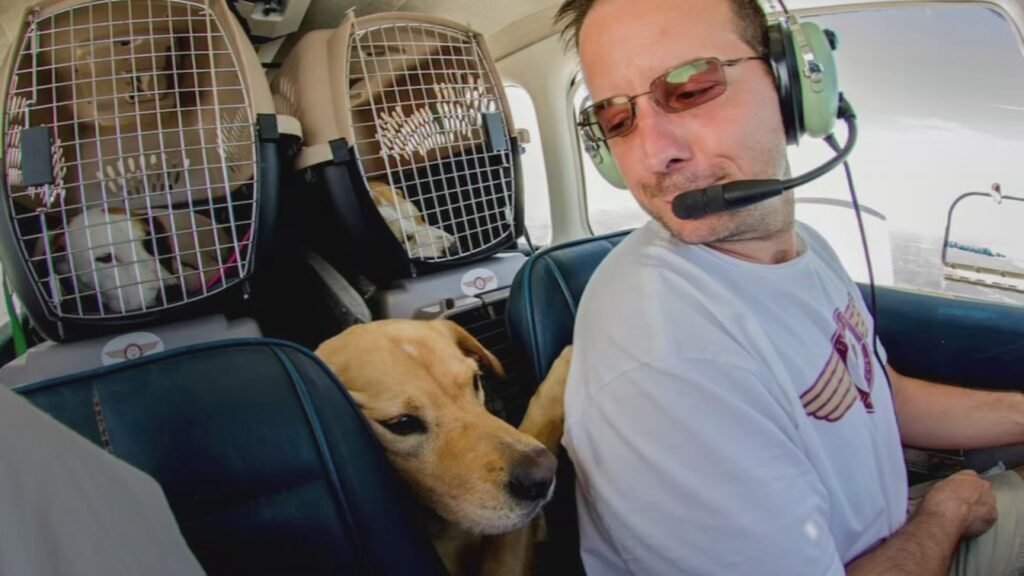
Video editor Justin is back in the United States, and Hope For Paws has announced that a substantial number of new rescue videos are on the way. This is relevant information for the organization’s community because the documentation work Justin does is not separate from the rescue work. It is integral to it. The videos that Hope For Paws has been producing and distributing for more than 18 years are the primary mechanism through which the organization reaches the people who fund its operations, the people who provide foster care, and the people who ultimately adopt the animals that come through the rescue system.
Eldad Hagar and his co-founder Lisa Chiarelli built Hope For Paws on a specific and unconventional premise: that detailed, emotionally honest video documentation of animal rescues, distributed through YouTube and social media, could create a community of engaged supporters large enough to fund a meaningful ongoing rescue operation in Los Angeles without institutional backing. That premise has proven correct to a degree that has made Hope For Paws one of the most-watched animal rescue channels anywhere in the world, with hundreds of millions of views across a library that documents individual animals with a specificity and continuity that no conventional shelter communication approach comes close to matching.
What Your Support Actually Funds
Hope For Paws is funded by its community of supporters through micro-donations. There are no large grants covering the operating costs of the rescue equipment, the veterinary care, the foster coordination, or the organizational infrastructure that makes it possible to respond to a kitten litter call and place all six animals in permanent homes within weeks of their rescue. Every dollar donated to Hope For Paws from individual supporters is part of what makes the specific outcome of this litter possible, and every rescue documented in a Justin-edited video is a direct demonstration of what those donations produce.
Kitten season never ends in the sense that the biological and social conditions that produce vulnerable outdoor cat populations do not switch off at any point in the calendar year. What kitten season actually describes is the peak intensity of a permanent condition, a condition in which the gap between the number of animals who need rescue, medical care, and placement support and the organizational capacity available to provide it is never quite closed. Hope For Paws works in that gap continuously, and the support of its community is what determines how wide the gap remains.
Help Hope For Paws Save the Next Six
Beans, Jalapeño, Pico, Queso, Guacamole, and Cilantro are in their forever homes. The next litter that needs this kind of care, attention, and placement network is already out there. Your support is what makes the response possible. Every donation, regardless of size, contributes directly to the capacity that turns a street kitten into a Tex-Mex-named household member.
Support Hope For Paws