

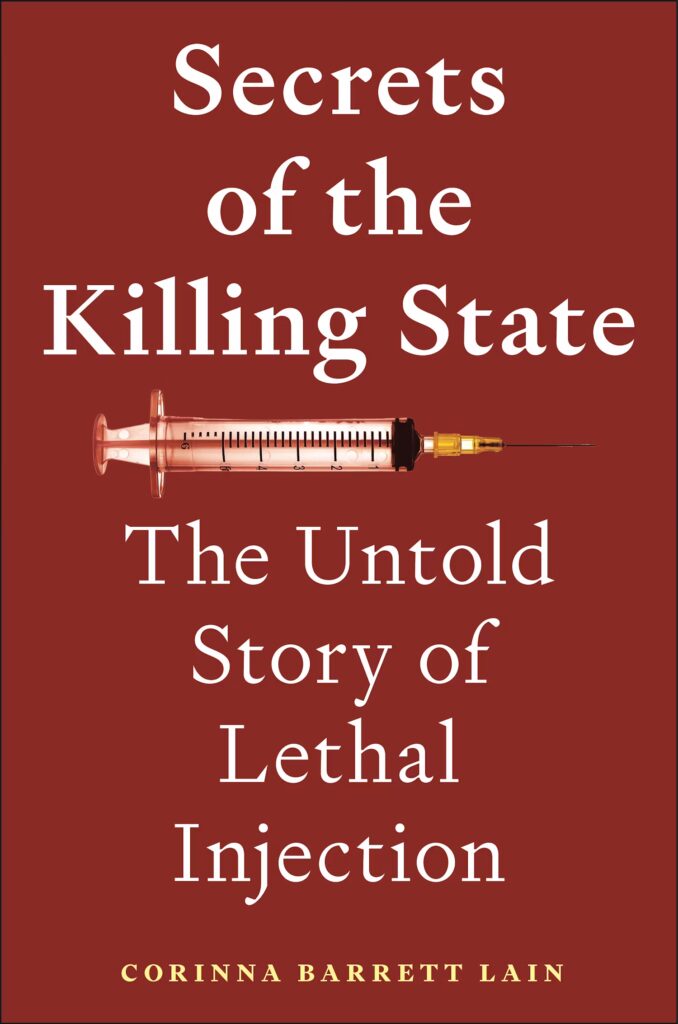
If You Believe in Limited Government, You Cannot Believe the State Should Have Unchecked Power to Kill. A Law Professor Makes the Case.
Conservatives Concerned About the Death Penalty sat down with University of Richmond law professor Corinna Barrett Lain, author of Secrets of the Killing State: The Untold Story of Lethal Injection, to examine what the death penalty reveals about government power, and why the conservative principles of limited government and individual liberty point in a very specific direction on this question.
| 45+ Years of the lethal injection era in the U.S. | 7 yrs Professor Lain’s research into lethal injection | 384 Pages of documented evidence in Secrets of the Killing State | 1977 Year lethal injection originated in Oklahoma |
The question that drives the Conservatives Concerned About the Death Penalty webinar series is not primarily about whether the death penalty is immoral in an abstract sense, though that question matters. It is a much more specific and politically pointed question: should conservatives who genuinely believe that government power must be constrained, that individual liberty is worth defending against state overreach, and that no institution should operate without accountability, be comfortable giving a government the unchecked authority to kill? The conversation that took place last night between Conservatives Concerned and University of Richmond law professor Corinna Barrett Lain, author of Secrets of the Killing State: The Untold Story of Lethal Injection, made that question concrete, specific, and very difficult to answer yes to.
Corinna Barrett Lain on Secrets of the Killing State
and What the Death Penalty Reveals About Government Power
The full conversation is now on our YouTube page. Watch it, share it, and send it to every conservative you know who hasn’t thought about this question yet.
What Americans Think Lethal Injection Is, and What It Actually Is: A 45-Year Gap
The popular image of lethal injection is specific and deeply held: a slight pinch, a smooth and swift transition to permanent sleep, administered by medical professionals in a clinical setting with the efficiency and oversight of a surgical procedure. After seven years of research drawing on litigation files, scientific studies, investigative journalism, autopsy reports, interviews, and scholarship across multiple fields, Corinna Barrett Lain’s verdict is unambiguous: not one element of that image is true. Secrets of the Killing State: The Untold Story of Lethal Injection, published by NYU Press in April 2025 and now in wide release in 2026, is the systematic documentation of the gap between what states tell the public about how they execute people and what is actually happening in death chambers across the country.
Lain is the S.D. Roberts and Sandra Moore Professor of Law at the University of Richmond School of Law, and she approaches lethal injection as a legal scholar rather than as an activist, which is precisely why the book is so difficult to dismiss. She is not making an argument from emotion about the people being executed. She is drawing on the documentary record of what states actually do, and the record is specific. There is the Oklahoma man who regained consciousness during his own execution and attempted to get off the gurney. There are the Arkansas executioners who applied cosmetic concealer to a dead man’s neck after the execution to conceal the five puncture wounds left by their failed attempts to place an intravenous line. There is Dr. Alan Doerhoff, Missouri’s chief executioner from 1995 to 2006, who had more than 20 medical malpractice charges on file and claimed his dyslexia caused him to confuse drug dosages, a revelation that prompted Missouri to pass a secrecy law shielding executioner identities that remains in effect today.
Lain identifies three foundational secrets at the core of the lethal injection practice. The first is that there is no science underlying the procedure. Lethal injection originated in Oklahoma in 1977, just after the Supreme Court’s Gregg v. Georgia decision reinstated the death penalty, and it was developed not by medical professionals or pharmacologists but by a state medical examiner and a legislator who were looking for an execution method that would appear more humane than the electric chair or gas chamber. The three-drug protocol that became standard, a sedative, a paralytic agent, and a drug to stop the heart, was designed to look clinical rather than to function as reliable medicine, and the paralytic agent in particular has been the focus of sustained scientific criticism because it prevents outward signs of distress in a person who may be experiencing severe pain without being able to show it.
The second secret is that the people administering lethal injections are not qualified medical professionals. Medical and nursing associations prohibit their licensed members from participating in executions, which means the people placing the intravenous lines, mixing the drugs, and managing the execution process are, in most states, prison employees with minimal medical training and no accountability structure analogous to the one that governs licensed medical practice. The third secret is that states have worked systematically to keep all of this from public view, through secrecy statutes, confidentiality agreements, and administrative practices specifically designed to prevent the documentation and review that any other life-or-death government function would be required to endure. The point of the secrecy is not to protect legitimate operational interests. The point is to prevent the public from knowing what is done in its name.
About the BookTitle: Secrets of the Killing State: The Untold Story of Lethal Injection Author: Corinna Barrett Lain, S.D. Roberts & Sandra Moore Professor of Law, University of Richmond School of Law Publisher: NYU Press Pages: 384 Research: Seven years of litigation files, scientific studies, investigative journalism, autopsy reports, interviews, and multi-disciplinary scholarship |
Three Secrets Lain Documents1
There is no science underlying the procedure. 2
The people administering it are not qualified medical professionals. 3
States have worked systematically to keep all of this from public view. |
The Strongest Conservative Argument Against the Death Penalty Has Nothing to Do with Sympathy for Criminals
The framing of the Conservatives Concerned webinar with Lain was deliberate and important. This was not a conversation about whether the crimes that put people on death row are terrible, or whether victims’ families deserve justice, or whether some people might in some abstract sense deserve the death penalty. Those conversations can exist and do exist, and they are not what Conservatives Concerned is primarily organized around. The conversation Corinna Barrett Lain was invited to have is about something more foundational: what the death penalty reveals about the nature of government power, and whether conservatives who have built their political identity on skepticism of that power have been consistent in applying it to the government’s authority to execute.
The conservative case against capital punishment does not require a position on the moral status of the worst criminals. It requires only the application of principles that conservatives already hold everywhere else: that government institutions are fallible, that unchecked power produces abuse, that secrecy in government operations is a warning sign rather than a management tool, that irreversible errors are categorically worse than reversible ones, and that the burden of proof for giving any government the authority to do something permanent and fatal to a citizen should be extraordinarily high. These are not liberal propositions. They are the propositions that animated the founding documents of this country and that conservatives have defended against progressive expansions of government authority in virtually every other domain for the past century.
What Secrets of the Killing State adds to this principled argument is the evidentiary record of what actually happens when government is given that power. The concealer applied to the dead man’s neck. The executioner with 20 malpractice charges who may have confused drug dosages. The Oklahoma man who woke up mid-execution. The Supreme Court cases in which condemned people asked to die by the same one-drug protocol used to euthanize pets and were denied by courts that have, in Lain’s assessment, largely abdicated their constitutional responsibility to enforce the Eighth Amendment’s prohibition on cruel and unusual punishment. The argument that lethal injection is a clean, humane, carefully administered process is not a defensible position after reading what is on the public record. It is a public relations maintenance effort by states that have strong institutional reasons to prevent the public from examining what they actually do.
Lain herself is careful to note that her book does not make a broad argument for or against the death penalty as a matter of moral principle. That is a deliberate choice, and it is the choice that makes the book effective across political audiences. The book is about lethal injection specifically, and what the documented reality of lethal injection reveals about the character of state power at its most extreme. Her conclusion is the same one that conservatives in the Conservatives Concerned network have reached from a different direction: the state at its most powerful moment is also the state at its worst, and a political tradition built on distrust of unchecked state power should find that conclusion uncomfortable in ways that demand a response.
Conservative Principles That Point Toward Skepticism of the Death Penalty
| → | Government fallibility. No government institution operates without error. The death penalty is irreversible. Florida has exonerated more death row prisoners than any other state in the country. These facts do not coexist comfortably. |
| → | Unchecked power produces abuse. The documented history of lethal injection, the unqualified executioners, the secret statutes, the botched procedures covered up with concealer, is a textbook illustration of what happens when government operates without meaningful accountability. |
| → | Secrecy is a warning sign. States have passed laws specifically to prevent the public from knowing who is executing people, what drugs are being used, and what the outcomes look like. Conservatives who would not accept this level of secrecy in any other government function should not accept it here. |
| → | Irreversibility requires a higher standard. Conservatives apply a higher burden of proof to government actions that cannot be undone. Execution is the one government action that absolutely cannot be undone. That standard has not been met. |
| → | Fiscal responsibility. Capital cases cost substantially more than non-capital murder prosecutions, in pre-trial costs, trial costs, and the decades of post-conviction litigation that death sentences reliably generate. Life without parole achieves the same public safety outcome at a fraction of the cost. |
The Courts Have Not Been Doing Their Job. That Is Lain’s Most Uncomfortable Finding.
The legal argument at the center of Secrets of the Killing State is not primarily about whether the death penalty should exist. It is about whether the courts have been doing the job the Constitution gives them in relation to it. The Eighth Amendment’s prohibition on cruel and unusual punishment is the constitutional mechanism for reviewing the methods states use to execute, and Lain’s assessment of how courts have applied that mechanism is specific and unflattering. She documents cases in which people scheduled for execution sought to die instead by the one-drug protocol used for animal euthanasia, a method that produces a reliable and painless death by overdose of the same sedative used in medical procedures, rather than by the three-drug protocol that carries a substantial documented risk of pain masked by the paralytic agent. Courts have largely rejected these challenges, and the reasoning they have used to do so reflects, in Lain’s assessment, a judicial reluctance to engage seriously with the evidence of how lethal injection actually functions.
The secrecy laws that states have passed to shield their execution processes from scrutiny compound this problem significantly. When a state passes a law preventing public disclosure of who is conducting executions, what drugs are being used, where those drugs are sourced, and what the observable results of executions look like, it is deliberately obstructing the kind of evidence-gathering that would allow courts, journalists, or the public to assess whether what is happening in death chambers meets constitutional standards. The argument that secrecy is necessary to protect executioners from harassment or to ensure drug supply is available has been accepted by courts in various jurisdictions. The effect of that acceptance is that the government gets to conduct a life-or-death process in the dark, and the people challenging it are required to prove unconstitutionality without access to the evidence that would allow them to do so.
Lain is also careful to note that her book changed her own thinking in a way that goes beyond the legal and procedural arguments. In the epilogue of Secrets of the Killing State, she reflects on how seven years of research into execution practice led her to confront something she had not expected to find herself thinking about: how different the people being executed are from who they were at the time of the crimes that put them on death row. This is not a sentimental observation. It is an observation about the specific nature of what the state is doing when it executes someone after decades of incarceration, which is executing the person that decades of incarceration produced, not the person who committed the crime that the sentence was imposed for. That distinction matters morally, and it is one that the machinery of capital punishment is structurally unable to address because execution dates are set years or decades after sentences are imposed without any systematic mechanism for evaluating who the condemned person has become in the time since.
Watch the Conversation. Read the Book. Sign the Statement.
The full conversation between Conservatives Concerned About the Death Penalty and Corinna Barrett Lain is on the Conservatives Concerned YouTube page, embedded above, and it is worth watching in its entirety rather than in excerpts. Lain brings the same precision to the conversation that she brings to the book: she is not performing outrage or making an emotional appeal. She is presenting what is on the documented record and letting the evidence carry the argument, which is exactly the kind of intellectual engagement that the conservative conversation about capital punishment needs more of.
Watch the Full Webinar
The conversation is embedded at the top of this page and on the Conservatives Concerned YouTube channel. Watch it. Share it to your networks, especially with conservatives in your life who haven’t yet heard this argument made from their own principles rather than from across a political divide.
Read Secrets of the Killing State
The book is available through Corinna Barrett Lain’s website, through NYU Press, and at booksellers nationally. It is 384 pages of meticulously documented research that is, in the words of the Washington Independent Review of Books, “spectacularly engaging: crisply written, full of moral clarity, and never preachy.” Lain also has upcoming events where you can hear her present the research in person.
Sign the Conservative Statement of Support
If you are a conservative who is concerned about government overreach and believes no government should have unchecked power over life and death, the Conservatives Concerned Conservative Statement of Support is the formal expression of that position. Adding your name matters: it tells elected officials that opposition to the death penalty is not a partisan issue but a principled one that exists within their own coalition.
Sustainable Action Now: Death Penalty Coverage
We cover capital punishment from every angle: legal, moral, factual, and political. The conservative opposition to the death penalty is one of the most underreported dimensions of the abolition movement, and conversations like this one with Corinna Barrett Lain are why that opposition is growing.
Visit SAN Death Penalty CoverageWe are grateful to Corinna Barrett Lain for this conversation, and grateful to the Conservatives Concerned community for making these conversations possible. Follow Conservatives Concerned on social media to be the first to know about the next webinar. The next one is coming. The work is not done. And the argument, it turns out, is easier to make than people expected once you apply the same principles to state execution that conservatives apply to everything else the state does in the dark with unchecked power and no accountability.