

Criminal Justice · Mass Incarceration
Nearly 200,000 Women Are Behind Bars in America. New Data Shows Where, and Why It Is Growing
A fresh national count finds more women held in local jails than in state prisons, most of them mothers, many of them never convicted. A second analysis asks whether handing local jails to immigration agents has bought anyone any peace.
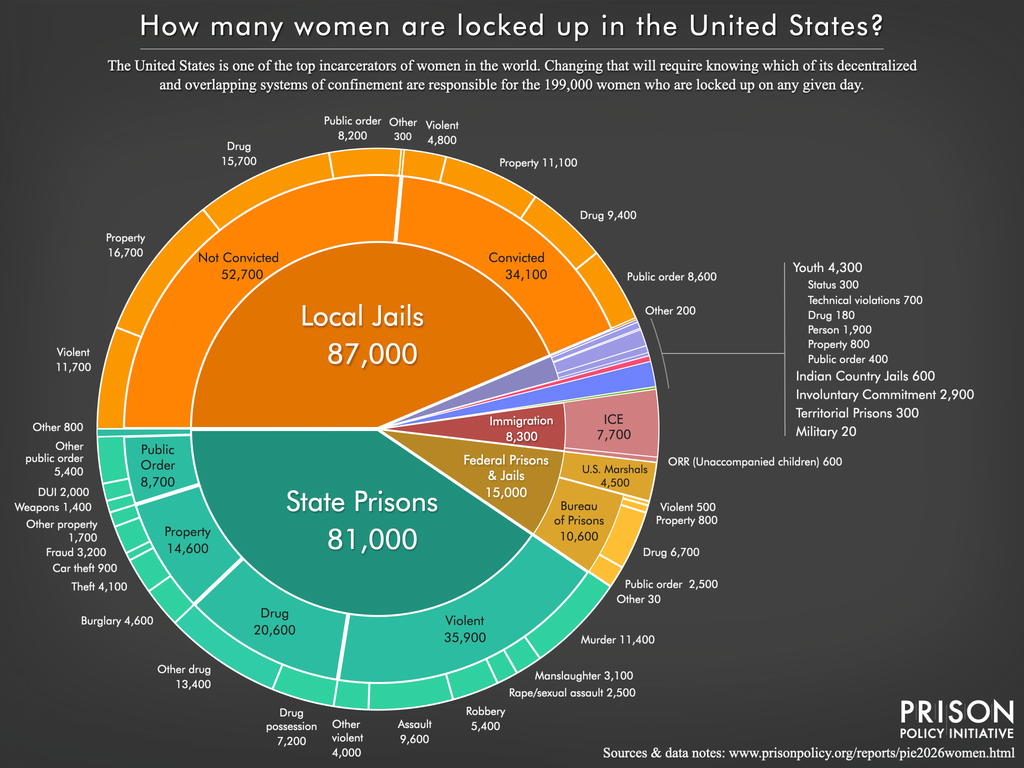
On any given day, 198,800 women are locked up.
That is the central number in “Women’s Mass Incarceration: The Whole Pie 2026,” a report released October 14 by the Prison Policy Initiative. The group, a research and advocacy organization that has spent years mapping American confinement, pulled together figures from several government agencies to produce a single picture of where women and girls are held. The result includes places that rarely make the headlines, from county jails to immigration detention centers to psychiatric units attached to criminal cases.
The Jail Is the Center of Gravity
The men’s system leans on prisons. The women’s system does not. Across the whole country, state and federal prisons hold roughly twice as many people as local jails, but for women the balance tips the other way: about 87,000 women sit in city and county jails, compared with 81,000 in state prisons. The state prison figure is itself a story, because it reflects a rebound from the sharp drop in populations during the early COVID years.
Local jails are supposed to be short stays, a place to wait for a court date. For many women they aren’t. About 61 percent of women held under local authority have not been convicted of anything. They are waiting for trial, and a great many are waiting because they cannot post bail. Women’s jail rates rose 31 percent between 2020 and 2024, while the rate for men rose 14 percent. The report counts roughly 2,400 more women in jails than at its previous count, a jump of nearly 3 percent.
Approximate daily counts as reported. Federal custody, juvenile facilities and other categories are also part of the total.
Women aren’t the margins of mass incarceration. They’re the fastest-moving part of it.
Who Is in There, and What They Left Behind
About 80 percent of women in local jails are mothers, and many are the primary caregivers for their children. A short stay is rarely short for a family. A missed shift becomes a lost job, a lost job becomes a missed rent payment, and a child ends up with a relative or in foster care before a judge has heard a word of the case. The report also stresses that incarcerated women carry heavier burdens of mental illness, disability, substance use and past trauma than the population at large, and that they are often held in facilities designed around men.
Probation and parole matter as much as the cells. By the report’s count, 819,400 women are under supervision, and probation alone accounts for 74 percent of all women under correctional control, compared with 18 percent who are incarcerated. The authors argue that supervision often works as a trap, because a missed appointment or a failed test can send someone back inside without any new offense.
The offenses behind the numbers are not the ones most people picture. Drug and property offenses account for more than half of the reasons women are incarcerated, and women are proportionally more likely than men to be held for them. The report’s co-authors point to the war on drugs and broken windows policing as the engines behind the trend. Among girls, the picture is similar in its unfairness: more than 5,000 girls are confined, about 85 percent in the juvenile justice system and roughly 600 unaccompanied migrant girls in federal refugee custody, and Black girls make up 37 percent of girls in juvenile facilities while accounting for 16 percent of girls under 18 nationwide.
The Hidden Categories
Two of the report’s counts deserve attention because they are new or fast growing. About 8,300 women and girls are held for immigration reasons, up 31 percent since 2024 for ICE detention, even as the number of unaccompanied girls in refugee custody fell. And roughly 2,900 women are held in psychiatric or civil commitment because of an underlying criminal charge, an estimate the report presents for the first time. In those settings, a woman answers to both a medical system and a criminal one, and neither is built to hand her back quickly.
Wendy Sawyer, one of the report’s co-authors, called the rapid increase in women’s prison and jail populations alarming. Co-author Brian Nam-Sonenstein pointed to decades of policy choices that criminalize poverty, addiction and minor offenses. One caution is worth noting for anyone citing the figures: the headline total of 198,800 is the report’s own, and an estimate of this size, assembled from many sources with different counting rules, carries some uncertainty.
A Second Front: Does Cooperating With ICE Reduce Arrests?
A separate analysis published October 6 and updated October 8 by the same organization looks at the argument that local cooperation with immigration enforcement keeps agents out of neighborhoods. Its authors say the data point the other way, and the next section walks through what they found.
The Bargain That Didn’t Hold
After the killings in Minneapolis earlier this year, the administration, as the researchers describe it, signaled it would pull back on community arrests if states and localities cooperated with federal immigration enforcement. The researchers call that a false bargain. Using ICE arrest data through August, they found that daily arrests nationwide rose from 313 in 2024 to 926 in 2025 and 1,187 so far in 2026. Arrests in communities climbed from 82 a day to 458 over the same stretch, and arrests at law enforcement locations without a detainer rose from 53 to 294.
Detainers, which are requests that a jail hold someone for ICE, remain central. Detainer-related arrests averaged 178 a day in 2024, 376 in 2025 and 435 in the first eight months of 2026. Where states refuse to honor them, the analysis finds fewer arrests overall. Oregon and Illinois, with the strongest protections, had lower arrest rates, while Florida and Georgia, which require collaboration, had high detainer and jail-based arrests, and community arrest rates about double those of Illinois and Oregon. States that took a middle path, including North Carolina and New Jersey, saw community arrest levels comparable to those that cooperate.
There is also what the authors call a federal criminalization loophole. ICE can refer people for federal immigration charges, which moves them into U.S. Marshals custody and often into local jails under per diem contracts. By the analysis, immigration-charge detentions held by the Marshals rose 29 percent compared with fiscal year 2024, while other federal detentions fell 10 percent, leaving about 20,000 people in federal custody on immigration charges. In Oregon, lawsuits against counties that held Marshals detainees were followed by a drop in reentry prosecutions, from 33 cases to 21 in comparable periods, though the authors acknowledge the sample is small and neighboring states saw increases.
The group’s recommendations are plain. Extend sanctuary laws to cover all federal immigration enforcement, including Marshals contracts. Limit how criminal records and location data flow to federal agencies. And reduce low-level police contact and decriminalize minor offenses, since those are often where ICE contact begins. Supporters of tougher cooperation argue that jail-based transfers are safer than street arrests, a claim these numbers challenge but that deserves a hearing.
Why These Two Stories Belong Together
The same jails sit at the center of both. Women wait there before trial because they can’t pay. Immigrants end up there on federal contracts. The money that keeps a county jail running often depends on how many beds it fills, and that is a problem no one on either side of the immigration debate can wave away. Whether the cell belongs to a mother waiting for a court date or a detainee on a Marshals contract, the question is who profits, who pays and what is gained.