
Kokopelli Injured Her Eye and Needs Help. Here Is How to Be Part of What Happens Next.
To know even one life has breathed easier because you have lived. This is the week Kokopelli needs the people behind Hope For Paws to show up for her.
“To know even one life has breathed easier because you have lived — This is to have succeeded!”
Quoted by Eldad Hagar, Hope For Paws
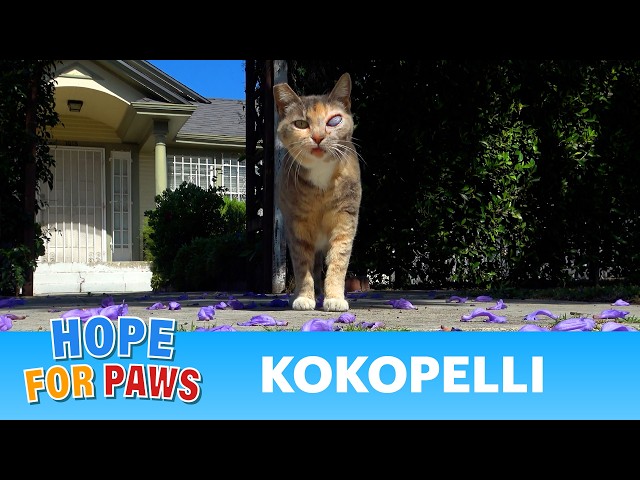
Kokopelli injured her eye. That sentence is short and the situation it describes is not. An eye injury in a dog, particularly one who is already in the care of a rescue organization responding to a fundraising need, is not a minor inconvenience that resolves on its own. It is a veterinary emergency with a timeline, with treatment costs, and with an outcome that depends on whether the resources are there when the treatment window is open. Eldad Hagar shared her story this week alongside a quote he’d read that stopped him, one about what it means to have made a life easier by being here. Watch Kokopelli’s story, and then keep reading for what her situation tells us about the everyday reality of rescue medicine.
Kokopelli injured her eye and needs your help. Watch her story and join the fundraiser.
What an Eye Injury Means for a Rescue Dog, and Why Timing Is Everything
Eye injuries in dogs range from superficial corneal scratches that heal with basic antibiotic drops to severe trauma requiring surgical intervention, specialist care, and in the worst cases enucleation, the removal of the affected eye, to prevent systemic infection from an eye that cannot be saved. The range is wide, and the urgency at the more serious end of it is genuine: untreated eye injuries can progress rapidly, and what might have been addressed conservatively early in the injury’s course can become a surgical situation within days if the treatment window is missed. Rescue organizations working with dogs like Kokopelli do not have the luxury of a wait-and-see approach when the animal’s eye is already injured, because waiting is itself a clinical decision with consequences.
Kokopelli’s situation is exactly the kind of veterinary need that the Hope For Paws fundraiser model is designed to address: not the dramatic, once-in-a-year emergency that attracts broad attention on its own, but the specific, time-sensitive, genuinely costly medical situation that lands on the organization’s plate because an animal in their care has an injury that can’t wait for next month’s general budget to be reviewed. The fundraiser asks for what it needs: small donations, aggregated from a community of people who understand what they’re funding and why it matters. That aggregation is what makes the math work for an organization responding to individual animals’ individual needs without the luxury of a large institutional endowment behind them.
Eye Injuries in Dogs: What the Veterinary Timeline Looks Like
A dog’s eye is anatomically complex and relatively vulnerable to trauma, particularly in active or street-level animals who encounter environmental hazards that domesticated, indoor pets do not. Corneal ulcers, the most common serious eye injury in dogs, are typically caused by trauma, foreign bodies, or chemical exposure and can progress from superficial to deep within 24 to 48 hours without appropriate treatment. Deep corneal ulcers carry a risk of perforation, which is a genuine emergency requiring immediate surgical intervention. Early treatment with appropriate antibiotic and anti-inflammatory drops can halt progression in many cases, but that window closes quickly. Cost is a common barrier to early treatment for rescue organizations managing multiple animals simultaneously, which is exactly why fundraisers like Kokopelli’s exist.
The Quote Eldad Shared This Week, and Why It Lands Differently in the Context of Rescue Work
“To know even one life has breathed easier because you have lived — This is to have succeeded!”
Ralph Waldo Emerson
Ralph Waldo Emerson wrote that sentence in the nineteenth century, in the context of a broader philosophy about the nature of success and the relationship between individual action and its effects on the people around us. Emerson was not thinking about veterinary fundraisers for rescue dogs when he wrote it. He was thinking about the question that sits underneath most serious thinking about what a life is for: not the accumulation of recognition or resources, but the specific, measurable, verifiable improvement in the experience of living for the people or beings who came into contact with you while you were here. One life breathing easier. That’s the metric. It is a remarkably low bar and a remarkably high standard simultaneously, depending on whether you’re thinking about it in terms of the absolute number or the quality of the commitment it requires.
Eldad shared it this week in the context of Kokopelli’s fundraiser, and the pairing is not accidental. Hope For Paws, across nearly two decades of rescue work in Los Angeles, has produced an enormous number of lives breathing easier: dogs who were injured, cats who were trapped, animals who were homeless and frightened and in pain who are now in homes, recovered, safe, and having the animal equivalent of a normal and good life. Each of those outcomes is a Emerson metric: one life breathing easier. The fundraiser for Kokopelli is a specific instance of the same thing, sized down to one dog with one injured eye who needs one course of treatment that costs a specific amount of money that a specific number of small donations can produce. The philosophy and the practical are perfectly aligned, which is why Eldad’s choice to pair the quote with this particular ask feels right rather than performative.
There is also something in the quote worth dwelling on that is specific to the experience of being part of a rescue network rather than being the person doing the rescue directly. Most of the people who donate to Kokopelli’s fundraiser will never meet Kokopelli. They will not hold her while the vet examines her eye. They will not be there when she gets better. Their contribution is financial, remote, and aggregated with hundreds of other contributions into a pool of resources that makes the treatment possible. Emerson’s metric does not require that you be present for the breathing easier. It requires only that your having lived, including your having donated five or ten or twenty dollars to a dog’s eye treatment, was one of the conditions that made the easier breathing happen. That is enough. It is, in fact, the whole thing.
Why “Small Donation” Is Not a Hedge. It’s a Description of How This Actually Works.
Eldad’s fundraiser communications consistently ask for a small donation, and the repetition of that phrase is neither false modesty nor a soft sell designed to make a large request seem more palatable. It is a description of the actual math that underlies Hope For Paws’ funding model. The organization is not sustained by a small number of large institutional donors whose gifts cover the operating budget for the year. It is sustained by a large number of small individual donors who contribute amounts that, individually, would not cover the cost of a single veterinary consultation, but that aggregated across a global community of supporters who have been following the rescue work for years, cover the operational costs of responding to hundreds of animals annually with the full range of care they require.
The small donation model has specific advantages that institutional funding does not provide: it is distributed across a very large number of contributors, which means the organization’s financial stability does not depend on any single donor’s continued participation, and it creates a direct, ongoing relationship between the community and the work that keeps both parties invested in the outcomes. The people who donated to the dog rescued from the freeway last month are the same people Eldad is asking to show up for Kokopelli this week, and they already know what Hope For Paws does with that money because they watched it happen. That accumulated trust is the foundation that makes the small donation model work, and it took nearly two decades to build.
How to Help Kokopelli Right Now
| → | Donate to Kokopelli’s fundraiser at HopeForPaws.org/donate. The fundraiser is active and every dollar goes directly toward her veterinary care and the ongoing rescue work that brought her there. |
| → | Watch and share the video. Kokopelli’s story on the Hope For Paws YouTube channel reaches the people who might donate, foster, or adopt when it travels through the networks of people who already care. Sharing is the specific mechanism through which that reach expands. |
| → | Become a recurring donor. One-time gifts to specific fundraisers are valuable and needed. Recurring monthly donations are the stable base that allows Hope For Paws to respond to the next Kokopelli without first launching a new campaign. Both matter. The recurring gift matters more over time. |
Help Kokopelli Breathe Easier
One life breathing easier because you were here. That is the metric. Kokopelli’s eye needs treatment. The fundraiser is open. A small donation from you, combined with small donations from everyone who watches this video and shares it, is exactly how this works. It has always been exactly how this works.
Donate to Hope For Paws Visit the SAN Rescue NetworkKokopelli injured her eye. Hope For Paws is there. The fundraiser is open. Emerson’s metric is available to every person who reads this and decides to chip in something small, and the beauty of that metric is that it doesn’t require heroism or sacrifice or anything that costs more than you can give. It requires only that you were here, that you heard about a dog who needed help, and that you did the small, practical thing that made her care possible. To know even one life has breathed easier because you have lived. That’s it. That’s success. Go donate.
Sustainable Action Now Rescue Network
We follow Hope For Paws and the full network of rescue organizations doing this work every day. Kokopelli is this week’s story. There will be another one next week, and the week after that, and the community that shows up for each of them is the reason they get to have a next chapter.
Visit the SAN Rescue Network