

Heating Oil Is Up 70 Percent in Maine. The Reserve Has Only Been Tapped Twice in 26 Years. This Is the Third Time.
The Department of Energy announced October 21 that it will loan 315,000 barrels from the Northeast Home Heating Oil Reserve to private fuel companies, completing deliveries by November 13. The reserve has held for 26 years. The Iran war changed the math. And the Maine Senate race is very much part of this story.
| 315,000 Barrels loaned from the reserve | 70% Rise in heating oil costs in Maine vs. a year ago | $5.97 Average per-gallon heating oil price in Maine as of Oct. 13 | 46% Below seasonal average: Northeast distillate inventory | 13% Projected increase in New England heating oil supply from the release |
The Northeast Home Heating Oil Reserve has existed for 26 years. In that time it has been tapped exactly twice: once when Hurricane Sandy struck in 2012 and once in the years following. On October 21, 2026, the Department of Energy announced a third release, a loan of up to 315,000 barrels to private fuel companies, with deliveries scheduled to complete by November 13. The trigger this time is not a natural disaster. It is a war. Heating oil prices in Maine have risen 70 percent in the past year, driven by supply disruptions from the Iran war and pipeline constraints across the Northeast, and about half of Maine households use heating oil as their primary heat source. The math is straightforward and the political context is impossible to separate from the policy decision: Maine is home to one of the tightest Senate races in the country, Republican Susan Collins is in the fight of her electoral life, and the administration’s reserve release landed twelve days before Election Day.
What the Reserve Actually Is, and What “Loan” Means in This Context
The Northeast Home Heating Oil Reserve was established in 2000 following the Northeast’s experience with severe heating oil price spikes in the winter of 1999 to 2000, when supply disruptions left New England households facing extraordinary costs during one of the region’s coldest winters in recent history. Congress authorized a strategic reserve specifically for heating oil in the Northeast, recognizing that the region’s heavy dependence on oil as a primary heat source, a dependence that reflects both the age of its housing stock and its distance from natural gas infrastructure, creates a specific vulnerability that the national Strategic Petroleum Reserve was not designed to address. The reserve holds approximately one million barrels of ultra-low sulfur distillate at four locations in New Jersey, Connecticut, Massachusetts, and Maine.
The October 21 release is structured as a loan rather than a direct sale, a distinction that matters both economically and practically. Under the Department of Energy’s request for proposals, private fuel companies that borrow from the reserve during the 2026 to 2027 heating season are required to return the same volume of oil plus a premium before the 2027 to 2028 heating season begins. The premium requirement ensures that the reserve is replenished at a higher level than it was depleted, which partially compensates for the timing risk of lending oil before winter prices peak. Energy Secretary Chris Wright directed the release after receiving sustained bipartisan pressure from Maine’s senators, and his directive note confirmed that the release was specifically intended to address “heightened home heating oil costs during the upcoming winter.” The 315,000 barrels being loaned represent approximately 31.5 percent of the reserve’s total one-million-barrel capacity.
Why Northeast Heating Oil Prices Rose 70 Percent in a Year, and Why the Reserve Alone Can’t Fix It
Heating oil and diesel fuel are produced from the same refining stream, which means that the diesel price crisis that has been building since the Iran war began in late February 2026, including the record $6.50-plus per gallon diesel prices documented nationally in recent weeks, is directly connected to the heating oil crisis that Maine families are now confronting as winter approaches. The Iran war’s disruption of oil shipments through the Strait of Hormuz, combined with drone strikes on Russian refining capacity, reduced global distillate output significantly, and the Northeast’s position at the end of the supply chain made it particularly vulnerable to inventory drawdowns that accumulated over months of elevated demand relative to constrained supply.
AAA data from early October 2026 documents the severity of the inventory situation: distillate inventories, which include both diesel and heating oil, were 14 percent below their seasonal average nationally and 46 percent below their seasonal average in the Northeast specifically. That 46-percent regional deficit is the number that explains why the Northeast Home Heating Oil Reserve became politically urgent so quickly. A national inventory deficit of 14 percent is a market problem. A regional deficit of 46 percent, in a region that relies more heavily on heating oil than anywhere else in the country and that is entering its heating season, is a household emergency for the roughly one-third of New England homes and half of Maine households that depend on heating oil as their primary heat source.
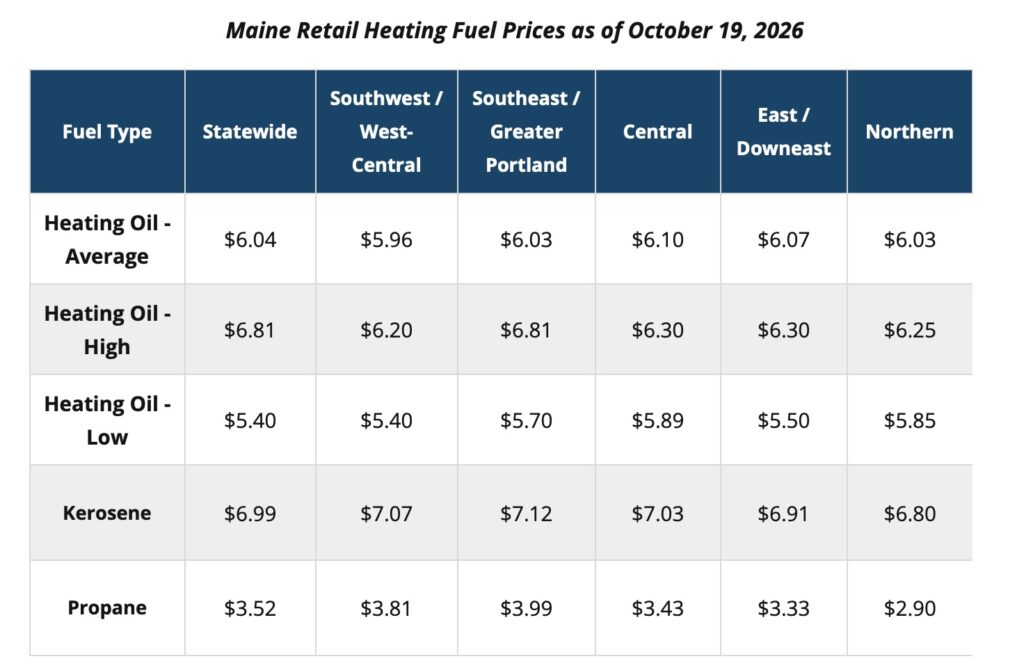
In Maine specifically, the price data tells the story most starkly. As of October 13, 2026, heating oil averaged $5.97 per gallon statewide, according to the Maine Department of Energy Resources. A year earlier, the same gallon cost $3.31. That 70 percent increase landed on Maine households not as an economic abstraction but as the specific, concrete reality of a winter approaching with fuel costs nearly double what their budget planning for last year’s heating season would have anticipated. Half of Maine homes heat with oil. The reserve release, and the political pressure that produced it, is a direct response to that specific population facing that specific problem at the specific moment when their political representation was already under intense scrutiny.
The Maine Senate Race Is Twelve Days Away. The Timing of This Release Is Not a Coincidence.
Maine Republican Senator Susan Collins is facing what analysts describe as potentially her tightest reelection race since she first won her seat in 1996. The reserve release came after Collins and Independent Senator Angus King sent a joint letter to President Trump last month urging him to release heating oil from the reserve as prices climbed. That bipartisan letter, Republican and Independent senators from the same state making the same ask on behalf of the same constituents, created the political conditions for a response that the administration could frame as responsive to constituent need rather than as a political calculation, even though it is clearly both. Energy Secretary Wright’s directive note cited his “extensive discussions with Senator Collins” directly, which is an unusual level of specificity in an executive agency action announcement and reflects the degree to which this release was understood by everyone involved as connected to the political situation in Maine.
Newsweek’s framing of the reserve release as an “olive branch” from Trump to Collins captures the dynamic accurately. Collins has maintained her political independence from Trump throughout his second term in ways that have created friction within the Republican caucus, and the reserve release represents a concrete policy benefit delivered to her state at a moment when her reelection is genuinely uncertain. Whether it helps her depends on whether Maine voters experience any actual price relief before November 3, which analysts are cautious about, and whether the release itself generates enough positive news coverage in Maine to shift sentiment in a race where the margin is likely to be tight. New Hampshire’s open Senate seat, a contest between Democrat Chris Pappas and Republican John Sununu, is also affected by Northeast heating oil prices, giving the administration a second midterm rationale for the timing.
It is worth noting that the reserve release, whatever its political motivations, was requested by both a Republican and an Independent senator on behalf of real households paying nearly six dollars a gallon for heating fuel with winter approaching. Policy actions can be simultaneously politically motivated and genuinely warranted by the conditions they respond to, and the Northeast heating oil crisis is not a manufactured political problem. The 70 percent price increase, the 46 percent inventory deficit, and the half of Maine households heading into winter dependent on fuel they cannot easily afford are real conditions that real people are navigating in real time. The reserve exists for this. The senators asked for it. The administration delivered it. Whether the timing was also convenient is a separate question from whether the action was appropriate, and the answer to both is yes.
315,000 Barrels Is Several Days of Regional Supply. The Underlying Problem Hasn’t Changed.
The price relief that the reserve release will actually deliver is, according to energy market analysts, likely to be limited in magnitude and short in duration. The 315,000 barrels being loaned represents approximately a 13 percent increase in New England heating oil supply in the near term, which is a real addition to a market that is 46 percent below its seasonal inventory average. It is not, however, a structural solution to the supply problem, and analysts have consistently noted that the volume represents only a few days of regional demand at normal consumption rates. The reserve loan adds supply to the market, and additional supply should exert some downward pressure on prices in the short term. It does not change the global supply dynamics driving prices, it does not address the pipeline constraints that have limited heating oil flow to the Northeast from refineries further south, and it does not produce any lasting effect on the Iran war that is the underlying driver of the entire situation.
The deeper story here is one that Sustainable Action Now has been covering across every dimension of the 2026 energy crisis: the Northeast’s profound vulnerability to fossil fuel price shocks reflects decades of infrastructure decisions that locked the region into oil and gas dependence at exactly the moment when the geopolitical risks of that dependence were becoming clearer. A region where half of Maine homes, and a third of all New England homes, depend on heating oil as their primary heat source in 2026 is a region that has not made the transition to electric heat pumps, weatherization, and renewable energy at anything like the pace that would provide insulation from the specific crisis playing out this fall. The reserve loan is a short-term response to a long-term structural vulnerability, and the 315,000 barrels being loaned are going to be returned with interest next year, at which point the next Iran war disruption or the next cold winter or the next pipeline constraint will produce the next heating oil crisis, and the senators of the day will write the next letter.
Sustainable Action Now: Climate and Energy Coverage
The Northeast heating oil crisis, the diesel export ban debate, the Norway gas pivot, the data center ratepayer fight, and the coal court ruling are all parts of the same story: what it costs to stay organized around fossil fuels when geopolitics keeps changing the price. We cover all of it.
Visit SAN Climate and Energy Coverage