
Politics · Washington, D.C.
Trump’s 250 Foot Arch Could Break Ground November 5: The Legal Fight to Stop It
The administration told a federal court it may begin building the Triumphal Arch the same day a planning commission is expected to approve it. Opponents have asked a judge to step in first.
Approve it in the morning. Pour concrete by afternoon.
That is the timeline the Justice Department laid out in a federal court filing on October 21. According to the notice, construction on President Donald Trump’s proposed 250 foot Triumphal Arch could begin as soon as November 5, the day the National Capital Planning Commission is scheduled to vote on the final plans. If the commission signs off, the Interior Department and the National Park Service are ready to issue construction authorizations on the spot. A day later, plaintiffs challenging the project asked a judge to stop the clock.
What Is Being Built
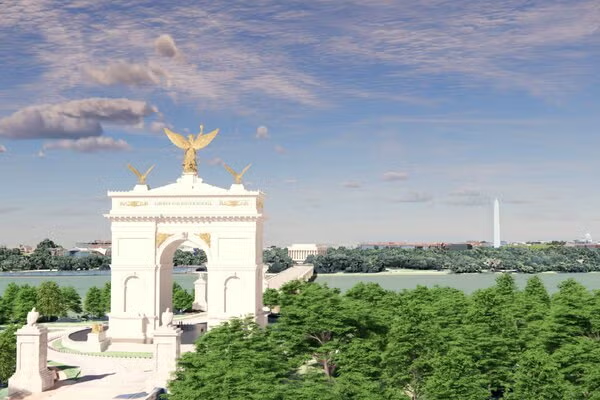
The arch would rise at Memorial Circle on the Virginia end of Memorial Bridge, on the line between the Lincoln Memorial and Arlington National Cemetery. It is modeled on the Arc de Triomphe in Paris, though at 250 feet it would stand more than twice the height of the Lincoln Memorial and dwarf its French inspiration. Trump has presented it as a centerpiece for the nation’s 250th anniversary and has said it will be paid for with private donations. No cost estimate has been released. He has also said the structure could double as a military complex capable of deploying drones and positioning snipers.
The project has moved quickly. The Commission of Fine Arts approved the design in May. The planning commission asked Interior for more information in June and is now due to vote. The Federal Aviation Administration, which has reviewed the site because it lies within the main approach and departure corridors for Reagan National Airport, has reportedly required a flame atop the structure and floodlight projectors for pilot visibility, and dropped an earlier requirement for red obstruction lights. A National Park Service assessment has estimated that, working in two ten hour shifts a day with cranes reaching 320 feet, the arch could be finished in about three years.
The question isn’t whether the arch is grand. It’s who gets to say yes.
The Veterans’ Case
The principal lawsuit was filed in February by three Vietnam War veterans and a retired architectural historian, represented by Public Citizen Litigation Group. Their argument is straightforward: only Congress can authorize a monument of this kind in the capital, and the administration has not asked it to. The project, they say, is “unauthorized by any law.” They told the court the administration has pressed ahead with site testing, plans and approvals from commissions “populated by friends of the administration.”
On October 22, they filed an emergency request for a preliminary injunction before Judge Tanya Chutkan, asking for a ruling by November 4 and a halt to construction unless Congress approves. They point to the planning commission’s chairman, Mark Paoletta, who wrote that he “will vote to approve this project,” as evidence the vote is effectively decided, and they cite reporting that career alternate members were replaced with political allies. They also say a National Park Service review found the arch would significantly harm more than 40 historic sites, including Arlington National Cemetery and the Lincoln Memorial.
Their most worrying argument is about timing. The plaintiffs point to the White House ballroom, which the Supreme Court allowed to continue after lower courts ruled against it, reasoning that halting a partly built structure would cause practical problems. If concrete is poured before a ruling, they argue, the arch becomes a fait accompli.
What the challengers say
Congress never authorized the arch.
The planning process is stacked with allies.
Building first would make a later ruling moot.
What the administration says
A 1925 law covering Memorial Bridge also authorizes the arch, because the bridge’s original plan included columns at its end.
The process follows required reviews.
Interior says it follows all laws and regulations.
Arlington County Joins the Fight
On October 8, the Arlington County Board became the first government body to sue over the project. Its suit against the Interior Department and the Park Service argues that the agency failed to conduct a thorough review, that the rushed process is a “pretext” for justifying a decision already made, and that the arch would clog a busy traffic corridor needed for emergency transport, to the harm of residents. The county wants construction halted until the National Environmental Policy Act is followed and proper analysis and testing are done. It also notes that the site sits in the airport’s flight corridors, which would likely require changes to flight paths.
The administration disputes the criticisms. The Interior Department has said it continues to follow all laws and regulations, and the White House has not offered detailed responses. Trump has championed the arch as a monument for the nation’s 250th anniversary.
The Judge’s Advance Notice Order
Judge Chutkan has previously required the administration to give the court notice before any construction related activity begins. Reports differ on the length of that notice, with one describing 48 hours and another at least 14 days, so the exact window should be confirmed from the docket. What matters is that the November 5 start date was disclosed in that context, giving the court a narrow window to act.
Why the Site Matters
The line between the Lincoln Memorial and Arlington National Cemetery is one of the most carefully protected views in the country. It was laid out to connect symbols of national unity and sacrifice, and it is why the plaintiffs, who regularly visit the cemetery, say they would be personally harmed. Preservationists have called the arch a vanity project that permanently degrades those sightlines. The administration argues the site fits the original plan for Memorial Bridge, which it says included columns at the bridge’s end.
The Calendar Ahead
- FebruaryThree Vietnam veterans and an architectural historian sue, arguing Congress never authorized the arch.
- MayThe Commission of Fine Arts approves the design.
- October 8Arlington County sues the Interior Department and the Park Service.
- October 21The Justice Department tells the court construction could begin November 5.
- October 22Plaintiffs ask for a preliminary injunction and a ruling by November 4.
- November 5The planning commission votes. Construction could start immediately afterward.
The next two weeks will decide whether the courts get to weigh in before the first shovel goes into the ground. If Judge Chutkan rules by November 4, the question of authority will be answered, at least for now. If she doesn’t, the arch may become something the courts are asked to unbuild, and that is a far harder thing to ask.