

Death Penalty · Florida
Florida Executed a Decorated Vietnam Veteran, and Now Two Dozier School Survivors Are Next
Taps sounded outside Florida State Prison on October 20. Within days, the governor signed another warrant. The state is closing in on a record, and the men next in line share a history the state has already apologized for.
The bugle played. Then the paperwork kept moving.
At 6:12 p.m. on Tuesday, October 20, William Reaves Jr., 77, was pronounced dead at Florida State Prison near Starke after a three drug lethal injection. Asked whether he had any last words, he answered, “No, I do not.” He had been convicted of the 1986 shooting of Indian River County sheriff’s deputy Richard Raczkoski in Vero Beach, and he was an Army veteran of Vietnam whom the Department of Veterans Affairs had rated 100 percent disabled for combat related post traumatic stress disorder. His execution was the eighteenth in Florida this year. Within days, Governor Ron DeSantis signed a warrant setting Thomas Overton to die on November 19, two weeks after Jesse Guardado is scheduled to be put to death on November 5.
The Night in Vero Beach and the Man Who Lived It
The facts of the crime are not in dispute. On September 23, 1986, Reaves placed a call to 911 from a payphone outside a Vero Beach convenience store. Deputy Raczkoski, a corporal, responded. A gun fell from Reaves’s shorts, the two men struggled for it, and Reaves regained control and shot the deputy four times as he tried to run. Raczkoski died that day. His family and friends have spoken of a grief that has never lifted, and many of them hoped the execution would bring some finality. That loss, the death of a law enforcement officer who had come to help, is the reason the case has always been so difficult to discuss in anything but absolutes.
Reaves’s lawyers asked the courts, and later the governor, to consider a second story that a jury never fully heard. He had volunteered for Vietnam, they said, even after being offered an easier posting in Panama. A friend died in his arms within a week of his arrival. He used heroin to cope before he ever came home, left the service with two medals and an honorable discharge, and was later rated totally disabled by the VA for combat related PTSD. On the night of the shooting he was high, and his defenders argue that he believed he was back in the jungle, reacting to a uniformed man as an enemy. He did not deny his role. At sentencing he apologized, and he described Raczkoski as the finest officer he had ever met.
The legal path was long and uneven. His first conviction and death sentence were thrown out by the Florida Supreme Court because of a conflict of interest involving the prosecutor, and he was retried, convicted and sentenced to death again in 1992. In 2015, a federal district judge found that his trial lawyer had been constitutionally ineffective for failing to present the full picture of his Vietnam service, and ordered a new sentencing hearing. A higher court later reversed on procedural grounds. This month the Florida Supreme Court rejected his final appeals, and the United States Supreme Court turned down a last minute request without comment on the day he died. More than one hundred military veterans had written to the governor the day before asking him to stop it.
Both men swore an oath to protect and defend. Both things are true.
The Statement From Floridians for Alternatives to the Death Penalty
Floridians for Alternatives to the Death Penalty, the state’s leading abolitionist organization, issued a statement the night of the execution. It is reproduced here exactly as released.
STARKE, Fla. – Tonight, We the People of the State of Florida executed Vietnam veteran William Reaves, Jr. for the 1986 murder of Corporal Richard Raczkoski. William was the 18th person executed in Florida this year, the 46th person executed since Gov. Ron DeSantis took office, and the 14th veteran executed during his tenure.
Supporters of the death penalty want us to live in a world of black and white, where good and evil are easily distinguished and a person’s worst act tells us everything we need to know about his life. The tragic loss of a police officer in the line of duty underscores that divisive narrative even further.
Much has been written about what unfolded in that Zippy Mart parking lot nearly four decades ago, when William took the life of a man who was trying to help him. Corporal Raczkoski’s family and friends have expressed their understandable deep and lasting grief, and their hope that this execution brings some finality. Even as we disagree with the punishment, we hope they feel some measure of relief.
On the other side, William’s family, his lawyers, and loved ones have been tirelessly trying to remind the public that there are indeed two truths at play here. One of his former attorneys, now a law professor, invites us to confront this false binary narrative: There are two stories of William’s life. In the prevailing narrative, he’s a monster who shot a good cop as the man begged for his life. In the untold story, he’s a victim of circumstance—a sweet kid from a small town who was sent to war, trained to kill in the service of his country, and returned home a psychological ruin. Both stories are true. Only the first has been given moral weight in popular memory. The second—the tale of William the war hero—explains his crime.
William, the war hero, is all too familiar with staring death in the face. Before he was prisoner #040002, he was Private Reaves, a young man who chose to go to Vietnam even after being offered an easier posting in Panama. Within a week of his arrival, a friend died in his arms, beginning a legacy of trauma that he was already using heroin to cope with before he even returned home. He served admirably and came back with two medals, an honorable discharge, and wounds that would shape the rest of his life.
William struggled to come to terms with what he had seen, done, and lost in that jungle. He went to the VA after returning stateside, and received a 100% disability rating for his combat-related post traumatic stress disorder. Like so many veterans, he was left to find his own way through civilian life while contending with combat-related PTSD he was ill-equipped to understand or overcome. The country that had trained him for war had not prepared him to live with its aftermath.
William was under the influence of drugs that night in 1986 when his combat trauma overtook him, and he believed he was back in Vietnam. Fearing for his life, he responded to Corporal Raczkoski as though he were an enemy combatant, then fled in a zigzag pattern, believing more enemies surrounded him. The war had followed William home, with devastating consequences for an officer who had no reason to expect that any harm would come to him.
After William confessed two days later, the country for which he had sacrificed so much began the process of seeking his death. The state minimized his service and suffering, belittled his combat experience, and called a witness who changed his story to keep the jury from hearing the full account of how his time in Vietnam affected his actions that night.
In 2015, a federal district court judge gave William a glimmer of hope. The judge concluded that his inexperienced counsel had provided constitutionally ineffective assistance by failing to present the full picture of his Vietnam service and its direct impact on his actions. The court also faulted the prosecutor’s improper denigration of William’s combat experience and ordered a new trial where a jury could hear the full picture and decide whether William should live or die.
But the state fought to preserve the death sentence. It appealed, and a higher court relied on procedural rules to extinguish that glimmer of hope. Having failed William when he returned from war, the state fought to keep that failure from receiving its full weight in the courtroom.
William never denied his involvement or made light of his crime. He expressed immense remorse and apologized in court. He spoke highly of Corporal Raczkoski, saying that he had “never met a finer officer in [my] life.” His requests for mercy, and those made on his behalf, asked the state to consider his responsibility alongside the service, trauma, and abandonment that preceded that night.
As a veteran himself, Governor DeSantis should understand that our obligations to those who serve do not end when they take off the uniform. He had the power to consider what the jury could not and to spare William’s life while holding him accountable for Corporal Raczkoski’s death. Instead, a governor who invokes the honor of military service used his pen to execute another man who carried the marks of that service.
We must resist this either-or narrative. Both men swore an oath to protect and defend. Corporal Raczkoski deserved to go home to his family after his shift ended that night. William Reaves deserved treatment, compassion, and understanding for his war wounds. Both things are true.
Two Warrants, Two Weeks Apart
The state has scarcely paused. Jesse Guardado, 64, is scheduled to die on November 5. He pleaded guilty to the September 13, 2004 killing of Jackie Malone, a 75 year old Walton County woman who had helped him find housing and work after he was released from prison. Prosecutors say he attacked her in her home during a crack cocaine binge, struck her with a tool, stabbed her and cut her throat, then took her purse, jewelry box, briefcase and cellphone. He was sentenced to death in October 2005, and in 2024 a panel of the Eleventh Circuit rejected his claim that his lawyers were ineffective at the penalty phase.
Thomas Overton is scheduled to die on November 19 at 6 p.m. He was convicted in 1999 of the August 22, 1991 murders of Michael MacIvor and Susan MacIvor in Tavernier Key, in Monroe County. Susan MacIvor was eight months pregnant. A jury recommended death for Michael MacIvor by a vote of 8 to 4 and for Susan MacIvor by 9 to 3, and the judge imposed both sentences in March 1999. Neither recommendation was unanimous, and in June 2025 a federal appeals court affirmed the denial of one of his claims about evidence withheld at trial. As of this writing, a petition circulated by abolition advocates lists a slightly different date, so readers should confirm the schedule with the Department of Corrections.
The Record Within Reach
Florida carried out 19 executions in 2025, the highest single year total since capital punishment resumed in 1976. With Reaves, it has now executed 18 people in 2026, and the Associated Press reports that Florida accounts for more than half of the 32 executions nationwide this year. If the Guardado execution proceeds on November 5, the state will tie its own record. If Overton’s follows on November 19, it will break it. In July, Florida executed two prisoners on the same day, the first state to do so in nearly a decade, and eight of this year’s executions involved men over 70.
What Dozier Was, and Why It Matters Here
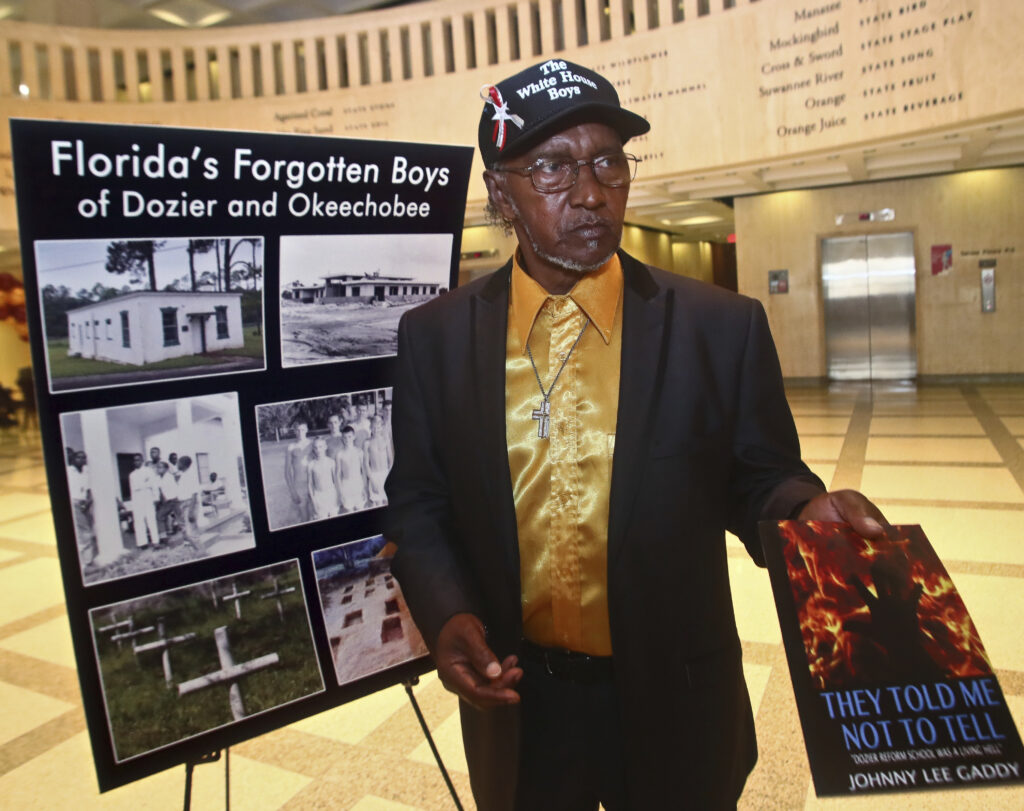
What binds Guardado and Overton is not only the November calendar. According to Floridians for Alternatives to the Death Penalty, both survived the Arthur G. Dozier School for Boys in Marianna, a state run reform school where children were beaten and abused. The school operated for more than a century before it closed, and its grounds later yielded dozens of unmarked graves of boys who died there. The facts about its brutality are no longer contested by the state. In 2017, the Florida Legislature unanimously passed resolutions apologizing for the abuse, and in 2024 Governor DeSantis signed legislation creating a compensation fund of $20 million for some survivors.
Reporting by Leonora LePeter Anton found that at least 34 boys who passed through Dozier later ended up on Florida’s death row, a figure that opponents of the death penalty cite as evidence of a pipeline from state custody to state punishment. Supporters of capital punishment answer that a hard childhood, however painful, does not excuse the killing of an innocent person, and the victims’ families have made that point with force in every one of these cases. Both arguments are part of the debate. What is unusual in these two cases is that the same state asking a court to carry out the sentence has already formally admitted the harm it did to the person being sentenced.
Advocates for clemency say
Florida had custody of these boys and failed them.
Its own apology and compensation law acknowledge the abuse.
Mercy would be consistent with that acknowledgment.
Supporters of the sentences say
The victims were killed, and juries and courts upheld the sentences.
Childhood suffering explains but does not excuse murder.
The families deserve finality after decades of litigation.
Where the Cases Stand Now
- October 13James Robertson and William Lee Thompson were scheduled to be executed, part of the run of warrants this fall.
- October 20William Reaves Jr. is executed at 6:12 p.m., the 18th execution of 2026.
- November 5Jesse Guardado is scheduled for lethal injection. This would tie the state record of 19.
- November 19Thomas Overton is scheduled for execution at 6 p.m. This would set a new record of 20.
Reading and Viewing on Dozier
For readers who want to understand the school, a handful of works stand out. Ben Montgomery and Waveney Ann Moore’s St. Petersburg Times investigation, “For Their Own Good,” recorded survivors’ accounts of the abuse. Michael Mechanic and Nina Berman’s “It Was Kind of Like Slavery” combines photographs and audio of survivors fighting to be heard. Colson Whitehead’s Pulitzer Prize winning novel The Nickel Boys was inspired by Dozier and was adapted into the film Nickel Boys, directed by RaMell Ross. And forensic anthropologist Erin Kimmerle, who led the search for the buried children, tells the story of that work in We Carry Their Bones: The Search for Justice at the Dozier School for Boys.
Florida has always insisted that capital punishment is about accountability. The coming weeks will test a harder question, which is whether the state that built and ran Dozier is willing to apply the same standard to itself. The answer will be written in two warrants, two weeks apart.