

Justice · Private Prisons
Mental Health Care Behind Bars Depends on the State You Are Sentenced In, a New 50 State Legal Study Finds
A 2026 study in Criminal Justice Policy Review reads the statute books of every state and the District of Columbia to ask a basic question: which legislatures actually require mental health programming for incarcerated people, and what happens to care when no law does?
When the law is silent, the contract decides.
Most people serving time in the United States are held in state facilities, which means the rules that govern their health, their daily routines and their chances of rehabilitation are written not in Washington but in fifty state capitals and the District of Columbia. A new legal and empirical study, published online on September 25, 2026 in Criminal Justice Policy Review, takes that fact as its starting point. Titled “A State-by-State Analysis of Legislative Frameworks for Mental Health Programming in Correctional Facilities,” it examines whether state legislatures have enacted laws that require mental health programs and services for incarcerated people, and whether the large differences in care from one jurisdiction to the next can be traced to differences in state level oversight.
The authors are Jennifer Wyatt Bourgeois of Texas Southern University, Dragana Derlic of Georgia Southern University and Stuti S. Kokkalera of Sam Houston State University. The Prison Policy Initiative added the paper to its research library this fall, bringing it to the attention of the advocates, lawyers and legislative staff who track conditions of confinement. For readers who follow the growing role of private prisons in American corrections, the work raises a question that deserves more attention than it has received: what protects a person with a serious mental illness when the statute is vague and the facility is run by a contractor?
What the Researchers Set Out to Measure
The study combines two methods. The first is doctrinal legal analysis, the traditional work of reading statutes closely to determine what they require, permit or leave unsaid. The second is content analysis of the statutory provisions themselves, applied both deductively, by testing the text against categories the authors defined in advance, and inductively, by letting patterns emerge from the language the legislatures actually used. An appendix lists the relevant chapter and provision for each jurisdiction, so that a reader can check a state’s law against the authors’ reading of it. That design matters because corrections policy is often discussed in generalities. A paper that points to the exact section of the code in each state gives lawmakers and litigators something concrete to work with.
The authors begin from a pattern that criminologists have documented for years. Programming inside prisons has historically leaned toward education, vocational training and life skills. Those programs are valuable, and the research on reducing reentry failure supports them, but they have tended to crowd out structured mental health services in the way legislatures think about what a prison is for. The study asks whether the uneven availability of mental health care is a product of that legislative emphasis, and it argues for statutory provisions that would support more equitable services across jurisdictions. Because the full text sits behind a journal paywall, this article describes the study’s stated aims, methods and argument rather than reporting its state by state tallies, and readers who want the specific findings for their own state should consult the paper and its appendix directly.
Most incarcerated people are held in state facilities, so the quality of their mental health care is largely a question of state law.
Why the Question Matters
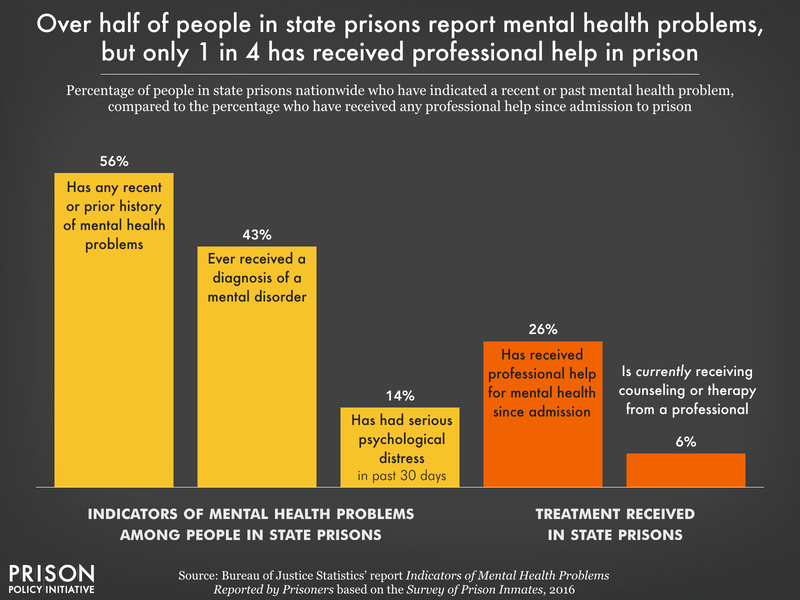
The scale of need explains the stakes. A federal Bureau of Justice Statistics survey of people held in state and federal prisons and local jails found that roughly 14 percent of prisoners and 26 percent of jail inmates met a threshold for serious psychological distress, and that more than a third of prisoners reported having been told by a mental health professional that they had a mental disorder. Those figures are far higher than in the general adult population. Correctional systems, in other words, hold a concentration of people with mental health needs that few community clinics would be asked to serve, and they do so in settings built around security rather than treatment.
The constitutional floor is real but low. Since the Supreme Court’s 1976 decision in Estelle v. Gamble, prison officials have been barred from showing deliberate indifference to the serious medical needs of the people in their custody, and lower courts have applied that principle to serious mental health needs. Landmark class actions, including the long running Texas litigation in Ruiz v. Estelle, pushed systems to provide screening, access to qualified staff and a basic treatment plan. But a constitutional standard is a minimum that a court enforces after harm has been shown, usually after years of litigation. It is not a program. A state statute that specifies what a prison must provide, who must provide it and how the work will be funded and reviewed does something different. It sets expectations in advance and gives administrators, legislators and the public a yardstick.
Where Private Operators Fit In
The study is a survey of state legislative frameworks, not an evaluation of private prison companies, and its authors do not make claims about any particular operator. The connection to contracted facilities comes from how the system is built. A private prison operates under a contract with the state, and the contract is where many of the operational details live: staffing ratios, the scope of clinical services, reporting duties and the penalties for falling short. Where a statute clearly requires mental health programming, a contract has to meet that requirement. Where the statute says little, the contract becomes the main source of obligation, and the quality of care depends heavily on how carefully the state’s contracting officials wrote and monitor it.
That arrangement is not unique to private facilities, since public prison systems also rely on budgets and administrative policy where statutes are thin. What differs is the layer of accountability. A public agency answers to the legislature and the governor through the ordinary channels of public records laws and budget hearings. A contractor answers to the agency that hired it, and the information the public sees is often filtered through that relationship. Critics of prison privatization argue that this structure leaves less room for independent scrutiny of clinical care, while the companies and their supporters say that contracts can set clear performance standards and that private operators are held to the same constitutional requirements as the state. Both points can be true at once, and a clear statute is one of the few tools that serves each side, because it replaces a negotiable promise with a legal requirement.
The case for stronger statutes
Clear mandates apply equally to public and contracted facilities.
Funding and staffing duties are set before a crisis, not after a lawsuit.
Legislators and the public can compare states using the same yardstick.
The concerns critics raise
Mandates without funding can produce paper compliance.
Corrections officials often prefer flexibility to adjust to local conditions.
Legislation alone cannot fix shortages of clinicians willing to work in prisons.
Oversight, Equity and the Two Tier Problem
The study’s central inquiry, whether inequities in care flow from differences in state oversight, points toward a concern familiar to anyone who has worked inside a corrections system. In a state that runs both public and privately managed prisons, the same person could receive very different care depending on the facility to which classification officials send them. Specialized treatment units, where they exist, tend to be limited in number, and people with the most serious illnesses are often concentrated there. Everyone else is held in general population housing, where care depends on the staffing and the contract terms of that particular prison. Advocates who focus on this pattern describe it as a two tier system, and the authors’ call for equitable services is an argument that the quality of treatment should not turn on a facility’s ownership or a person’s address on the map.
Staffing sits at the center of that debate. Corrections systems in many states have struggled to recruit and keep psychiatrists, psychologists, nurses and counselors, and shortages have been widely reported in both public and privately run facilities. A statute cannot hire a clinician, but it can require a staffing standard, tie that standard to funding and require regular reporting, so that a shortage becomes visible to lawmakers before it becomes a lawsuit. Independent auditing, public reporting and clear enforcement powers are the usual ingredients in the reform proposals that follow from research of this kind, and they are the elements that determine whether a mandate changes what happens in a housing unit at two in the morning.
What a Strong State Framework Typically Spells Out
Researchers and advocates who review corrections law generally look for the same features: a defined scope of required services, screening at intake and at regular intervals, qualified clinical staff, continuity of care on release, limits on the use of isolation for people with serious mental illness, and independent reporting that applies the same way to public and contracted facilities.
What Lawmakers and Readers Can Do With the Findings
For legislators, the most practical value of a fifty state review is comparison. A lawmaker in one state can see how a neighboring state wrote its mandate, whether it attached funding, and what reporting duties it created. The appendix of statutory citations is built for exactly that kind of use. For the people who negotiate and monitor prison contracts, the study is a reminder to treat mental health provisions as central terms rather than boilerplate, with measurable standards, access to records and meaningful remedies when a provider falls short. For families and advocates, it offers a way to ask a specific question at a hearing: what does our state’s law actually require, and who checks?
The authors’ underlying argument is simple and difficult to dispute. If the goal of incarceration includes preparing people to return to their communities, and if a large share of the incarcerated population lives with mental illness, then mental health programming belongs alongside education and job training as a core function that a legislature defines, funds and reviews. Whether a prison is run by a state agency or a private company, the law should make that obligation unmistakable. As more of the country’s attention turns to conditions of confinement and the business of corrections, this study gives the debate what it has often lacked, a documented, state by state account of what the law says and where it says nothing at all.
- 1976Estelle v. Gamble establishes that deliberate indifference to serious medical needs in custody is unconstitutional.
- 1980Ruiz v. Estelle leads to court ordered changes in Texas prison health and mental health care.
- September 25, 2026The state by state legislative analysis is published online in Criminal Justice Policy Review.
- Fall 2026The Prison Policy Initiative adds the study to its research library.