

Death Penalty · California
Newsom Commutes All 548 California Death Sentences, the Largest Mass Commutation in U.S. History: What It Means and What Comes Next
In one of his final acts in office, the governor turned every death sentence in the nation’s largest condemned population into life without parole. Supporters call it overdue. Prosecutors and some victims’ families say it undoes decisions made by juries. The California Supreme Court now has to rule on most of it.
The largest death row in the country is, on paper, empty.
On the morning of Thursday, November 5, 2026, California Governor Gavin Newsom announced that he was commuting the death sentences of all 548 people on the state’s death row to life without the possibility of parole. It is the largest single act of clemency of its kind in American history, and it reaches far beyond California. The state’s condemned population accounted for more than a quarter of everyone sentenced to death in the United States, and the Death Penalty Information Center says the commutations cut the national total by nearly 30 percent, to roughly 1,388 people, the lowest number since 1984. Newsom took the step with only weeks left in his second term, and the reaction has split along lines that are by now familiar: abolition advocates and a coalition of victims’ relatives praised it, while prosecutors, victims’ rights groups and other relatives of murder victims condemned it. For continuing coverage of capital punishment across the country, see the Sustainable Action Now death penalty reporting.
The Governor’s Reasoning
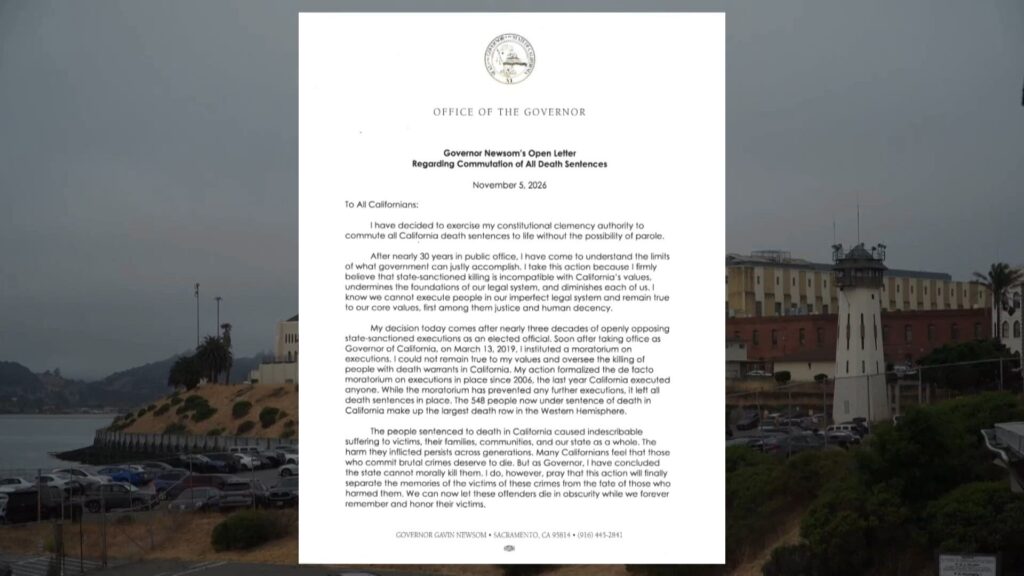
In a public letter announcing the decision, Newsom wrote that state sanctioned killing is incompatible with California’s values, undermines the foundations of the legal system and diminishes everyone. He said he had considered commuting only some sentences, but concluded that drawing lines between crimes would create two classes of murder victims, so he excluded no one. He wrote that he had consulted victims, public safety experts, and religious and civil rights leaders, and he added that those who are commuted “will die in prison but not by our hand.” They will not be eligible for the new commutation and resentencing regulations at the state Board of Parole Hearings.
The decision follows a pattern. Shortly after taking office for his first term, Newsom imposed a moratorium on executions in 2019, calling the death penalty a failure, and he later dismantled the execution chamber at San Quentin and ended the state’s execution protocol. California has not carried out an execution since 2006. Since 1978, according to figures cited by the Death Penalty Information Center, the state has spent an estimated 6 billion dollars on capital punishment while carrying out 13 executions. Eight people have been exonerated from California’s death row.
How the Legal Process Works
Not every commutation takes effect at once. Under the California Constitution, the governor can act alone on sentences for people who do not have multiple felony convictions, which covers 166 of the 548. For the remaining 382, he is asking the California Supreme Court to agree, and the court needs the approval of four of its seven justices. Reporting from CalMatters indicates that nearly 400 people fall into that second group. Until the justices decide, the commutations for those people are not final. The Court has not yet announced how or when it will take up the matter, and the outcome will determine whether the headline number of 548 holds.
“I take this action because I firmly believe that state-sanctioned killing is incompatible with California’s values, undermines the foundations of our legal system, and diminishes each of us.”
The commutations also change practical realities for the people involved. For years, California’s death row has been in transition. Since 2024, male prisoners have been moved out of individual cells at San Quentin and distributed among 24 other prisons, and the 20 women under sentence of death were transferred to general population at the Central California Women’s Facility. A May 2026 report found that about 70 percent of the condemned were still waiting for appeal counsel to be appointed, and reporting notes that people who were entitled to lawyers for those appeals will no longer have them after commutation, a consequence that appeals lawyers are likely to examine closely. Los Angeles County alone sentenced 319 people to death, about 174 of whom were still on death row. Well known cases affected include Richard Allen Davis, convicted in the murder of Polly Klaas, Charles Ng and Scott Peterson.
Praise From Abolition Advocates
Death Penalty Focus, a California based group that works to end capital punishment, welcomed the announcement. In a statement issued from Sacramento, its president, Mike Farrell, said the governor was meeting the moment. In an opinion piece on the organization’s website, Farrell called the action “the principled, compassionate, and logical thing for him to do,” given the governor’s earlier moratorium, the dismantling of the gas chamber and the dismissal of the execution protocol. He wrote that, as one of his last acts in office, Newsom was again showing humane leadership by refusing to let what Farrell described as a “brutal, racist, arbitrary, and unfair criminal justice system” continue. Robin Maher, executive director of the Death Penalty Information Center, called the action “a decisive moment” in the history of the American death penalty.
Some relatives of murder victims also support the decision. Jess Nichol, the sister of Polly Klaas, said that execution “has absolutely nothing to do with my recovery or with real public safety.” A coalition of victims’ families, prosecutors, former corrections professionals, faith leaders, civil rights advocates and business leaders welcomed the move, and days before the announcement, 50 relatives of murder victims had urged universal clemency.
Arguments for the commutations
California has not executed anyone since 2006 and has spent about 6 billion dollars.
The system has shown racial and county level disparities over five decades.
Executions do not help survivors heal or improve public safety.
Arguments against
Juries and judges imposed these sentences, and a governor should not undo them.
Voters rejected repeal in 2012 and 2016.
Victims’ families were not given notice, and some say they are denied justice.
The Opposition
Critics say the action disregards the will of voters and the wishes of many victims’ families. California’s death penalty was created by a ballot measure, so only another vote can repeal it, and voters rejected repeal initiatives in 2012 and 2016. Topo Padilla, president of Crime Victims United, objected to undoing a sentence “rendered by a jury and signed off by a judge.” Anne Marie Schubert of the Criminal Justice Legal Foundation pledged to challenge the commutations in the state Supreme Court and said victims’ families were not notified. Marc Klaas, father of Polly Klaas, said the commutations “upset me terribly.” Prosecutors and police organizations also criticized the move.
Where the Move Fits in American History
According to the Death Penalty Information Center, this is the eighth time in the modern era that a governor has granted clemency to every person sentenced to death in a state. The previous largest was in Illinois, where Governor George Ryan commuted 167 death sentences in 2003 before leaving office. About 440 people on death rows have received commutations since 1972, and analysts say the pace of executions in the country has slowed while federal courts have become less likely to stop them, which leaves clemency as one of the few tools left to governors. CalMatters reports that the action may add pressure on other governors who have criticized capital punishment, including Mike DeWine of Ohio and Laura Kelly of Kansas, though Ohio and Kansas have not announced similar plans. Republican governors in Alabama and Oklahoma have recently commuted individual sentences in accomplice cases.
What Happens Next
The California Supreme Court must decide whether to approve the 382 commutations that need its consent. Xavier Becerra, the incoming governor, has said he will extend the execution moratorium, but prosecutors in counties such as Riverside and San Bernardino are expected to continue seeking death sentences, so a new death row could slowly form unless voters or the legislature end the practice. Newsom, whose term ends in January, is reportedly weighing a run for president in 2028.
- 1978California reinstates the death penalty; 13 executions follow over the decades.
- 2006The state carries out its last execution.
- 2012 and 2016Voters reject ballot measures to end the death penalty.
- 2019Newsom imposes a moratorium on executions.
- November 5, 2026Newsom commutes all 548 sentences and asks the court to approve 382.
- January 2027Governor Becerra takes office and has said he will extend the moratorium.
The commutations resolve one question, whether California will execute any of the 548 people on its death row, while opening others about the role of clemency, the limits of executive power, the rights of victims’ families and the meaning of a vote taken twice at the ballot box. The answers will come from the California Supreme Court, from the next governor and, in the longer run, from the voters.