His Owner Dragged Him 300 Feet From a Moving Truck. Then Surrendered Him to Hope For Paws. Now Watch What Happens.
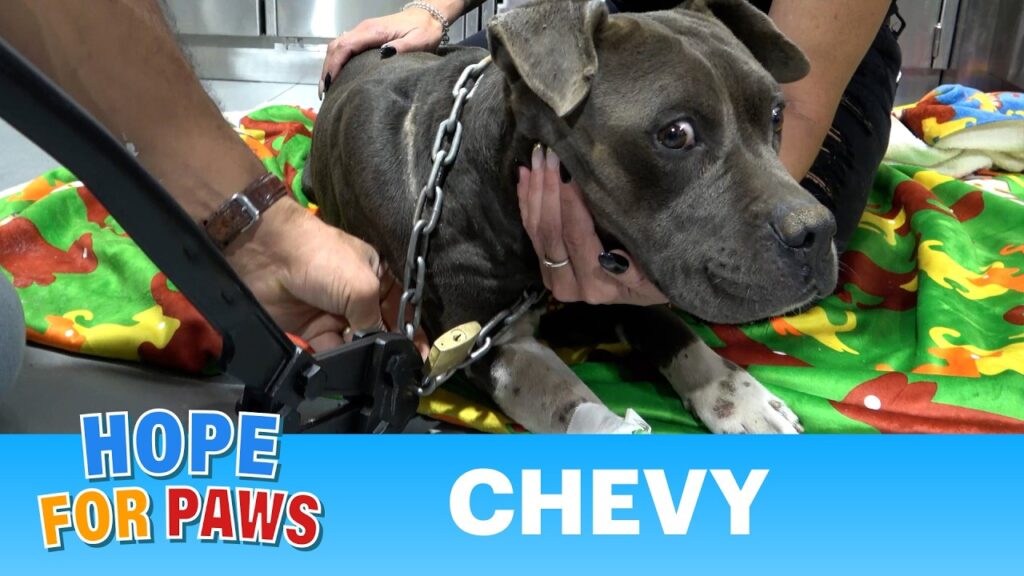
Chevy is a pit bull who fell off a truck and was dragged for 300 feet while his owner kept driving. No medical attention was sought. No vet was called. When Hope For Paws got involved, his owner surrendered him. What came after is the reason this organization exists.
The injury that Chevy came in with was the kind that the Hope For Paws team specifically noted they couldn’t show the full extent of in their video. That detail alone tells you something about what this dog went through. He fell off a moving truck and was dragged for 300 feet, and the person responsible for him did not seek veterinary attention. He drove away with Chevy injured and untreated. When Hope For Paws made contact, the owner agreed to surrender him, which is the single genuinely good decision in this story and the one that gave Chevy everything that followed. Watch his story below.
Chevy fell off a truck and was dragged 300 feet. His owner surrendered him to Hope For Paws. The rest of his story is worth watching in full.
What a 300-Foot Road Drag Does to a Dog, and Why Chevy’s Survival Is Remarkable
Road drag injuries in dogs are among the most traumatic and complex presentations that veterinary emergency teams encounter. When an animal is dragged along asphalt or concrete at speed, the friction produces injuries that are simultaneously deep and extensive: abrasions that strip away layers of skin and tissue across large surface areas, underlying muscle damage, possible fractures from impact with the ground surface, and contamination of all open wounds with road debris, grease, and bacteria that make infection a serious and immediate risk. The severity of road drag injuries scales with both the speed of the vehicle and the distance dragged, and 300 feet at moving-vehicle speed produces a wound profile that veterinary professionals treat as a true emergency requiring immediate and sustained care.
Chevy’s owner did not take him to a vet after this happened. This is the fact in the story that sits next to everything else and that the narrative cannot soften no matter how the outcome turns out. A dog fell off a truck, was dragged 300 feet, and the person who owned him did not seek medical attention. The injuries that result from road drag are not subtle or ambiguous. They are immediately visible and acutely painful. The decision not to get veterinary care for an animal in that condition is a decision to leave an animal in pain without treatment, and it is the kind of decision that animal welfare advocates, veterinary professionals, and most of the public recognize as neglect in the clearest possible terms. Chevy survived not because of anything his owner did after the accident. He survived because Hope For Paws got involved and his owner made the one right call that was available to him: he let them take Chevy.
The phrase “totally preventable accident” in Hope For Paws’ description of Chevy’s situation is doing real work. Chevy did not have to fall off that truck. Dogs travel safely in vehicles every day when they are secured appropriately, inside the vehicle or in a properly restrained crate in a truck bed, in ways that prevent exactly the kind of fall that produced this situation. Pit bulls and other large dogs are not rare in trucks across America, and the specific danger of an unsecured dog in an open truck bed has been documented, advocated about, and the subject of animal welfare legislation in multiple states precisely because this kind of incident is not unusual. Chevy’s injury was not a freak occurrence. It was the predictable outcome of a specific, avoidable choice.
Safe Travel for Dogs in Trucks: What Should Have Happened
Dogs riding in open truck beds face risks that include falling during sudden stops, sharp turns, or low-speed collisions, being thrown from the bed in accidents, and suffering road debris impact at highway speeds. Veterinary and animal welfare organizations consistently recommend that dogs travel inside the vehicle where possible, or in a secured, crash-tested crate in the truck bed if inside transport is not feasible. Harness systems that attach to truck bed anchors provide an intermediate option. Several states have laws or pending legislation addressing unsecured animals in vehicle cargo areas. Chevy’s case is not an isolated incident, and the injuries road drag produces are severe enough that prevention advocacy around this specific issue has real stakes.
Chevy Is Healing. And He Is Enjoying His New Life in a Way That Says Everything About This Dog.
Road drag injuries require extended, intensive veterinary care. The wound management alone, daily cleaning, debridement of damaged tissue, bandage changes, monitoring for infection, and in many cases skin grafting for areas where the tissue loss is too extensive for primary healing, is time-consuming and expensive work that can extend across weeks or months depending on the severity of the initial injury. Chevy’s case, which the Hope For Paws team noted was too severe to show in full on their platform, fell into the category of injuries that require exactly this sustained commitment. He did not get to go home after a week. He got the care he needed for as long as he needed it, which is what the Hope For Paws model provides and what would not have been possible if his owner had kept him.
What the team observed as Chevy healed is the detail that matters most to understanding who this dog is: he is enjoying his new life. That phrase is specific and it is earned. A dog who has been through significant trauma, pain, wound care, and the complete disruption of his previous living situation is not automatically happy. Many dogs emerging from that kind of experience require behavioral rehabilitation alongside their physical healing, working through fear responses, pain associations, and the disruption of whatever social bonds and environmental familiarity they had before the injury. Chevy appears to be moving through his healing process with the particular combination of resilience and social openness that pit bulls specifically are documented to exhibit with a frequency that consistently surprises people who hold breed prejudices based on reputation rather than direct experience.
Pit bulls occupy a strange and largely unearned position in American public perception. They are the breed most frequently cited in breed-specific legislation, the most commonly euthanized dog in shelters, and the subject of a body of media coverage that has built a reputation for dangerousness that does not accurately reflect the behavioral profiles of individual dogs who have received appropriate care and socialization. What the rescue community, shelter workers, foster networks, and veterinary professionals who actually spend time with pit bulls consistently observe is a different animal entirely: a breed characterized by high social intelligence, strong desire for human affiliation, physical resilience, and a forgiving temperament that allows dogs who have had genuinely difficult histories to form new attachments with remarkable speed and completeness. Chevy is not surprising the people who know pit bulls. He is confirming what they already knew.
Chevy Is Now Fostered Through LA Animal Rescue. His Forever Home Is Still Out There.
Chevy is now in foster care through LA Animal Rescue, Hope For Paws’ partners who are managing his placement and adoption process. The foster stage is critical for a dog in Chevy’s situation because it gives him a home environment in which to continue his physical and emotional recovery while the adoption process is underway, and it gives potential adopters the benefit of a foster family’s first-hand knowledge of how he functions in a household setting, what his energy level looks like, how he responds to other animals and people, and what kind of environment would give him the best possible home. Foster families are the connective tissue between rescue and adoption, and they are the reason that dogs like Chevy arrive in their permanent homes as understood animals rather than as unknowns.
If you are in the Los Angeles area and are interested in adopting Chevy, LA Animal Rescue is the direct contact for that conversation. Hope For Paws has handed his adoption process to their partners specifically so that the people who know him day-to-day can speak most accurately to who he is and what kind of home will work best for him. What the adoption profile of a dog like Chevy typically looks like, based on what Hope For Paws has described and what his breed and situation suggest, is a dog who needs someone with experience and patience, enough space for a large dog who will get his full energy back as he heals, and the kind of consistent positive attention that allows a resilient, socially oriented animal to build the stable attachment that will be the foundation of the rest of his life.
|
🏠
Adopt ChevyChevy is in foster care through LA Animal Rescue. If you want to adopt him, contact them directly. They know him and can tell you everything you need to know about whether he’s the right dog for your home. Visit LA Animal Rescue |
💛
Support Chevy’s RecoveryChevy’s ongoing veterinary care is funded by Hope For Paws donations. A small monthly contribution to Hope For Paws is what makes it possible to respond to the next Chevy before the call even comes in. Donate to Hope For Paws |
The Owner Surrendered. That Was the Right Outcome for Chevy. Here’s Why It’s Complicated.
The outcome of Chevy’s case, that his owner surrendered him rather than retaining ownership, is the best available outcome for Chevy in the short term and the only one that gave him immediate access to the medical care he needed. It is also worth being clear about what a surrender is and is not: it is not accountability, it is not a legal consequence, and it does not create any record that would prevent this person from acquiring another animal. Animal surrender in the context of neglect or abuse is the mechanism through which rescue organizations most commonly obtain animals from owners who will not or cannot provide appropriate care, and it is often the fastest available path to the animal getting help. It is a pragmatic tool for reaching the animal. It is not a system for addressing the conduct that produced the need for rescue in the first place.
Hope For Paws focuses on the animal. That is a deliberate and defensible organizational choice: their capacity is rescue, veterinary care, and placement, and expanding into investigation, prosecution, and legal advocacy would require a different organization than the one they have built and been effective at being. The accountability question, the legislative work around animal cruelty laws, the prosecution of cases where neglect has been documented, and the policy advocacy that would create stronger protections for animals in exactly Chevy’s situation, belongs to the partners in the broader animal welfare ecosystem. At Sustainable Action Now, we track all of it. The rescue is the immediate story. The legal and policy framework is the longer one.
Support Chevy and the Animals After Him
Chevy made it because Hope For Paws was there. The next dog in his situation is out there right now, and whether they get the same outcome depends on whether the organization that found Chevy has the capacity to respond. A small recurring donation is the specific thing that builds that capacity. Download the Hope For Paws app on the App Store or Google Play to stay connected to every rescue as it happens.
Donate to Hope For Paws Visit the SAN Rescue NetworkChevy fell off a truck. He was dragged 300 feet. Nobody came back for him right away. And now he is in foster care with LA Animal Rescue, healing at his own pace, enjoying something that looks very much like the beginning of the life he deserved from the start. Watch the video. Share it widely. If Chevy is your dog, call LA Animal Rescue. And if he’s not your dog, consider the one after him, and the one after that, and the organization that will respond to those calls when they come in because people like you made sure it could.
Sustainable Action Now Rescue Network
We follow Hope For Paws, LA Animal Rescue, and the full network of organizations doing rescue, rehabilitation, and advocacy for animals across Los Angeles and beyond. Chevy’s story is one of thousands. We intend to keep covering all of them.
Visit the SAN Rescue Network