

Death Penalty · Public Opinion
Death Penalty Support Falls Below a Majority for the First Time Since 1971, Gallup Finds, With Democrats and Young Adults Leading the Shift
Forty nine percent of Americans now favor the death penalty for convicted murderers and 45 percent oppose it. Support among Republicans, though still high, is among the lowest Gallup has recorded for the group, and fewer than four in ten adults under 30 are in favor.
The last time Gallup found this little support, the Supreme Court was about to strike down every state’s law.
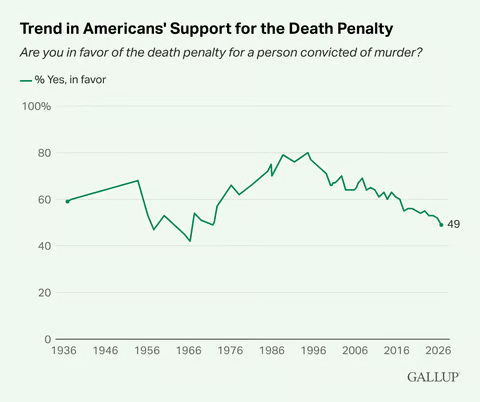
For the first time in 55 years, fewer than half of American adults say they favor the death penalty for people convicted of murder. Gallup, which released the findings on November 10, 2026, reported that 49 percent of those surveyed support capital punishment and 45 percent oppose it. The reading is statistically similar to last year’s 52 percent, but it is symbolically significant. The last time support dipped below a majority was in 1971, when it was also 49 percent, and the last time it was lower than it is now was in 1966, when a record low of 42 percent favored the death penalty. The high point was 80 percent in 1994. The poll was conducted October 1 to 19, beginning the day after Tennessee’s failed attempt to execute death row prisoner Christa Pike, an episode that led the governor to pause executions in the state while an investigation proceeds. Gallup did not attribute the result to any single event, and the long trend points to forces that have been building for decades. For continuing coverage of capital punishment and criminal justice reform, see the Sustainable Action Now death penalty reporting.
Ninety Years of Public Opinion
Gallup first asked Americans about the death penalty in 1936, when 59 percent favored it and 38 percent opposed it. In most readings over the following nine decades, majorities have favored executing convicted murderers. The main exceptions came between 1965 and 1971, when a series of legal challenges worked their way through the courts, a period that ended in 1972 when the Supreme Court ruled that all state death penalty laws as then written were unconstitutional. States rewrote their statutes and executions resumed in 1977, by which time support had climbed to 66 percent. It stayed at 60 percent or higher for roughly the next 40 years before slipping to 55 percent in 2017. Over the past decade it has hovered in the mid to low 50s, and this year it reached 49 percent.
It is worth reading the poll with care. A difference of a few points can fall within the normal margin of a survey, which is why Gallup describes the change from 52 percent to 49 percent as statistically similar. The more meaningful signal is the direction over time, with support more than 30 points below its 1994 peak and below the halfway mark for the first time in more than five decades.
Support for the death penalty has dropped from 80 percent to 49 percent in a generation.
A Widening Partisan Gap
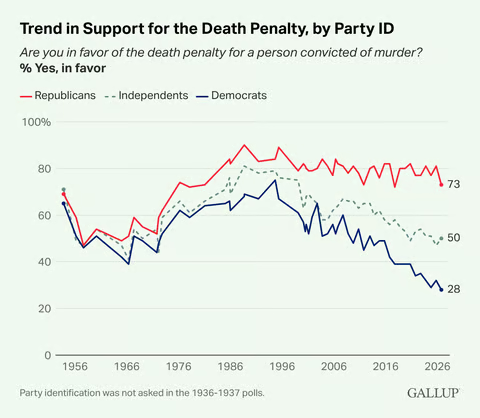
Every political group is less supportive than it was in the 1990s and 2000s, but the declines are uneven. Only 28 percent of Democrats now favor the death penalty, which is 28 points lower than in 2000 and 47 points below their 1994 high. Among independents support stands at 50 percent, down 18 points since 2000 and 29 points since 1994. Republicans have been more stable, with 73 percent in favor this year. That is one of the lowest readings Gallup has recorded for the group, compared with a typical level around 80 percent since the 1990s, but it remains by far the highest of the three. Because Democrats have moved much further, the gap between the parties is 45 points today, close to the 43 point average of the past 10 years and well above the average of about 25 points between 1990 and 2015.
Younger Americans Are Less Likely to Favor It
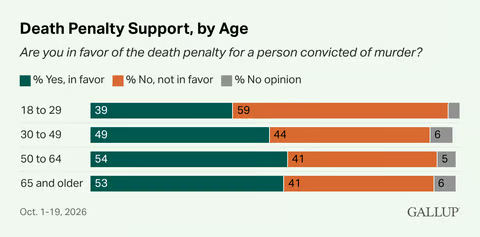
Age shows the sharpest divide. Only 39 percent of adults under 30 favor the death penalty, and Gallup found support below a majority among younger adults generally, while majorities of Americans 50 and older continue to favor it. Reports on the poll put support at 49 percent among those aged 30 to 49, 54 percent among those 50 to 64 and 53 percent among those 65 and older. In 2000, support was much higher in every age group, including 61 percent among 18 to 29 year olds, 67 percent among those 30 to 49 and 71 percent among those 50 and older. Gallup’s 2024 analysis found that age differences appear within every party, so younger Democrats, independents and Republicans are each less likely than older members of the same party to support capital punishment. Older Democrats and independents have also become less supportive over time, while older Republicans have remained steady.
What the numbers show
Support is at 49 percent, the first reading below a majority since 1971.
Democrats at 28 percent, independents at 50 percent, Republicans at 73 percent.
Adults under 30 at 39 percent, against 61 percent in 2000.
What the numbers do not show
A single cause. Gallup did not tie the result to one event.
A majority for abolition. Forty five percent oppose, and a sizable share of Americans still support it.
Any change in law. Policy is set by legislatures, courts and governors.
How Advocates and Supporters Read the Trend
Groups that work to end capital punishment, including Conservatives Concerned, a project that organizes conservative opposition to the death penalty, say the shift reflects growing public attention to its costs, its record of wrongful convictions and its inconsistency with limited government principles. They point to the dip in Republican support as evidence that arguments about fiscal responsibility, the risk of error and respect for life are reaching conservative audiences, and they say their work is to educate and mobilize conservatives on those grounds. Those are the advocates’ own explanations, and the poll does not measure why respondents answered as they did.
Supporters of capital punishment continue to argue that some crimes are so grave that execution is the only proportionate response, that it provides justice for victims and their families, and that it should remain available to states. A majority of Republicans and about half of independents still say they favor it, and in several states, prosecutors and legislators have recently defended it. Both views are part of an unresolved national debate, and Gallup’s numbers show a country divided closely enough that neither side can claim a settled consensus.
The Events Around the Poll
The survey began the day after Tennessee’s attempt to execute Christa Pike did not proceed as planned, and the governor has paused executions in the state pending an investigation. Several weeks after the survey ended, on November 5, California Governor Gavin Newsom announced plans to commute the sentences of everyone on the state’s death row. Gallup’s field period closed before that announcement, so the poll does not reflect public reaction to it.
- 1936Gallup first measures support at 59 percent, with 38 percent opposed.
- 1966Support reaches a record low of 42 percent.
- 1972The Supreme Court rules that state death penalty laws as written are unconstitutional.
- 1994Support peaks at 80 percent.
- 2017Support falls to 55 percent after four decades at 60 percent or higher.
- October 1 to 19, 2026Gallup conducts the survey, finding 49 percent in favor.
- November 10, 2026Gallup publishes the results.
Gallup’s own conclusion is that support has declined significantly over three decades, led by Democrats and younger generations, and that it may decline further if the trends among younger adults continue. Whether that opinion shift translates into new laws will depend on legislatures, governors and courts, but the poll gives both sides a new baseline for the debate ahead.