

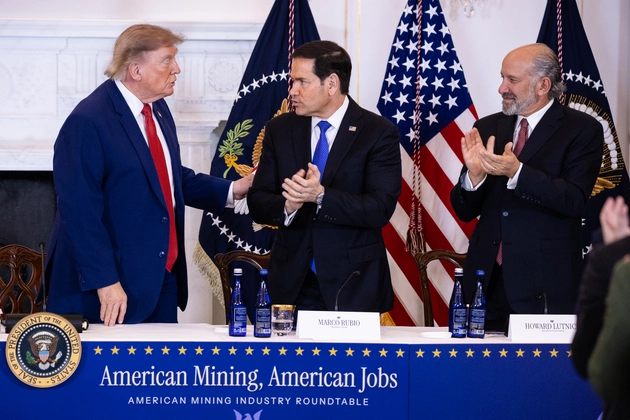
Democrats Sharpen Their Post-Midterm Target: Trump’s Critical Mineral Deals
Congressional Democrats are building the groundwork for a wave of investigations into the administration’s sprawling critical mineral spending program, arguing that federal money meant to counter China’s grip on the market has instead flowed toward companies with financial ties to the Trump and Lutnick families.
Washington has spent the past year racing to build a domestic supply chain for the minerals that power everything from fighter jets to smartphones, and the Trump administration has poured government money into that effort at a scale rarely seen outside of wartime industrial policy. Now, with control of Congress up for grabs in the midterms, Democrats are laying the groundwork to turn that spending spree into one of their central oversight targets, betting that questions about who actually benefits from the deals will resonate with voters far more than the underlying policy debate over critical minerals itself.
The program at the center of the fight is genuinely significant on policy grounds alone. Facing a Chinese government that controls the overwhelming majority of global rare earth processing, the administration has taken equity stakes in at least seven mining and materials companies, backed a strategic minerals reserve it has branded Project Vault, and negotiated international agreements, including an $8.5 billion critical minerals deal signed with Australia, all aimed at building alternatives to Beijing’s supply chain before it can be used as leverage in a future trade dispute. Few in either party dispute that reducing dependence on Chinese processing is a legitimate national security goal.
What Democrats object to is not the goal but the execution. Senate Democrats, including Richard Blumenthal, Adam Schiff, and Elizabeth Warren, sent letters this summer to the Departments of Commerce, Defense, Energy, and Interior identifying at least fourteen companies with financial ties to the Trump or Lutnick families that are collectively in line for close to nine billion dollars in federal support, citing an earlier New York Times investigation into the overlap. The senators asked the agencies to preserve every record and communication tied to those deals, a standard first step before a more formal investigation follows.
The Lutnick Family Connection
No single deal has drawn more attention than the government’s investment in USA Rare Earth, an Oklahoma based company that received a package worth roughly one point six billion dollars in federal loans and equity earlier this year. Cantor Fitzgerald, the financial firm Commerce Secretary Howard Lutnick ran for nearly three decades before joining the administration and later handed off to his sons Brandon and Kyle, served as a placement agent on the private capital raise that accompanied the federal award. Representative Zoe Lofgren, the ranking Democrat on the House Science Committee, wrote in a detailed letter that the structure of the deal gave the Commerce Secretary unusual leverage over the company while simultaneously benefiting the firm his family now runs, calling the arrangement a serious conflict.
The administration has defended the broader program as sound industrial policy rather than favoritism. Responding to earlier rounds of Democratic scrutiny, White House spokesperson Kush Desai said the president remains focused on reshoring critical manufacturing and that the government’s equity stakes reflect a genuine investment in the long run success of American technology, adding that safeguarding the country’s supply chain should not be delayed by additional bureaucracy. Commerce officials have said similar deals, including a price floor arrangement for MP Materials meant to protect it from being undercut by cheaper Chinese supply, are designed to give companies the confidence to build out capacity the market alone would not support.
What Democrats Are Asking
Document preservation, GAO investigations into conflicts of interest, and briefings from Commerce, Defense, Energy, and Interior on how mineral deal recipients are chosen.
What the White House Says
The equity stakes represent long term investment in American manufacturing and supply chain security, not favoritism, according to White House officials.
A Blocked Subpoena and a Widening Fight
The dispute has already produced one real test of how far Republicans are willing to let the investigations go. Democrats on the House Natural Resources Committee moved to subpoena Donald Trump Jr. over his investment firm’s stake in Vulcan Elements, a rare earth magnet maker that received a six hundred and twenty million dollar Pentagon loan shortly after his firm bought in. Committee Republicans blocked the subpoena, a decision Democrats have pointed to repeatedly as evidence that meaningful oversight will not happen while the party controls both chambers, and one they have promised to revisit immediately if that changes after November.
Industry executives say the political overhang is already shaping business decisions, months before any formal investigation could realistically begin. Mining and defense technology firms currently negotiating federal financing describe a growing wariness about how a change in control on Capitol Hill could affect deals already in motion, and at least one industry official said privately that companies are increasingly reluctant to be named in correspondence that could later be read into a congressional record. Some executives have reportedly turned down available federal funding altogether rather than risk being pulled into an investigation over ties they may not have chosen and cannot easily unwind.
Why the midterms matter here specifically: congressional committees only gain real subpoena power when the majority party wants to use it. Every document request Democrats have sent so far has been voluntary, and every attempt to force testimony has been blocked by the Republican majority, which is exactly why control of even one chamber after November would change what oversight is actually capable of.
What began as a series of individual letters and document requests is increasingly being treated by both parties as a preview of a much larger fight. For Democrats, the mineral deals offer a rare opportunity to combine a serious national security debate with a simpler, more visceral argument about whether public money is being steered toward politically connected insiders. For the administration and the companies receiving federal support, the challenge is proving that a program built for speed, in a race against Chinese supply dominance, can also withstand the kind of scrutiny that speed was designed to avoid. How that argument plays out over the next several months may say as much about the midterms themselves as it does about rare earth minerals.
Federal spending decisions on energy and critical minerals ripple through supply chains that reach New Jersey manufacturers too.
Follow more coverage on accountability and public policy in the Sustainable Action Now politics section.