

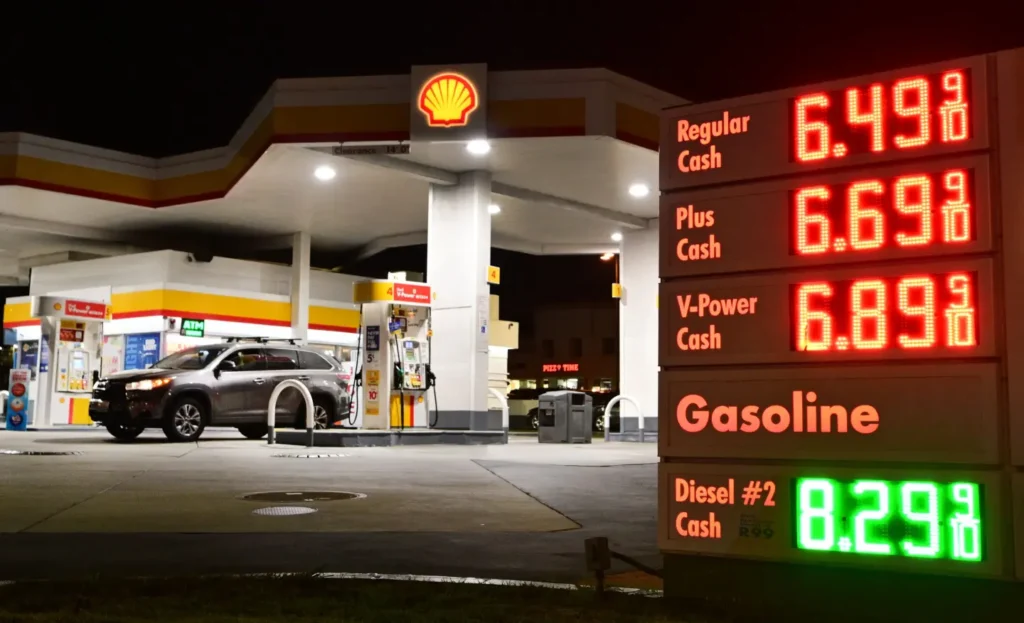
The Trump administration is internally split over a 90-day ban on diesel exports that Trump supports, his Energy Secretary opposes, agricultural-state Republicans are demanding, and oil-producing-state Republicans are fighting. The midterms are six weeks away. Diesel keeps climbing.
Diesel Is $6.52 a Gallon. The White House Is Considering a Fuel Export Ban. The Oil Industry Says That Will Make It Worse.
The Trump administration is internally split over a 90-day ban on diesel exports that Trump supports, his Energy Secretary opposes, agricultural-state Republicans are demanding, and oil-producing-state Republicans are fighting. The midterms are six weeks away. Diesel keeps climbing.
| $6.52 Average U.S. diesel price per gallon, Sept. 24 | 77% Rise in U.S. diesel prices since the Iran war began | 90 Days the proposed export ban would last | ~10 Years since the U.S. last restricted energy exports |
A gallon of diesel fuel in the United States now costs $6.52, according to AAA data from September 24, 2026. That is 77 percent higher than it was before the Iran war began in late February, and it has risen 91 cents in the past month alone, a 16.2 percent jump driven by Iran’s restriction of oil shipments through the Strait of Hormuz and drone strikes on Russian refineries that eliminated another chunk of global refining capacity. Diesel powers the semitrucks, trains, construction equipment, and farm machinery that move and produce everything else in the American economy, which means a 77 percent diesel price increase is not an energy story contained to the fuel sector. It is an inflation story, a food price story, a supply chain story, and, with six weeks until midterms, a very acute political story. The White House knows all of this. It is currently fighting with itself about what to do.
“Dammit, Something Has to Happen.” What the White House Is Actually Considering.
Politico reported on September 23, citing five people familiar with internal discussions, that the Trump administration is preparing a plan to ban diesel exports from the United States for 90 days. The plan is designed to trap domestically refined diesel supply inside the U.S. market in the hope that increasing domestic supply relative to demand will bring pump prices down before November. Trump expressed support for the measure directly at the United Nations General Assembly on September 22, saying, “I’ve said, ‘Let’s not send out the diesel.’ We make a lot of diesel. I’ve called for it within my people. I’ve been talking about it.” Treasury Secretary Scott Bessent confirmed at the same event that the administration has been “examining” the possibility.
The White House subsequently denied the Politico report, calling it “not true,” which is a curious formulation for a story based on five named sources describing active planning discussions. The denial may reflect the genuinely unresolved internal debate rather than the absence of any proposal: Trump publicly supports the idea, his Treasury Secretary has acknowledged examining it, and five people familiar with the discussions told one of the most authoritative political publications in Washington that planning is actively underway. “Not true” and “not yet final” are different statements, and the White House chose the former.
The legal framework for a diesel export ban is genuinely unclear, which is part of why the White House denial may reflect procedural rather than substantive resistance. The United States has not restricted energy exports in more than a decade, and the authority to do so would require either a statutory basis or an executive order stretching an existing power, both of which carry legal risks that administration lawyers are presumably working through. The administration’s timeline is nevertheless compressed: reporting suggests Trump wants a decision by the end of this week, which means whatever legal architecture an export ban requires is being assembled, or found to be unavailable, in real time.
Why Diesel Prices Affect Everything Else
Diesel fuel powers the commercial transportation infrastructure that moves virtually every physical good in the American economy. Semitrucks run on diesel. Freight trains run on diesel. Farm tractors, combines, and irrigation pumps run on diesel. Construction equipment runs on diesel. When diesel prices rise by 77 percent, the cost of transporting and producing everything that diesel-powered equipment touches also rises, and those costs are passed through to consumers in the form of higher prices for food, building materials, manufactured goods, and most services that involve any physical supply chain. This is why diesel price inflation is not a fuel story contained to truck drivers and farmers. It is a general inflation accelerant that affects price levels across the entire economy.
The President Wants a Ban. His Energy Secretary Calls It a Blunt Tool That Doesn’t Work. This Is an Active Argument.
The internal split inside the administration over the diesel export ban is real, substantive, and reflects a genuine policy disagreement rather than a communications problem. Energy Secretary Chris Wright, whose portfolio is directly implicated by a ban on energy exports, has been the most vocal internal opponent. Wright told CBS News on September 6 that the administration is focused on boosting domestic output rather than restricting trade, and he told the Wall Street Journal that “the blunt tool of banning diesel exports definitely doesn’t work.” Interior Secretary Doug Burgum has raised a different concern, warning that an export ban could invite retaliation from trading partners who would interpret a U.S. restriction on energy exports as a trade action requiring a reciprocal response.
The Republican caucus is similarly divided along lines that map almost perfectly onto each member’s district economic interests. Agricultural-state Republicans, representing farmers whose operating costs are directly tied to diesel prices, have been pushing for the export ban with increasing urgency as fuel costs have climbed. Their constituents use diesel to plant, harvest, and transport crops, and the 77 percent price increase since February has been devastating to farm operating margins in ways that show up in constituent mail and town hall meetings in ways that are difficult for their elected representatives to ignore. Oil-producing-state Republicans, representing districts where the petroleum industry is a major employer and economic driver, oppose the ban on the grounds that restricting exports would reduce the value of the crude oil being produced in their states and undermine an industry that their voters depend on.
The oil industry itself is in a different category from the internal Republican debate because the industry has an economic stake in the outcome that is more direct and more immediately calculable than any politician’s. The American Petroleum Institute’s president Mike Sommers has warned that trapping crude and diesel supply inside the U.S. market would likely force domestic refiners to cut production, paradoxically shrinking global supply and pushing prices higher rather than lower. The argument is counterintuitive but economically coherent: U.S. refineries are calibrated to produce at their current export volumes, and disrupting that export market doesn’t simply redirect their output to domestic consumers. It changes the economics of running the refinery at all, with production cuts as a likely response that would leave less diesel in the domestic market than before the ban.
The Policy Question: Would a 90-Day Export Ban Actually Lower Diesel Prices for American Consumers?
The economic argument for a diesel export ban rests on a simple supply and demand logic: if diesel currently being shipped to Europe, Asia, and Latin America is instead kept in the domestic market, the increased domestic supply should reduce domestic prices. The United States exports a substantial volume of distillate fuel oil, of which diesel is the largest component, and redirecting even a portion of that volume to the domestic market would increase the supply available to U.S. consumers and truckers and farmers who are paying $6.52 a gallon at the pump right now. Axios reported that economists say the move could benefit America in the short term, which is the political timeline that matters most to the administration with six weeks until midterms.
The argument against runs through the refinery production dynamics that the oil industry’s critics of the ban are emphasizing. U.S. refineries produce diesel as part of a complex output mix calibrated to the economics of both domestic and export markets together. When you eliminate the export market for 90 days, you don’t simply redirect the export volume to domestic consumers. You change the economics of the refinery’s entire operation, and the industry’s argument is that those changed economics would lead to production cuts that would reduce total diesel output, leaving less rather than more available for American buyers. The same economists quoted by Axios saying a ban could provide short-term U.S. relief also noted it would likely raise global prices significantly, because the volume currently being exported is being consumed somewhere, and the countries currently importing U.S. diesel would have to find alternative supplies or go without.
The historical precedent the administration would be reaching for is thin. The United States has not restricted energy exports in any comparable form in more than a decade, and the policy context then was sufficiently different that the lessons don’t transfer cleanly. The situation the ban is responding to, a geopolitical supply shock driven by an active military conflict over a maritime chokepoint, is exactly the kind of scenario in which market interventions are most politically attractive and most economically uncertain, because the underlying supply constraint is not a domestic market failure that a domestic policy intervention can fix. Diesel is $6.52 a gallon because the Strait of Hormuz is being disrupted by an active war. A 90-day export ban does nothing to the Strait of Hormuz.
The Diesel Crisis Is Not a Crisis About Diesel. It Is a Crisis About What Happens When Fossil Fuel Dependency Meets Geopolitical Instability.
The diesel export ban debate is happening because the United States economy runs on diesel, and diesel comes from oil, and oil is a geopolitically organized global commodity whose price is determined by events in the Strait of Hormuz and the drone strike targeting decisions of military planners in Tehran and Washington rather than by anything American energy policy can directly control. This is not a new insight. It is the insight that has motivated energy security arguments for clean energy alternatives for the past fifty years, every time a geopolitical event produced an oil price shock and a political crisis over fuel costs, and every time those fuel costs eventually came down, the political urgency for structural change dissipated along with them.
The $6.52 diesel price and the administration’s scramble to find a policy tool to address it represent the specific failure mode of an economy that has not reduced its diesel dependency on a timeline that the geopolitical situation turned out to require. The farms and trucking companies and construction firms paying $6.52 a gallon are paying it because the clean energy alternatives that could have replaced diesel-powered equipment in their operations were not deployed at the scale and pace that would have provided insulation from the current disruption. That deployment is possible. The electric truck technology exists. Electrified farm equipment is being developed. The transition is technically available. What it has lacked is the policy urgency and public investment that the current crisis was completely predictable to produce, the exact sequence of events that energy transition advocates have described for decades.
At Sustainable Action Now, we cover this intersection because the diesel story and the climate story are the same story, told from different vantage points across time. The immediate story is about pump prices, political calculations, and whether the White House can find a legal mechanism for an export ban that its own Energy Secretary believes will not work. The longer story is about the entirely avoidable nature of an economy so deeply organized around a commodity whose supply can be disrupted by a military conflict seven thousand miles away that a 77 percent price increase in seven months is the predictable result, and that the best available policy response is a 90-day band-aid being debated among people who fundamentally disagree about whether it will make things better or worse.
The Story Is Moving Fast. Here Is What Happens Next.
Trump said he wants a decision on the diesel export ban to come “fast,” which in the context of a compressed pre-midterm week means the situation is likely to move quickly. The legal path to a ban is unclear and being actively worked through. The industry opposition is organized and vocal. The internal dissent from Wright and Burgum is on the record. Whether the president overrides his own cabinet’s stated position and announces a ban, whether the legal obstacles prove insurmountable in the available time, and whether the White House denial becomes the final word or a temporary pause are the three questions that determine what this story looks like by the end of the week. Watch the diesel pump price, watch Wright’s public statements, and watch whether any executive order language appears. The midterms are the timeline. Six weeks is a very short window to move a fuel price that is being driven by a war.
Sustainable Action Now: Energy and Climate Coverage
The diesel crisis, the coal court ruling, the $100 oil price, the Norway gas pivot, the data center ratepayer fight: all of it is the same story about what it costs to stay organized around fossil fuels in a world where geopolitics keeps changing the price. We cover all of it.
Visit SAN Climate and Energy Coverage