
After Seven Years, Fifteen Young Canadians Finally Got Into That Courtroom. The Crowd Outside Erupted When They Did.
On October 26, 2026, La Rose v. His Majesty the King went to trial in Vancouver, British Columbia. The case was filed in October 2019. These young Canadians were between the ages of 10 and 19 then. They are seven years older now and they walked into the Federal Court of Canada asking it to say, plainly and legally, that the government’s climate failures violated their constitutional rights.
| 7 yrs From filing to trial, October 2019 to October 2026 | 15 Youth plaintiffs from seven provinces and one territory | 8 wks Scheduled trial length, through late November, with closing arguments in February 2027 | 1st Federal youth climate trial ever heard in Canada |
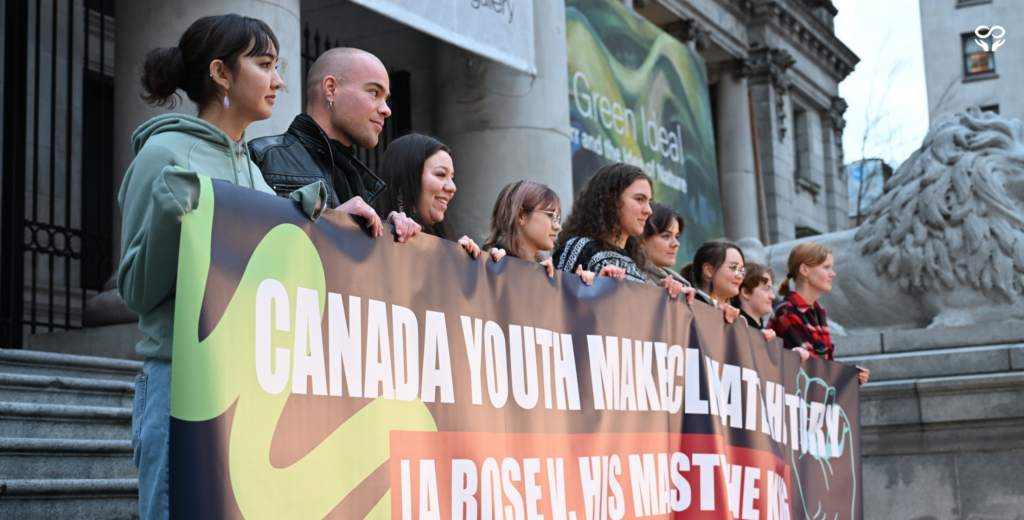
The crowd outside the Federal Court of Canada in Vancouver was wearing rose pins. People carried hearts and held signs. When the fifteen young plaintiffs came into view, the supporters who had lined the streets sang, chanted, and then cheered loud enough that the moment was audible inside the building. These young people have been living with this case since 2019. Some of them were ten years old when it was filed. The one who took the stand on Day 1 was seventeen when her hometown was ordered to evacuate in the face of wildfires, and she described the ash falling from the sky in a courtroom that was filled to capacity, with more supporters gathered at a nearby viewing session to watch together. This is what seven years of fighting to be heard in court looks like when you finally get there.
What This Case Is, Where It Came From, and Why Seven Years Is Both a Long Time and the Point
On October 25, 2019, fifteen children and youth from across Canada, from seven provinces and one territory, filed a lawsuit in the Federal Court of Canada against the Crown and the Attorney General of Canada. Supported by Our Children’s Trust, the legal advocacy organization that has supported youth climate litigation in multiple countries, the young plaintiffs alleged that Canada’s greenhouse gas emissions and its failures to take sufficient action on climate change were contributing to a crisis that directly harms them now and will continue to harm them throughout their lives, and that this conduct violates their rights under sections 7 and 15 of the Canadian Charter of Rights and Freedoms: the right to life, liberty, and security of the person, and the right to equality under the law.
The case’s procedural history is itself part of the argument. In October 2020, a Federal Court judge dismissed the case, acknowledging that the climate impacts on the plaintiffs were “significant, both now and looking forward into the future,” while nonetheless ruling that the claim as structured couldn’t proceed. The plaintiffs appealed. On December 13, 2023, three justices from Canada’s Federal Court of Appeal unanimously ruled that the youth deserve a trial. A year after that, in December 2024, the Federal Court set the trial dates: eight weeks beginning October 26, 2026, in Vancouver, with closing arguments anticipated for February 2027. The fact that it took seven years to get into the courtroom is not incidental to the case’s significance. It is part of what the plaintiffs are asking the court to reckon with: that the legal system’s pace and the climate crisis’s pace are badly mismatched, and that young people are bearing the cost of that mismatch in the form of wildfires, evacuations, and the loss of landscapes they grew up in before the courts ever heard their names.
Fifteen youth plaintiffs, ages 10 to 19, file La Rose v. Her Majesty the Queen in Federal Court, supported by Our Children’s Trust. The case alleges Charter rights violations through Canada’s contributions to the climate crisis.
Federal Court dismisses the case, acknowledging significant climate harms to the plaintiffs but declining to allow the claim to proceed. Plaintiffs immediately appeal.
Three justices from the Federal Court of Appeal unanimously rule that the youth deserve a trial. A unanimous appeals court decision reversing a dismissal is a significant legal development.
Federal Court confirms the eight-week trial, set to begin October 26, 2026, in Vancouver. Justice Fothergill noted that “the impact of this case may be profound” if the youth prevail.
Trial opens in Vancouver with plaintiffs’ opening arguments by lead counsel Catherine Boies Parker, KC, followed by the first plaintiff testimony from Kira Young. The courtroom is filled to capacity. Closing arguments are anticipated for the week of February 22, 2027.
What the youth plaintiffs are asking for is specific and legally meaningful. They are seeking two things from the Federal Court: a declaration that Canada’s conduct in contributing to climate change has violated and continues to violate their rights under the Canadian Charter of Rights and Freedoms, and an order requiring the government to prepare and implement a legally binding Climate Recovery Plan that reduces Canada’s greenhouse gas emissions in line with what scientists say is necessary to stabilize the climate system. A win would mean a court-ordered plan that is binding on the government, enforceable through the court, and designed around the constitutional rights of youth rather than around the political calculations of successive governments that have repeatedly made and broken emissions commitments.
The Opening Argument: The Government Has Known About the Climate Crisis for Decades and Has Kept Making Promises It Has Kept Breaking
Catherine Boies Parker, KC, lead counsel for the plaintiffs, opened the case by establishing the central factual and constitutional argument that the trial is built on: that Canada’s government has known about climate change for decades, has made repeated commitments to reduce its greenhouse gas emissions, has failed to meet those commitments, and that this pattern of known harm and broken promises has contributed to a collective failure whose consequences fall most heavily and most unjustly on young people who had no voice in the decisions that created it. The opening was a precise statement of what the plaintiffs intend to prove over eight weeks of trial testimony, expert evidence, and legal argument about what the Canadian Charter requires of a government that acknowledges the harm it is causing and continues causing it anyway.
The phrase “collective failure” in Boies Parker’s opening is doing specific legal work. The defense in climate litigation cases frequently argues that any individual government’s contribution to global emissions is too small and too diffuse to be the proximate cause of any specific harm to any specific plaintiff, and that the appropriate remedy for collective global problems lies with legislatures and international agreements rather than with domestic courts adjudicating constitutional rights. The plaintiffs’ framing of “collective failure” directly engages this argument: they are not claiming Canada alone caused climate change, but that Canada’s specific conduct, including its specific broken commitments and its specific continued emissions, is an identifiable contribution to a documented harm that has materially affected these fifteen young people’s lives, and that the Canadian Charter’s protections are broad enough to require the government to account for that contribution.
The government of Canada’s defense position is not that climate change isn’t real or that young people aren’t harmed. The courts have already acknowledged both. The defense is expected to contest whether the harms are sufficiently linked to specific government conduct to constitute a Charter violation, whether the remedies sought are within the court’s institutional competence to order, and whether climate policy is properly a judicial question at all or whether it belongs exclusively to the legislative and executive branches. These are genuine constitutional questions without clean precedent in Canadian law, which is precisely what makes this the first federal youth climate case to reach trial in Canada’s history.
Kira Young Took the Stand and Described the Ash Falling From the Sky. She Was 17. Her Mother Stayed Behind to Help Evacuate the Hospital.
The most powerful moment of Day 1 was also its most human. Kira Young, one of the fifteen youth plaintiffs and the first to testify, grew up in Yellowknife, in the Northwest Territories. She described a childhood shaped by the land around her: canoeing, skiing, biking on the lakes and terrain that she knew well enough to call it home rather than just a place she happened to live. That landscape was her reference point for what the world was supposed to look like, and in the summer of 2023, she watched it transform in a way that she told the court has not left her since.
During a family canoe trip on the Keele River, wildfire smoke grew so thick that her family could no longer see across the water to the opposite bank. Back in Yellowknife, the sky turned orange. “Ash fell from the sky,” she told the court. Then, in mid-August, the order came for the entire community of Yellowknife to evacuate. She was 17 years old. She left with her father and her brother. Her mother, who was an essential worker, stayed behind to help evacuate the hospital. Before Kira left, she walked through her house taking photos and videos of every room, fearful that she was documenting a place she might never see intact again. The family drove south along the only highway out, past flames burning beside the road, through a community that had already been destroyed by fire in the days before. They were displaced for about three weeks.
Since the evacuation, Kira has returned to the burned forest surrounding her home in Yellowknife. The landscape she described to the court is hauntingly quiet, which for someone who grew up knowing those forests as places of ordinary sound, of birds and wind and water, is itself a form of loss. She described the experience as traumatic and told the court it still affects her. She joined the case after the evacuation, specifically because she wanted to help prevent young people from having to go through what she went through, not as a past story that has been resolved, but as a present reality with a future that policy decisions will determine. Her testimony was not offered as an anecdote about one bad summer. It was offered as evidence that climate change is not an abstract future threat waiting for courts and governments to catch up with it at some more convenient time. It is already happening, to real people, in real places, in ways that don’t allow for the luxury of further delay.
The 2023 Northwest Territories Wildfires: What Kira Witnessed
The 2023 Northwest Territories wildfire season was the most severe in the territory’s recorded history. In August 2023, more than 230 fires were burning simultaneously across the NWT. The fires prompted the mandatory evacuation of Yellowknife, a city of approximately 20,000 people, the first mandatory evacuation of the city in its modern history. Residents had between 24 and 48 hours to leave before the fires reached the city’s borders. The smoke plume was visible across much of North America, and air quality readings in Yellowknife during the peak fire period were among the worst ever recorded in any North American urban area. The burned area in the NWT during 2023 exceeded four million hectares. Kira Young was 17 when she drove out of her city on the only highway south, past flames, with her mother left behind to help evacuate the hospital.
What the Plaintiffs Are Actually Asking For, and Why This Trial Has Implications Beyond Canada
A win for the La Rose plaintiffs would require the Federal Court of Canada to issue two orders: a declaration that Canada has violated the constitutional rights of its youth through its climate conduct, and a directive requiring the government to prepare and implement a court-ordered, legally binding Climate Recovery Plan designed to reduce greenhouse gas emissions in line with scientific guidance on what is necessary to stabilize the climate system. The plan would not be voluntary. It would not be subject to the same political cycle that has allowed successive Canadian governments to make and unmake emissions commitments without legal consequence for the better part of three decades. It would be enforceable through the court that issued it, with the government accountable to that court for its implementation and progress.
Federal Justice Fothergill, in earlier proceedings, stated that “the impact of this case may be profound” if the youth prevail. That assessment reflects the constitutional novelty of what the plaintiffs are attempting: they are asking a federal court to rule that the Canadian Charter creates enforceable climate obligations on the government, a question that Canadian federal courts have never addressed on the merits. Jurisdictions that have reached similar conclusions, including the Dutch Supreme Court in the Urgenda case and the German Federal Constitutional Court’s 2021 climate ruling, have produced binding government obligations that changed the trajectory of national climate policy in ways that legislative and diplomatic processes had failed to produce. The La Rose plaintiffs are attempting to produce the Canadian version of that kind of ruling.
The trial is scheduled to run through late November, with closing arguments anticipated during the week of February 22, 2027. The proceedings are open to the public through the court’s official viewing access. La Rose is part of a growing global movement of rights-based youth climate litigation, cases filed in jurisdictions across Europe, Asia, the Americas, and Africa, in which young people are using constitutional and human rights frameworks to hold governments legally accountable for the climate decisions that will determine the conditions of their lives. The movement reflects a specific and historically earned frustration: the political and diplomatic processes designed to produce adequate climate action have not produced it, and the legal frameworks that protect individual rights from government action are being asked to fill the gap. Seven years after fifteen Canadian youth filed this case, that argument is finally in front of a judge who has the authority to rule on it.
Sustainable Action Now: Climate Justice and Youth Litigation
La Rose v. His Majesty the King is the most significant rights-based climate case in Canadian history. We cover this trial, the youth climate litigation movement globally, and every other dimension of the fight for a livable future. The trial runs through late November. We’ll be following it.
Visit SAN Climate Coverage SAN Criminal Justice CoverageKira Young was 17 when she drove out of Yellowknife with her father and brother while her mother stayed behind to evacuate the hospital. She took photos of every room in her house in case she never saw it intact again. She drove past flames on the only road south. She watched ash fall from the sky and listened to a burned forest go silent. She joined this case because she didn’t want other young people to have to go through that, and on October 26, 2026, she sat in a courtroom in Vancouver and told that story to a judge who has the authority to declare that what happened to her was a constitutional failure of her government. Fifteen young Canadians waited seven years for that moment. The crowd outside erupted when they walked in. The trial has five weeks still to go.