
The Cute Puppy Post in Your Feed Is Hiding Something Disturbing
Online puppy sales are booming across Europe. Social media platforms have become the primary marketplace for a trade that FOUR PAWS investigators found filled with illegal breeders, sick underage puppies, car park handovers, and dogs who bear no resemblance to the photos used to sell them.
| 11 Sellers visited during FOUR PAWS Bulgaria investigation | 0 Sellers who fully complied with legal requirements | 100s of dogs suffering behind each misleading online ad | EU Bulgaria: a confirmed hotspot for puppy trafficking |
Somewhere in your social media feed, probably not far from where you are reading this, there is a post featuring a small, fluffy puppy in a clean, comfortable-looking setting, with a price, a contact number, and a description that could make even the most cautious person consider reaching out. What that post almost certainly does not show is the backyard where the puppy was actually bred, the mother it was separated from weeks before it was old enough to leave her, the illness it is already carrying, or the car park where the handover will happen so that the seller never has to let you see where the dog came from. FOUR PAWS has just returned from Bulgaria with evidence of exactly this, and the scale of what their investigators found makes a compelling case that every platform hosting these ads is enabling a welfare crisis they have the power to end.
The investigation that went behind the ads, and into the facilities they were hiding.
Behind the Ads: What FOUR PAWS Investigators Found When They Went in Person
FOUR PAWS identified Bulgaria as a investigation target because the country has become a recognized hotspot in the European online puppy trade, a geographic and regulatory intersection where inadequate enforcement, lower costs of living that make large-scale amateur breeding economically attractive, and easy cross-border digital advertising combine to produce one of the most active nodes in a trafficking network that moves dogs across Europe in the same way other contraband is moved: as quickly as possible, with as little documentation as possible, and with sellers who are expert at creating the appearance of legitimacy from a digital distance while maintaining careful control over what buyers can actually see. Investigators visited eleven sellers identified through online listings. Every single one of them revealed violations. The findings across those eleven visits are documented, specific, and representative of a much larger pattern.
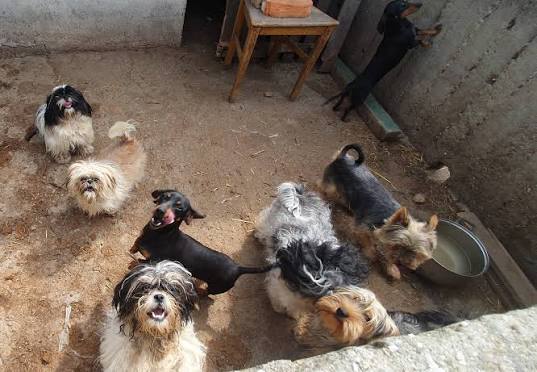
The breeding and housing conditions that investigators found bore no resemblance to the environments shown in the online listings used to attract buyers. Puppies were kept in unsanitary conditions that no responsible welfare standard would permit. The animals themselves were visibly unwell: already showing signs of illness and behavioral distress at ages when a healthy puppy raised in appropriate conditions should be curious, playful, and physically robust. Several were being offered for sale well below the minimum age at which puppies should be separated from their mothers, a practice that causes documented psychological and developmental harm that can affect an animal’s behavior and health for the duration of its life. The sellers were prepared to send these puppies abroad without the documentation that European regulations require for cross-border animal movement, and they offered to arrange handovers in car parks or other neutral locations specifically to prevent buyers from gaining any direct knowledge of where the dog had come from or the conditions in which it had been bred.
What FOUR PAWS Investigators Found Across 11 Sellers in Bulgaria
|
❌
|
Unsanitary breeding conditions with no resemblance to the environments shown in online listings used to attract buyers. |
|
❌
|
Underage puppies offered for sale, separated from their mothers prematurely, causing developmental and psychological damage with lasting consequences. |
|
❌
|
Visible illness and distress in puppies only weeks old, indicating inadequate veterinary care and breeding conditions incompatible with basic welfare standards. |
|
❌
|
Little or no documentation, with sellers willing to send dogs across European borders without the paperwork that EU regulations require for legal cross-border animal movement. |
|
❌
|
Car park handovers arranged deliberately to prevent buyers from ever seeing the breeding facility and to deny any accountability trail for the seller. |
|
❌
|
Multiple legal violations, including unregistered breeders operating outside licensing requirements and the illegal ear cropping of young puppies, a painful and medically unnecessary procedure now banned across much of Europe. |
|
❌
|
Extreme physical trait exaggeration in certain breeds, breeding for characteristics known to cause chronic health problems, including severe breathing difficulties and mobility impairment, pushed to a degree that left animals visibly struggling to function normally. |
Social Media Platforms Are Advertising This Trade to Millions of People for Free
The reason the online puppy trade has expanded so dramatically across Europe over the past decade is not complicated: social media platforms have given sellers of illegally bred puppies free access to audiences of millions, with minimal oversight, minimal verification requirements, and algorithms that actively distribute appealing content, including photos of young puppies, to exactly the audiences most likely to respond to it. A seller operating an unlicensed breeding facility in rural Bulgaria can post a photograph of a photogenic puppy to a Facebook group or Instagram account in the morning and have inquiries from potential buyers across Germany, the Netherlands, France, and the UK by the afternoon. The platform requires nothing from the seller by way of verification of their licensing status, their breeding conditions, or the health and age of the animal being offered. The post looks identical to a post from a legitimate, licensed breeder because the platform makes no distinction between them.
The tactics that illegal sellers use to avoid the platform policies that nominally prohibit private puppy sales are well documented and easily identified by anyone looking for them. Sales are presented as rehoming arrangements rather than commercial transactions, avoiding the language that content moderation systems are trained to flag. Contact is directed to private messaging or to external platforms where the commercial nature of the transaction can proceed without visible record. Groups dedicated to puppy sales migrate to new names and new structures when their previous incarnations are removed, and the removal process is slow enough that the sales they were facilitating have often already been completed before any enforcement action takes effect. FOUR PAWS is calling on platforms to move from reactive removal of flagged content to proactive identification of the behavioral patterns that characterize this trade, and to apply verification requirements for anyone advertising animals for sale that would function as a meaningful deterrent rather than an easily circumvented formality.
The Tactics Illegal Sellers Use to Stay Online
Illegal puppy sellers have become sophisticated at operating within the technical letter of platform policies while violating their intent. Common tactics include framing sales as rehoming donations to avoid commercial language triggers, directing buyers to private messages immediately to move the transaction off-platform, using rotating account names and group structures to evade bans applied to specific pages, and presenting professional-looking photographs that bear no relationship to actual breeding conditions. The investigative findings in Bulgaria confirm that sellers are aware of platform oversight and specifically structure their operations to minimize their digital accountability footprint while maximizing their audience reach.
The Dogs Pay the Price for Every Purchase Made Without Asking Where the Puppy Came From
The welfare consequences of the online puppy trade operate at multiple levels, and they are not limited to the animals sold through illegal listings. The mothers of those animals, the breeding females who are kept in permanent reproductive labor in the unsanitary backyard facilities that FOUR PAWS investigators documented, bear the most sustained and invisible burden of this trade. A breeding female in an unlicensed facility producing multiple litters per year to supply the online market is an animal whose entire existence is defined by continuous pregnancy, lactation, and premature separation from her offspring. The behavioral and physiological consequences of that existence are severe and cumulative. These animals are not shown in the listings. They never are.
The practice of ear cropping, which FOUR PAWS investigators documented being applied to young puppies in the Bulgarian facilities they visited, is one of the more straightforward welfare violations in the trade because its illegality in most of Europe is clear and its justification is entirely cosmetic. Ear cropping involves surgically altering the shape of a puppy’s ears for appearance purposes, a procedure performed without anesthesia in unlicensed settings that causes acute pain and carries significant infection risk, all in service of making a dog look a specific way that a buyer or a breed standard has decided is desirable. The practice has been banned in most European countries precisely because its only function is human aesthetic preference applied to an animal’s anatomy without any benefit to the animal and with documented harm to it.
The extreme physical trait exaggeration that FOUR PAWS documented is a less immediately visible but more structurally significant welfare problem, because it is embedded in breed standards and buyer preferences that extend well beyond the unlicensed breeder market. Breeds that have been selected over generations for flattened faces, shortened muzzles, and compressed airways, including the French bulldog, English bulldog, and pug, are among the most popular dogs in European markets and among the dogs most frequently found in online listings. The brachycephalic obstructive airway syndrome that affects these breeds produces animals that cannot breathe normally, cannot regulate their temperature efficiently, and frequently require surgical intervention to achieve a functional airway. Breeding for the most extreme expression of these traits, as the investigators documented occurring in Bulgaria, produces puppies who are visibly struggling to breathe and move properly from the first weeks of their lives.
If You Are Looking for a Dog, Know What the Trade Wants You Not to Know
FOUR PAWS is explicit in calling on people who are considering purchasing a puppy to understand the tactics used to manipulate that decision online, and to apply a minimum set of requirements that any legitimate seller can meet and that illegitimate sellers almost certainly cannot. The emotional appeal of a puppy photograph is real and powerful, and the trade depends on buyers acting on that emotional appeal before engaging the kind of critical inquiry that would reveal the listing for what it is. Understanding those tactics in advance is the single most effective protection against funding the suffering that the FOUR PAWS investigation documented.
Red Flags in an Online Puppy Listing
| ⚠️ | The seller is unwilling to let you visit the breeding location and see the puppy with its mother before purchase. |
| ⚠️ | The handover is offered in a car park, motorway service area, or any neutral location away from the breeding premises. |
| ⚠️ | The puppy is under 8 weeks old. Legal minimum age for separation in most European countries is 8 weeks, and many responsible breeders keep puppies longer. |
| ⚠️ | The seller cannot provide full documentation: vaccination records, microchip registration, health certificate, and breeder registration number. |
| ⚠️ | The puppy is being shipped internationally, especially from a different country, without you having met the dog in person at its place of birth. |
| ⚠️ | Multiple breeds are available simultaneously from the same seller, suggesting a puppy mill operation rather than a genuine single-breed enthusiast. |
| ⚠️ | The price seems unusually low for the breed, which may indicate the dog has not received proper veterinary care or has been bred in conditions that reduce costs at the animal’s expense. |
The most straightforward alternative to purchasing from an online listing is to adopt from a rescue organization. Rescue dogs of every age, breed, and size are available across Europe through organizations that have assessed the animal’s health and temperament, provided necessary veterinary care, and can give you accurate information about the dog’s needs and history. Adoption does not fund the trade. It does not reward illegal breeding. It takes one dog out of a system that is already overwhelmed and puts that dog in a home where it can have the life it was denied before rescue.
Take Action with FOUR PAWS
FOUR PAWS is calling on social media platforms to enforce their own policies and on buyers to stop feeding demand for illegally bred puppies. You can support the campaign, report suspicious listings, adopt instead of purchase, and donate to the organization doing this investigation work across Europe.
Take Action: Stop the Puppy Trade Donate to FOUR PAWS Adopt, Don’t ShopThe puppies in the online listings are real. The suffering behind the listings is real. The investigators who went into those breeding facilities in Bulgaria documented it, and the video above shows what they found. Sharing this information, reporting suspicious listings, and choosing adoption over online purchase are the most direct actions available to people who want to be part of changing a trade whose scale is, as FOUR PAWS observed, unfathomable from a listing page but entirely visible when you walk through the facility door.
Sustainable Action Now Rescue Network
We follow FOUR PAWS and the full network of organizations doing investigation, rescue, and advocacy work for animals across Europe and globally. The dogs behind these listings deserve better. So do the buyers who were never told the truth about where they came from.
Visit the SAN Rescue Network