

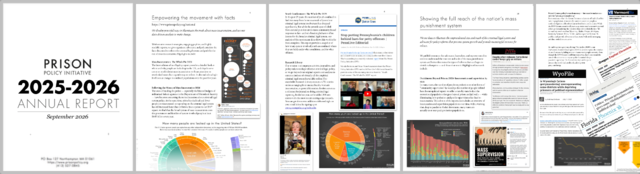
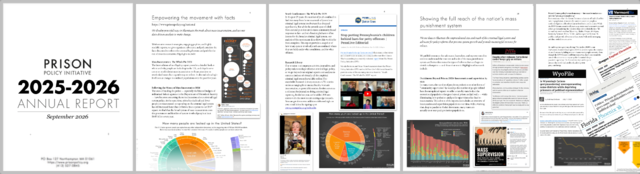
When the Prison Policy Initiative launched in 2001, criminal justice reform barely registered as a political priority. A quarter century later, its newest annual report lays out nearly two million people still confined nationwide, a $445 billion price tag, and a system that has simply found new places to grow. Read The Full Report.
Twenty-Five Years In, the Prison Policy Initiative’s New Report Shows How Much and How Little Has Changed
When the Prison Policy Initiative launched in 2001, criminal justice reform barely registered as a political priority. A quarter century later, its newest annual report lays out nearly two million people still confined nationwide, a $445 billion price tag, and a system that has simply found new places to grow.
A quarter century ago, the Prison Policy Initiative set out with two fairly modest sounding goals: help the public understand what mass incarceration was actually doing to the country, and win concrete policy changes that would shrink the system rather than simply manage it. In 2001, that mission put the organization well outside the political mainstream. Criminal justice reform was not a subject most elected officials wanted to touch. Twenty five years later, the organization’s newest annual report arrives at a moment when the conversation has shifted considerably, even as the underlying numbers remain stubbornly large.
The 2025 to 2026 Annual Report, released this month to mark the milestone, functions as both a retrospective and a status update. It walks through the organization’s major research releases from the past year, alongside the advocacy tools built around them, and it does so while tracking a criminal legal system that has proven remarkably good at relocating its growth even when one part of it shrinks.
The Big Picture Hasn’t Gotten Smaller
The centerpiece of the report is an updated edition of the organization’s signature research product, Mass Incarceration: The Whole Pie, which pieces together data from every corner of the country’s confinement systems into a single picture. The 2026 edition finds nearly two million people held across more than five thousand state, federal, local, and tribal facilities on any given day, a rate that remains the highest of any independent democracy in the world.
What has changed is where that growth is actually coming from. According to the report, the recent increase in the overall confined population is almost entirely attributable to a 58 percent spike in ICE immigration detention, even as the population held in local jails for ordinary criminal cases actually declined. In other words, the topline number is climbing while the traditional criminal legal system it once measured most directly has been relatively flat.
The report also documents how unevenly that population is distributed by race. Black Americans make up roughly 14 percent of the U.S. population, according to the report, yet account for 42 percent of everyone currently incarcerated, a disparity the organization frames as one of the clearest indicators that the system’s burden has never been distributed evenly. Local jails in particular remain heavily filled with people who have not been convicted of anything, held pretrial simply because they cannot afford bail while their cases move through the courts.
Following the Money
A second major report from the past year, Following the Money of Mass Incarceration, put a dollar figure on the system the Whole Pie report maps geographically. The organization’s updated estimate puts the total annual cost of mass incarceration and criminalization at a minimum of $445 billion, a figure that spans far beyond what most people typically think of as prison spending.
That last figure is worth sitting with. Nearly $28 billion of the system’s total cost is paid not by taxpayers through public budgets, but directly out of pocket by incarcerated people and the families supporting them, through money bail, court fines and fees, marked up commissary purchases, and phone and video call charges that can run far higher than a comparable call placed from outside a facility. The report treats that figure as a distinct category deliberately, arguing that these costs function as a hidden, regressive tax layered on top of the system’s public price tag.
A New Focus on Local Jails and Deportation
One genuinely new addition in this year’s report is a research release examining how local city and county jails function as an entry point into the federal immigration detention system. The organization published its findings alongside a grassroots toolkit built specifically to help local communities push back against municipal jails cooperating with ICE, treating the two releases as companion pieces rather than separate projects.
New This Year
A first-of-its-kind mapping of how local jail bookings feed into federal immigration detention and deportation, paired with a public toolkit for community organizing against local ICE collaboration.
The pairing reflects a pattern in how the organization has approached its research more broadly over the past year: publish the underlying data, then immediately hand advocates something they can actually use with it, rather than leaving the findings to sit in a report that only policy specialists are likely to read closely.
Parole That Rarely Gets Used, and Supervision That Never Ends
Two additional reports examined a part of the system that operates well outside prison walls but shapes millions of lives just as directly. A two part investigation into discretionary parole boards found that these boards, which exist specifically to offer a path out of incarceration, are used far less often than their design would suggest. According to the research, applications are frequently denied based on factors entirely outside an incarcerated person’s control, undermining parole’s basic function as a release valve within the system.
A companion analysis went further, aggregating forty five years of state level data on probation and parole to track the quiet expansion of what the report calls community supervision, the sprawling apparatus of monitoring, check-ins, and restrictions that keeps millions of people under state control without holding them behind physical walls. The report frames this growth as a kind of parallel system, one that rarely draws the same public attention as prison population figures but affects a comparable number of lives.
Why community supervision numbers matter: a person on probation or parole is not counted in most public discussions of “how many people are incarcerated,” yet remains under state supervision, subject to conditions that can result in reincarceration for violations that would not otherwise be crimes. Tracking this population over four and a half decades allows researchers to see growth that prison population counts alone would miss entirely.
A Health Crisis Behind Bars That Rarely Gets Named
The final major thread in this year’s report turns to a subject that has received comparatively little attention in criminal justice research: the specific healthcare needs of aging women in custody. The population of incarcerated women aged fifty and older has nearly doubled over the past fifteen years, according to the report, a demographic shift that has outpaced most facilities’ ability, or willingness, to adjust their medical care accordingly.
To document the gap, the organization incorporated first-hand testimony from incarcerated journalists describing how carceral health systems handle, or fail to handle, reproductive healthcare, perimenopause, and menopause. The resulting picture is one of a medical system built around a younger, male-dominated population that has not meaningfully adapted as the demographics inside it have shifted.
Taken as a whole, the 2025 to 2026 Annual Report reads less like a victory lap for a twenty five year old organization and more like an inventory of unfinished work. The flagship population count has not meaningfully shrunk. The cost has grown. And the newest research keeps finding fresh corners of the system, jail to ICE pipelines, underused parole boards, aging women’s health, that had gone largely undocumented until now. If the report’s anniversary framing carries an implicit message, it may be this: a quarter century of sustained research and advocacy has changed the national conversation considerably, even as the system itself has proven exceptionally durable.
Understanding the true scale and cost of incarceration is the first step toward meaningful reform.
Follow more coverage in the Sustainable Action Now criminal justice section.