

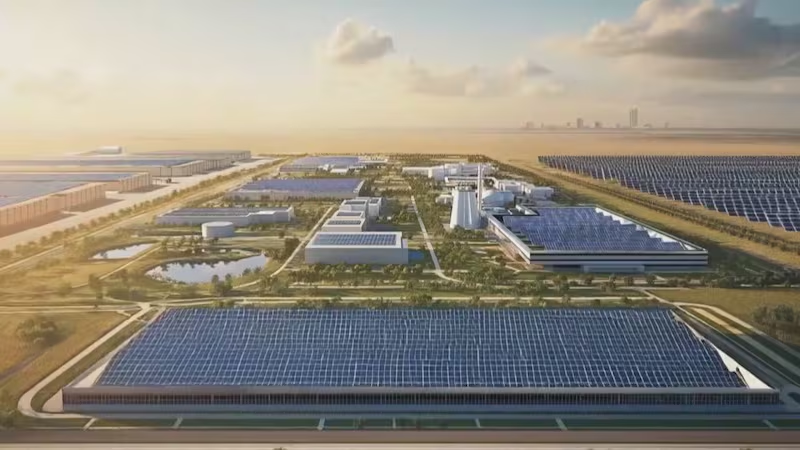
Voters are angry about their electric bills. A lot of them blame the massive AI data centers going up near their neighborhoods. House Republicans know it. They just can’t agree on what to do about it before November.
Republicans Have a Data Center Problem, and the Clock Is Running Out
Voters are angry about their electric bills. A lot of them blame the massive AI data centers going up near their neighborhoods. House Republicans know it. They just can’t agree on what to do about it before November.
Data centers used to be invisible. Not anymore.
They sit behind chain link fences on the edge of suburbs nobody thought much about. Now those same suburbs are producing some of the loudest voter anger of the entire midterm cycle. Electric bills are up. Water tables are stressed. Big, humming buildings are going up faster than anyone can explain what they actually do. And Republicans, who spent most of this year cheering the AI boom, are suddenly the ones holding the bag.
That’s the tension running through a story POLITICO broke this week: House Republicans are scrambling for a coherent answer on data centers before voters go to the polls, and party leadership is nowhere near as eager to act as the members whose seats are actually on the line.
The Committee That’s Actually Moving
Here’s the split. President Trump has spent the year championing data centers as the backbone of American AI dominance. Meanwhile, the members who have to face voters in six weeks are fielding calls from constituents furious about rate hikes tied directly to the power those facilities pull off the grid. Same party. Two very different incentives.
Rep. Brett Guthrie, the Kentucky Republican who chairs the House Energy and Commerce Committee, thinks he’s found the bridge. His bill, the Ratepayer Protection Act, would put teeth behind a voluntary compact the White House already got more than 300 utilities, electric cooperatives, and AI hyperscalers to sign. The idea is simple enough to fit on a bumper sticker: the companies building the data centers should pay for the energy costs they create, not the homeowner down the street.
It’s not just a Republican talking point. The underlying bill, sponsored by Colorado Republican Gabe Evans and Florida Democrat Kathy Castor, cleared committee in July on a 52 to 0 vote. Zero opposition. Both sponsors happen to be running in competitive races this fall, which tells you plenty about where the political wind is blowing.
So Why Isn’t It Moving Faster?
Good question. Guthrie wants Speaker Johnson to schedule a floor vote. Soon. The House is barely in session after Labor Day, mostly to handle a budget resolution, which leaves a narrow window before members head home to campaign. Leadership hasn’t committed to a date. That hesitation is the whole story in miniature: a functioning, bipartisan, already voted-on bill sitting in limbo while the clock runs down.
Democrats aren’t exactly cheering from the sidelines either. Frank Pallone, the committee’s top Democrat, called for an outright moratorium on new data centers back in June. He wants something with more bite than a ratepayer bill. Guthrie thinks that’s overkill. Pallone thinks Guthrie’s bill doesn’t go far enough. Welcome to Congress.
The GOP Leadership Bet
Pass something narrow and bipartisan, keep Trump’s data center enthusiasm intact, and hope it’s enough to blunt the backlash without picking a fight with the industry.
The Vulnerable Members’ Bet
Get a bill to the floor now, put a real vote on the record before November, and give anxious voters something concrete to point to.
Texas Is the Preview
Watch Texas if you want to see where this goes next. Governor Greg Abbott called his state the “epicenter of AI development” back in November. By August, he’d paused new data center approvals pending a regulatory audit. That’s a real reversal, not a messaging tweak.
Then Ken Paxton, running for Senate, rolled out something he’s calling the Texas First Data Center Plan. It blocks facilities that could rely on Chinese technology and makes companies liable if their AI systems put children at risk. Whether or not the policy details hold up, the signal is unmistakable: even in the reddest of red states, “unleash AI at any cost” isn’t a winning message anymore.
Why this matters beyond Congress: data centers aren’t a niche tech story anymore. They’re showing up on the same list as grocery prices and gas prices when voters get asked what’s squeezing their budget. A district that hosts one of these facilities, or sits on the grid feeding one, is a district where this fight is no longer abstract.
Six weeks. That’s what’s left.
Six weeks to schedule a vote, pass something, and actually campaign on having done it. Or six weeks of dithering, followed by a lot of candidates trying to explain to angry constituents why nothing happened. Guthrie’s betting on the former. Leadership hasn’t shown its hand yet. And every day that passes without a floor vote is a day Democrats get to ask a very simple question on the doorstep: if this bill had zero votes against it in committee, what exactly is the holdup?
Energy policy is shaping up to be one of the defining fights of this year’s midterms.
Follow more coverage in the Sustainable Action Now politics section.