
In late October, fifteen young Canadians who were as young as seven when they first filed suit will walk into a federal courtroom in Vancouver to argue that their government’s climate policy is violating their constitutional rights. No youth-led case has ever gone this far in Canadian legal history.
Seven Years, Fifteen Plaintiffs, One Trial: Canada’s First Youth Climate Case Finally Reaches Court
In late October, fifteen young Canadians who were as young as seven when they first filed suit will walk into a federal courtroom in Vancouver to argue that their government’s climate policy is violating their constitutional rights. No youth-led case has ever gone this far in Canadian legal history.
Most lawsuits that get dismissed on a pretrial motion stay dismissed. La Rose v. His Majesty the King did not. Filed in October 2019 by fifteen young Canadians ranging from seven to nineteen years old at the time, the case was thrown out by a Federal Court judge in 2020, who ruled that the plaintiffs’ claims were too broad and diffuse to be decided in court. Most legal teams would have treated that as the end of the story. This one appealed instead, and on October 26, seven years after the case was first filed, it finally goes to trial in Vancouver.
The plaintiffs, who come from seven provinces and one territory, are arguing that federal climate legislation violates their rights to life, liberty, and security of the person under Section 7 of the Canadian Charter of Rights and Freedoms. They are not asking the court to award damages. They are asking a judge to order the federal government to adopt a science based Climate Recovery Plan, one that would bring Canada’s greenhouse gas emissions in line with what climate scientists say is actually necessary to protect their generation’s future.
How a Dismissed Case Became a Trial
The path from filing to trial took most of a decade, and very little of it was smooth. After the 2020 dismissal, the plaintiffs appealed to the Federal Court of Appeal, which ruled in December 2023 that the case could proceed, reviving claims the lower court had rejected. The plaintiffs filed an amended statement of claim in May 2024, and by that December, the Federal Court of Canada had formally confirmed a trial date and allocated eight weeks of court time in Vancouver, a scheduling commitment that signals how seriously the court is treating the underlying legal questions.
A legal team including Our Children’s Trust, West Coast Environmental Law, Arvay Finlay, Tollefson Law, and the Pacific Centre for Environmental Law and Litigation has represented the plaintiffs throughout. That kind of sustained, multi-organization legal support over seven years is itself unusual, reflecting how significant environmental and legal advocacy groups view the case’s potential reach well beyond the fifteen individual plaintiffs bringing it.
Who the Plaintiffs Are
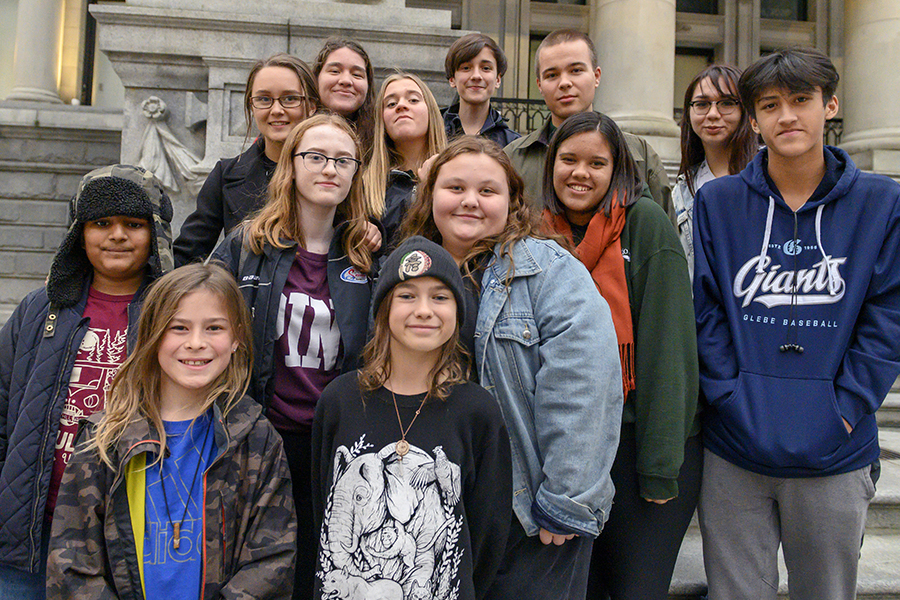
The fifteen plaintiffs, among them Sierra, Cecilia, Sophia, Zoe, Sáj, Haana, Lauren, Montay, Mikaeel, Madeline, Maddy, Albert, Sadie, Kira, and Leandrea, were still children when the case began, drawn from communities as geographically distant as Vancouver Island and the Northwest Territories. Each has described living with direct, personal effects of climate change, from wildfire smoke to disrupted access to traditional land and food sources, effects their legal team argues are not hypothetical future harms but present, documented ones.
That distinction, between climate change as an abstract future risk and climate change as a present, personal harm, sits at the legal heart of the case. Canadian courts have historically been reluctant to treat broad government policy failures as the kind of specific, identifiable harm that a Charter challenge requires. The 2023 appellate ruling that revived this case turned in part on the argument that the plaintiffs’ claims were specific enough, tied to identifiable federal legislation and its measurable effects, to actually be heard on their merits rather than dismissed as too diffuse to litigate.
What’s Actually Being Asked of the Court
Unlike many high profile climate lawsuits, this case is not seeking financial compensation. The plaintiffs are asking the Federal Court to declare that current federal climate policy violates their Charter rights, and to order the government to implement a Climate Recovery Plan grounded in what climate science identifies as necessary to protect a livable future. If a judge grants that order, it would mark the first time a Canadian court has directed the federal government’s climate policy on constitutional grounds, a outcome with implications that would likely extend well beyond the fifteen plaintiffs who brought the case.
Why this trial is being closely watched internationally: youth-led climate litigation has produced mixed results worldwide, from a landmark 2024 ruling by the European Court of Human Rights in favor of Swiss climate plaintiffs to dismissed cases in other jurisdictions. A Canadian ruling in the plaintiffs’ favor would add significant weight to the argument that courts, not just legislatures, have a role to play in enforcing climate accountability, and would likely be cited in similar litigation elsewhere.
How the Public Can Follow the Trial
Organizers with Our Children’s Trust have built a public facing schedule around the trial’s opening, treating it as a moment worth marking rather than a private legal proceeding. A public webinar on October 7 will feature one of the youth plaintiffs alongside members of the legal team, offering a firsthand account of the case ahead of the trial’s start. On October 26 itself, supporters are gathering outside the Federal Court of Canada in Vancouver as the plaintiffs arrive, with a watch party planned at the Vancouver Art Gallery and an evening rally following the day’s proceedings.
Whatever the outcome, the trial itself represents a milestone rarely reached in youth-led climate litigation anywhere in the world: an actual courtroom hearing on the merits, after years spent simply fighting for the right to be heard at all. For the fifteen plaintiffs, some of whom have grown from children into young adults over the course of this litigation, October 26 marks the end of one long fight and the beginning of another, considerably shorter one, inside the courtroom itself.
A generation of young people is increasingly turning to the courts when legislatures move too slowly on climate.
Follow more coverage in the Sustainable Action Now youth section.