They can’t vote. They didn’t cause this crisis. But they are standing up anyway, for Wisconsin’s waters and climate, and for every child who will inherit the world we leave behind.
Fifteen Wisconsin Kids. One Constitutional Fight. A Future That Belongs to Them.
They can’t vote. They didn’t cause this crisis. But they are standing up anyway, for Wisconsin’s waters and climate, and for every child who will inherit the world we leave behind.
| 15 Young plaintiffs in Dunn v. Wisconsin | 8 yrs Age of youngest plaintiff, Caroline | 2X Matched donations through WHEN Justice | Now The case is entering its next stage |
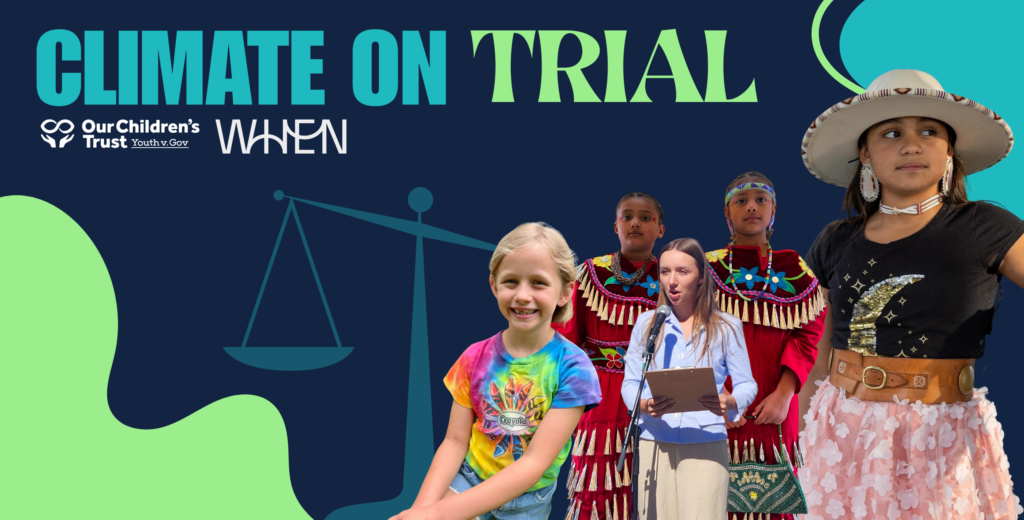
Today, the story of fifteen Wisconsin children fighting for their constitutional right to a livable future comes to life on screen. Climate on Trial is a new short documentary that takes you inside the lives of the young people at the heart of Dunn v. Wisconsin Public Service Commission, a landmark case in which children whose lives have already been shaped by climate change are demanding that their state government acknowledge the crisis and account for it in the decisions it makes on their behalf. These are not abstract plaintiffs. They are kids who love their state, love the outdoors, and are refusing to sit back while decisions about their future are made without them.
CLIMATE ON TRIAL
Watch the film. Get inspired. Share it widely. These young people need our community behind them.
What These Kids Are Actually Arguing in Court
Dunn v. Wisconsin Public Service Commission is a constitutional case brought by fifteen young Wisconsin residents against the state agency responsible for regulating the energy utilities that shape Wisconsin’s air quality and climate future. The plaintiffs argue that the Wisconsin Public Service Commission has been making consequential decisions about the state’s energy infrastructure, including approvals for gas-fired power plants that emit the pollutants driving both local air quality crises and the broader climate crisis, without adequately accounting for the documented dangers those decisions impose on the children who will live with their consequences for the rest of their lives. The constitutional argument centers on the rights of young people to a government that does not make decisions on their behalf that knowingly compromise their health and their future.
The case sits within a growing international and domestic movement of youth climate litigation, in which young people are using the courts to demand that governments and regulatory bodies treat climate change not as an abstract future concern but as a present constitutional matter with immediate consequences for identifiable individuals. What distinguishes Dunn v. Wisconsin in the landscape of these cases is both the specificity of the harm claims, which connect regulatory approvals to documented health consequences affecting named plaintiffs right now, and the youth of the plaintiffs themselves, including an eight-year-old who was already carrying the consequences of those regulatory decisions in her daily life before the case was ever filed.
Meet the Kids at the Heart of This Case
The documentary introduces the people behind the case names and filing documents, and that introduction is the most important thing it does. These are not actors in a lesson about climate change. They are children living specific, documented consequences of the decisions being challenged in court, and their stories are specific enough to resist the kind of abstraction that allows climate policy debates to proceed without any human face attached to what is actually at stake.
Caroline
Caroline is eight years old and keeps an inhaler close by because the air she breathes in Wisconsin has become dangerously polluted by wildfire smoke and emissions from gas-fired power plants. She is the youngest plaintiff in the case and one of the clearest examples of the immediate, present-tense harm that the documentary was designed to make visible. The Wisconsin Public Service Commission did not consider Caroline when it approved the energy infrastructure that is affecting her breathing. This case argues that it should have.
Kaarina
Kaarina is the named plaintiff whose name the case formally carries. Her family lived through a massive rockslide connected to the increasingly extreme weather events that climate scientists have documented as a consequence of the accelerating climate crisis. The rockslide forced her family to move. The displacement is real. The connection between the regulatory decisions being challenged and the conditions that produced the rockslide is the legal and evidentiary argument at the heart of the case, and Kaarina’s story is what makes that argument human rather than purely technical.
Tyler, Waazakone, Mukademigwan, and Gookoonz
These four siblings are fighting to protect the Indigenous cultural traditions that connect them to their community and to the land they call home. Their participation in the case adds a dimension that purely health-focused climate litigation often underrepresents: the harm that environmental degradation causes to Indigenous communities whose cultural identity, ceremonial practices, and intergenerational knowledge systems are inseparable from the health of the land and water they have been connected to for generations. The disruption of those connections by climate-driven ecological change is a documented and serious harm, and these four young plaintiffs are putting it before a Wisconsin court.
About WHEN Justice
WHEN Justice (Wisconsin Health and Environmental Network for Justice) is the partner organization providing legal and advocacy support for the young plaintiffs in Dunn v. Wisconsin Public Service Commission. The case is now entering its next stage, and WHEN Justice has launched a fundraising campaign to power that work. Every donation made through the campaign link is currently being matched dollar for dollar for a limited time, effectively doubling the impact of every gift made before the matching period ends.
Why Youth Climate Litigation Matters More Than the Individual Cases
Dunn v. Wisconsin is one case in a global pattern of young people turning to the courts because the legislative and regulatory processes that were supposed to protect them have not. The pattern is broad and accelerating. In the United States, Held v. Montana produced a landmark 2023 ruling in which a Montana court found that the state’s failure to consider climate impacts in its energy permitting process violated the constitutional rights of young plaintiffs. In Juliana v. United States, youth plaintiffs argued for decades for federal recognition of a constitutional right to a stable climate, keeping the issue in courts and public attention through a period when federal legislative action was stalled. Internationally, the European Court of Human Rights ruled in 2024 that Switzerland’s inadequate climate policy violated the human rights of older women plaintiffs, establishing a precedent that advocates around the world immediately began applying to cases involving younger plaintiffs with longer futures at stake.
The theory that connects all of these cases, and that the fifteen Wisconsin plaintiffs are advancing in their own state’s courts, is not complicated: governments have obligations to the people they govern, those obligations include not making decisions that knowingly impose serious harm on identifiable members of the public, and children who will live for decades with the consequences of decisions being made right now are the most identifiable possible members of the public with the most direct stake in those decisions. The fact that children cannot vote, cannot lobby, cannot donate to political campaigns, and have no formal mechanism for participating in the regulatory processes that determine their futures is precisely what makes the courts the appropriate venue for their claims. The courthouse may be the only door that opens to people who have no other access to the decisions being made in their name.
The documentary’s contribution to this legal and political landscape is to make the human reality of the case impossible to set aside. Regulatory proceedings produce documents. Courts produce opinions. Documentaries produce faces and voices and the specific details of specific lives that allow the people watching to understand what is actually at stake in language that legal argument rarely provides. The lawyers working on the case and the public health expert featured in Climate on Trial provide the analytical and evidentiary framework. The children provide the reason it matters.
Three Ways to Be Part of This Right Now
Watch the Documentary
The film is embedded above and available on YouTube. Watch the full documentary. Meet Caroline, Kaarina, Tyler, Waazakone, Mukademigwan, and Gookoonz. Let their specific stories be the thing you carry into conversations about climate and children’s rights.
Donate to WHEN Justice (Gifts Are Matched Right Now)
The case is entering its next stage, and WHEN Justice has launched a dollar-for-dollar matching campaign to fund that work. Every donation made through the campaign link is doubled for a limited time. Even a small gift becomes a larger contribution to the legal work that keeps these fifteen kids in court fighting for what should belong to all of us.
Share the Film and Their Story
If you are not in a position to donate, sharing the documentary and the story of these fifteen young plaintiffs with your community is genuinely meaningful. Cases like this one succeed partly on their legal merits and partly on the breadth of public awareness surrounding them. Every person who watches, who knows, who talks about it makes the political and cultural environment around the case slightly more favorable to the outcome these kids are fighting for.
Support the Kids Fighting for All of Our Futures
WHEN Justice’s matching campaign turns every donation into double the support for the legal work that keeps Dunn v. Wisconsin moving forward. There are just a few days left to make your gift go twice as far. Only donations made through the campaign link will be matched.
Watch Climate on Trial SAN Youth and Climate CoverageCaroline has her inhaler. Kaarina found a new home after the rockslide. Tyler, Waazakone, Mukademigwan, and Gookoonz are still fighting for the land that connects them to who they are. All fifteen plaintiffs are doing something that most adults in their position would find difficult: they are standing up, in a formal legal proceeding, against a state government, for a future they have not yet been allowed to vote for. The least we can do is watch their story, share it, and, if we are able, make it twice as powerful with a matched donation before the window closes.
Sustainable Action Now: Our Youth and Climate Coverage
We cover the young people leading the fight for climate accountability and the cases, campaigns, and communities behind them. The next generation did not cause this crisis. We cover them because they deserve to be heard.
Visit SAN Youth and Politics Coverage