
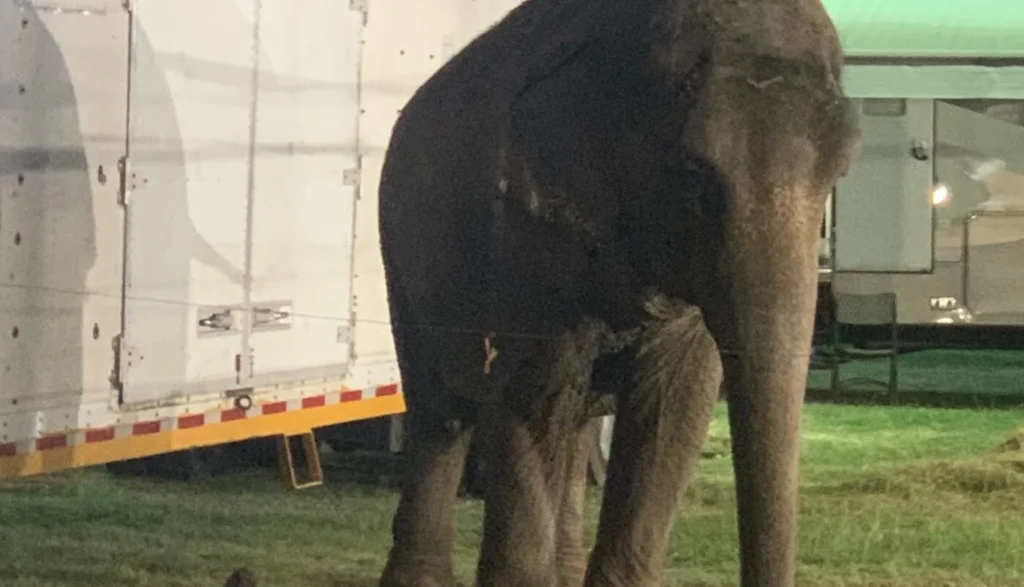
There are moments when a single animal’s story becomes the clearest possible window into a system of cruelty that the public has been conditioned, over generations, not to see. Okha is one of those animals, and her story is one of those windows. She is 56 years old. She was born in India in 1970. She was captured as a baby — torn from her herd, from her mother, from the only world she had ever known — and shipped across the world to be sold to an American circus family. She has spent every year since in chains, in trailers, in parking lots, in arenas full of strangers who paid to watch her perform tricks that no wild elephant would ever choose to perform. She has outlived every elephant companion she was ever given. She is, right now, in 2026, still working. Still being loaded into a truck. Still being hauled from city to city. Still being managed with a bullhook — a metal-tipped implement designed to control large animals through the threat and infliction of pain.
Okha the elephant is widely recognized by animal welfare organizations as one of the most prominent and prolonged examples of captive elephant abuse currently active in the United States. She is not a historical case study. She is not a cautionary tale told in the past tense. She is a living animal enduring ongoing harm right now, and the organizations fighting to free her — including PETA and CompassionWorks International — are working against a system that has been profiting from her suffering for more than half a century.
This is her story. And it is a story about far more than one elephant.
From India to the Circus: A Life Stolen Before It Began
He rents Okha out to traveling operations including Loomis Bros. Circus and various Shrine circus productions, functioning as an animal supplier to whoever is willing to pay for her appearance.
The nature of this arrangement matters and deserves to be named clearly. Okha is not an attraction cared for by the organization whose name appears on the marquee. She is livestock — in the most literal commercial sense of that word — leased to different operations throughout the year, loaded and unloaded from trailers, integrated into shows she did not choose and cannot leave, and returned to the next booking on the calendar when each engagement ends. Her life is structured entirely around the logistics of her commercial utility to a network of traveling entertainment operations. Her own needs, her own species-specific behaviors, her own social requirements — none of these have ever been the organizing principle of her existence. They have been systematically denied for fifty-six years.
What a Lifetime of Circus Life Has Done to Her
Elephants are among the most cognitively complex and emotionally sophisticated animals on earth. The scientific understanding of elephant cognition, social structure, and emotional life has deepened substantially over the past three decades, and what it has revealed is a species that forms deep, lasting bonds with other elephants across generations; that mourns its dead; that communicates through a range of vocalizations, tactile contact, and subsonic rumbles too low for human ears to detect; that demonstrates self-awareness, empathy, long-term memory, and problem-solving at levels that are exceptional even among non-human animals. Elephants need each other in ways that are not metaphorical or sentimental. Social connection is a biological necessity for their psychological functioning. Deprive an elephant of contact with other elephants and you do not simply leave them alone — you damage them in ways that science can now measure and document.
Okha has been alone, without any contact with another elephant, for four years.
Until 2022, she had two companions — Kosti and Megue — who traveled with her and provided the minimal social contact that any elephant in circus conditions could access. That year, Franzen retired both of them. Kosti went to a zoo. Megue went to a theme park. Okha was left behind. She has been in solitary confinement ever since, isolated from her own species in a way that veterinary and behavioral experts in elephant welfare consistently identify as one of the most severe forms of psychological harm that can be imposed on this animal. A lone elephant in a circus trailer is not simply a working animal. She is a social being in a state of chronic deprivation so fundamental that it constitutes a form of ongoing psychological torture.
The physical consequences of Okha’s lifetime in captivity are equally severe and increasingly visible. She is morbidly obese, scoring a 5 out of 5 on physical body condition charts — a rating that indicates dangerous excess weight relative to skeletal structure. The cause is straightforward: a lifetime of extreme confinement in small pens and transport trailers provides virtually no opportunity for the range of movement that elephants’ bodies require. Wild elephants walk up to fifty miles a day. Okha lives in spaces measured in yards, not miles, and has for decades. The accumulated physical consequences of that confinement are now impossible to hide. She visibly staggers. She struggles to stand. She struggles to lie down. Arthritis, which is endemic in captive elephants of advanced age, compounds the weight problem and the mobility limitations into a cycle of physical suffering that each additional year in her current conditions will only make worse.
PETA President Tracy Reiman has described the situation directly: Okha staggers about in obvious pain, still in servitude to her abuser. That description is not rhetorical. It is the observable physical reality of what five and a half decades of circus life have produced in this animal’s body.
Despite all of this — the morbid obesity, the arthritis, the mobility impairment, the four years of complete social isolation — Okha continues to work. She is loaded into a truck and transported thousands of miles across the country to appear at circus shows. She gives rides to large groups of children. She performs tricks. For much of her career, she was known for one of the more dangerous of those tricks: balancing on top of a small ball, a physically demanding maneuver that requires the animal to put enormous concentrated stress on joints that are already compromised. She is not performing these acts voluntarily. She is performing them because she has been trained — through the systematic use of pain and fear — to comply with commands, and because noncompliance produces consequences she has learned, over fifty years of conditioning, to avoid.
The Bullhook: What It Is and Why It Is Still Legal
The primary tool used to manage Okha and other circus elephants in the United States is a bullhook — a rod with a sharp metal hook at one end, designed to be pressed, jabbed, or struck against sensitive areas of an elephant’s body to produce movement in a desired direction. The elephant’s skin is thick in most areas but extremely sensitive in others — behind the ears, around the eyes, on the underside of the trunk, and at joint creases — and the bullhook is specifically designed to exploit that sensitivity. It is, by design, a pain-compliance device.
The use of bullhooks on captive elephants has been a focal point of animal welfare advocacy for years, and a growing number of cities and states have enacted laws restricting or banning their use. These bans are meaningful but incomplete, because the traveling nature of the circus industry means that elephants move across jurisdictions with different rules and that enforcement in any given location is limited by the brief duration of each visit.
Brian Franzen’s operation has not operated without scrutiny from federal authorities. The USDA has documented violations of the Animal Welfare Act by his exhibitor operation, including failures to maintain transport trailers to required standards and serious deficiencies in animal care. A whistleblower has reported that Okha was confined in a truck for 20 to 21 hours per day while on tour — a period of confinement so extreme that it would be considered inhumane by any reasonable animal welfare standard, for any species. Franzen himself has been charged with felony cruelty to animals, and footage exists of him striking an elephant in the face with a bullhook. This is the documented record of the man who has owned Okha for her entire American life, and to whom she is still legally subject today.
The Movement to Free Her: Progress, Victories, and the Work That Remains
The campaign to free Okha is active, coordinated, and producing results — though not yet for Okha herself.
PETA and CompassionWorks International have made her case a centerpiece of their broader campaign against circus animal exploitation. Advocacy groups are actively tracking her transport route and pressuring specific venues, fairgrounds, universities, and community organizations to cancel bookings that include her or other elephant acts. This venue-by-venue pressure campaign has proven effective as a strategy. When enough bookers decline to host an animal act, the circuit that act travels becomes economically unviable. The goal is not merely to protest — it is to systematically shrink the market for what Okha’s exhibitor is selling until the commercial logic of continuing to keep her on the road collapses.
The results of this approach are visible in the broader industry. In 2026, Jordan World Circus dropped elephants from its lineup entirely following a hard-hitting PETA campaign that included dozens of protests at tour stops across the country and more than 600,000 emails from supporters. The Mysterious Circus dropped all animal acts last year under similar public pressure. These are genuine victories. They represent elephants who are no longer being loaded into trailers and hauled from city to city. They demonstrate that sustained, organized, public pressure on the institutions that book and host these acts produces the structural change that cannot be achieved through protest alone.
But Okha is still in the Loomis Bros. Circus and Shrine circus circuit. She is still owned by Franzen. She is still alone, still working, still being managed with a bullhook in a body that can barely carry her own weight. The pressure campaign is working in the aggregate. For Okha specifically, it has not yet produced the outcome she needs.
The ultimate goal of the organizations fighting for her is her transfer to an accredited, open-space elephant sanctuary. There are several such sanctuaries in the United States, operating under professional wildlife management standards, where elephants who have spent decades in captivity can live out their remaining years in naturalistic habitats with access to large spaces, varied terrain, and — most critically — the company of other elephants. The Elephant Sanctuary in Tennessee and the California-based Performing Animal Welfare Society sanctuary are among the facilities that provide this kind of genuinely rehabilitative environment for former captive elephants. These are not zoos. They do not charge admission. They do not require the elephants to perform. They exist specifically to provide what captive elephants have been denied throughout their working lives.
At 56 years old, Okha is at an age when elephants in the wild would be among the most respected members of their herds — older matriarchs whose accumulated knowledge of migration routes, water sources, and social dynamics makes them essential to the survival and functioning of the group. The tragedy of her situation is not simply that she has suffered for fifty years. It is that the animal she was born to be — an intelligent, social, experienced elder of her species — has never been allowed to exist. She has been a circus prop since before most of the people reading this article were born, and she is still being treated as one today.
What Shrine Circuses Need to Answer For
Okha’s story cannot be told fully without naming the role that Shrine circuses have played in sustaining the market for captive elephant acts. The Shriners — the fraternal organization whose hospital fundraising work is widely known and respected — have for decades sponsored traveling circus events that feature animal acts, including elephants managed by some of the most documented abusers in the industry. Brian Franzen’s operation has appeared at Shrine-sponsored events multiple times, exposing Okha to audiences who may not have known the background of the exhibitor they were helping to finance.
The disconnect between the Shriners’ charitable identity and the animal welfare record of the exhibitors their events have hired is significant and has been a focus of sustained advocacy. PETA and other organizations have repeatedly called on Shriners International to use its authority over local chapter events to ban animal acts entirely across the organization. That call has not yet produced a universal policy change, though some individual chapters have moved away from animal acts under local advocacy pressure.
The economic math of this situation is straightforward. Shrine circuses attract audiences partly because of the spectacle of performing animals. Elephants in particular have historically been among the most commercially compelling attractions in traveling shows. Every ticket sold to a Shrine circus featuring Okha is a direct financial contribution to the system that keeps her in chains, and that connection runs through a charitable organization that most attendees associate with children’s hospitals rather than animal exploitation.
The Broader Context: Elephants in Captivity and the End of an Era
Okha’s case exists within a broader arc of change that is moving, however slowly, in the right direction. Ringling Bros. and Barnum & Bailey Circus retired its elephants in 2016 and ultimately closed its doors entirely the following year, in part because of the sustained public rejection of animal acts that advocacy campaigns had been building for decades. A growing majority of Americans oppose the use of wild animals in entertainment. Legislation restricting or banning elephant acts and bullhook use has been enacted in cities and states across the country. The global consensus against wild animal circus acts has been hardening for years, with bans or severe restrictions now in place in the United Kingdom, Scotland, Ireland, Austria, Belgium, Finland, Malta, and dozens of other countries.
The American circus industry that once made elephants its defining spectacle has been contracting for years, and most of the elephants who remain in it are elderly animals who were captured from the wild in the 1960s and 1970s and have spent their entire lives in conditions that the current generation of Americans increasingly and correctly recognizes as unacceptable. These animals will not live forever. Each one who dies in a circus context rather than in a sanctuary represents a failure of the advocacy, the legislation, and the institutional will that could have gotten them out sooner.
Okha is one of those animals. She is 56 years old, and there is no certainty about how many years she has left. Every year she spends in Franzen’s operation is a year she will not spend in an open landscape, moving freely, in the company of other elephants, in conditions that reflect any meaningful standard of what an elephant’s life should look like.
What You Can Do Right Now
The campaign to free Okha depends on public engagement, and there are concrete actions available right now to anyone who has read this far and wants to contribute to it.
Contact venues in your area that host Loomis Bros. Circus or Shrine circus events and ask them directly to decline bookings that include elephant acts. PETA maintains an active action alert with specific venues to contact, and that list is updated regularly as Okha’s touring schedule becomes known. A polite, specific, personal message to a venue’s management — from a community member or potential patron — carries more weight than a form email, and venue cancellations are one of the most effective tools available in this campaign.
Contact Shriners International and your local Shrine chapter to communicate that Shrine-sponsored events that feature animal exploitation do not reflect your understanding of what the organization stands for, and that you would like to see a universal policy banning animal acts across all chapter events. The organization’s hospital work is genuinely valuable, and there is no reason that work needs to be financed by events that cause documented harm to elephants.
Follow and support PETA and CompassionWorks International, the organizations carrying the most active load of this campaign. Share their content. Donate to their work. Show up at protests if Loomis Bros. Circus or any other operation featuring Okha comes to your community. The venue pressure campaign works when the public shows up, and it works faster when more people are involved.
And tell Okha’s story. The most powerful force available in campaigns like this one is the expansion of public awareness about who these animals are and what is being done to them. Okha is not an abstraction. She is a 56-year-old elephant who was taken from her mother as a baby in India, shipped across the world, kept in chains for fifty years, and is still working today. Every person who knows that story is a person who will not buy a ticket to watch her perform, and who might make sure others don’t either.
She has been waiting 56 years for someone to free her. The pressure to make that happen is building. It needs to build faster.
Sustainable Action Now will continue covering the campaign for Okha’s release and the broader movement to end captive elephant exploitation in American entertainment.