

Somewhere inside the federal government, a document that was not supposed to become public has become public, and what it describes is one of the most significant shifts in American nuclear energy policy in decades. A leaked White House strategy paper, reported by Politico and subsequently confirmed through Energy Department communications, reveals that the Trump administration is formally moving away from Yucca Mountain as the nation’s designated permanent nuclear waste repository and replacing that four-decade deadlock with a new framework: find states that are willing to host nuclear waste storage and processing facilities, offer them economic incentives significant enough to make the proposition attractive, and build a new category of institution called a Nuclear Life-Cycle Innovation Campus that does considerably more than just store waste underground.
Five states have already signed non-binding agreements indicating initial interest in participating: Tennessee, Utah, Louisiana, Idaho, and Oklahoma. And in Illinois, municipalities in Grundy County and Will County, which have lived alongside active nuclear reactors for decades, have independently expressed willingness to expand their existing nuclear footprint to host these multi-use campuses. The politics of nuclear waste disposal, which have been largely frozen since the Obama administration halted the Yucca Mountain project in 2011, are moving again, and the direction they are moving in is worth examining carefully from every angle that matters: the energy security angle, the climate angle, the environmental justice angle, and the fiscal and technological reality of what the plan actually proposes.
At Sustainable Action Now, we cover energy and climate together because they are not separate conversations. The nuclear waste question sits at the intersection of both: it involves a low-carbon electricity source whose long-term viability depends on solving the waste problem that it has been deferring for 80 years, and it involves environmental and public health risks that do not distribute themselves evenly across populations or across geography.
Why America Has So Much Nuclear Waste
Before evaluating what the administration’s plan proposes, it is worth understanding the basic science and logistics of why the waste problem exists and why it has been so difficult to resolve.
Nuclear power plants generate electricity through fission, the process in which uranium atoms are split inside a reactor, releasing heat that boils water into steam that spins turbines to produce electricity. The fuel for this process consists of small pellets of enriched uranium-235 packed into long metal tubes called fuel rods. Over the course of three to six years of operation, the uranium in the fuel rods becomes depleted enough that it can no longer sustain the fission chain reaction efficiently. At that point, the rods are classified as spent nuclear fuel and are removed from the reactor.
The critical fact about spent nuclear fuel is that “spent” does not mean inert. The fission products created when uranium atoms split, the new atoms and isotopes that result from the reaction, remain intensely radioactive for periods that dwarf the entire span of recorded human history. Some of the isotopes in spent nuclear fuel will remain dangerously radioactive for tens of thousands of years. They emit ionizing radiation capable of damaging biological tissue, they generate significant thermal heat, and they require physical isolation from living ecosystems for time periods that make the concept of “safe storage” genuinely challenging to design for.
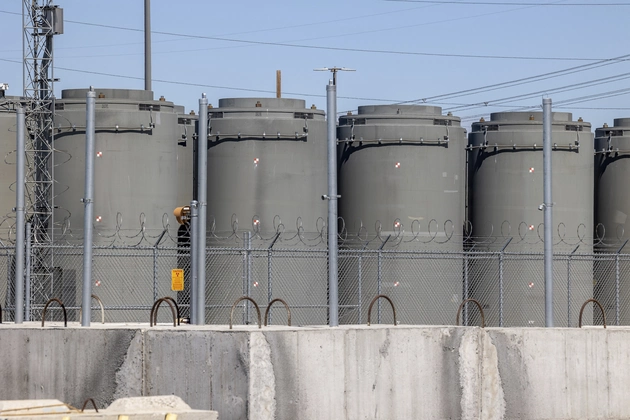
Currently, the United States has approximately 90,000 metric tons of spent nuclear fuel distributed across 35 states, stored at the sites of the commercial nuclear plants that generated it. Most of this fuel sits in two primary storage configurations: spent fuel pools, which are deep concrete and steel structures filled with water that provides both cooling and radiation shielding, and dry casks, which are heavy reinforced concrete containers that house spent fuel after it has cooled sufficiently in the pool. Both configurations are technically safe under current conditions and under current oversight frameworks. Neither was designed as a permanent solution. Both have been serving as indefinite holding strategies because the permanent solution has not been built.
The Yucca Mountain geological repository in Nevada was supposed to be that permanent solution. Federal law designated it as the nation’s sole permanent repository in 1987. The site was studied for decades, tens of billions of dollars were spent on scientific assessment and engineering design, and the conclusion of that work was that Yucca Mountain’s geology was suitable for the isolation of high-level nuclear waste for the required timescales. Nevada’s political resistance to the project, combined with shifting federal energy priorities and the Obama administration’s decision to defund the project in 2011, left it in legal and political limbo. The result is the situation that currently exists: 90,000 metric tons of waste in 35 states, going nowhere, accumulating as plants continue to operate.
What the Leaked Plan Actually Proposes
The strategy document that has become public describes three interconnected policy changes that together represent a genuine structural shift in how the federal government intends to approach nuclear waste disposal.
The first is the formal abandonment of Yucca Mountain as the sole designated permanent repository. This is not the first time an administration has moved away from Yucca Mountain in practice, but framing it as a formal policy departure rather than a funding decision is significant because it clears the legal path to pursue alternatives without the decades of litigation that any Yucca Mountain revival would have produced.
The second is the adoption of a consent-based siting model that inverts the previous approach. Rather than designating a repository site through federal authority and then managing the resulting political opposition, the administration is seeking states that proactively volunteer to host nuclear waste storage and processing infrastructure in exchange for federal economic packages that the document frames as substantial enough to be genuinely transformative for participating states. The consent-based model is not a new idea in nuclear waste policy circles; it has been recommended by expert panels and advocacy groups for decades as the approach most likely to produce a durable political outcome. The new element is the administration’s willingness to actually implement it and the economic scale of the incentives being offered.
The third and most novel element is the Nuclear Life-Cycle Innovation Campus framework, which represents a significant expansion of what “hosting nuclear waste” is being asked to mean. The previous model was essentially: states agree to accept waste, waste gets buried permanently underground, states receive some economic compensation. The new model proposes something considerably more ambitious: states agree to host a multi-function facility that combines consolidated interim storage of dry cask waste from around the country, active research into advanced reprocessing and recycling technologies that would reduce the total volume and radioactive lifespan of the remaining waste, and eventually deep geological disposal of whatever high-level waste remains after recycling. The campus model is designed to be an economic development anchor, not just a storage facility, and the economic projections attached to it are substantial enough to change the political calculus in states with significant existing energy infrastructure and workforce capacity.
The Five States and Why They Stepped Up
The geographic and demographic profile of the five states that have signed non-binding participation agreements reflects both the practical requirements of the campus model and the political economy of energy development in the United States in 2026.
Tennessee brings the deepest existing institutional infrastructure of any of the five states. Oak Ridge National Laboratory, established as a cornerstone of the Manhattan Project and operating continuously ever since as one of the nation’s premier energy research institutions, gives Tennessee a workforce of nuclear physicists, engineers, materials scientists, and specialized technicians that no new facility would need to develop from scratch. The state has lived alongside nuclear research infrastructure for eight decades, its regulatory and emergency response frameworks are calibrated to nuclear operations, and the economic relationship between Oak Ridge and the surrounding communities of east Tennessee is one of the most established examples of what a nuclear research campus looks like in practical terms.
Idaho’s participation is equally grounded in existing reality. The Idaho National Laboratory is the nation’s premier nuclear energy research and development center, currently serving as the primary testing ground for advanced reactor designs that represent the next generation of commercial nuclear power. Adding a waste consolidation and recycling campus to a state that already houses the facility testing the reactors that will produce future nuclear waste is a logical integration that the campus model was arguably designed to enable.
Utah’s participation is the most actively pursued of the five, driven by a state government that has made energy abundance a central political priority and has moved with unusual legislative and regulatory speed to position itself as the front-runner in the campus competition. Governor Spencer Cox’s “Operation Gigawatt” initiative has provided the political and administrative framework for the state’s nuclear ambitions, and the legislature has passed enabling legislation establishing a new Nuclear Energy Regulatory Office specifically to manage the pursuit. The economic case that Utah’s leadership has constructed around the campus proposal frames the projected $50 billion in private infrastructure investment and more than 10,000 high-paying engineering and technology jobs not as compensation for accepting an environmental burden but as the rationale for treating the campus as an economic development prize worth competing for.
Oklahoma and Louisiana bring different assets to the table. Both states have large, established industrial workforces centered on fossil fuel extraction, refining, and chemical processing, workforces with the mechanical, engineering, and safety culture competencies that a nuclear campus would require. The energy infrastructure corridors that already exist in both states, including the pipeline networks, electrical transmission systems, and heavy industrial logistics capacity that decades of oil and gas development have built, provide a foundation for nuclear campus development that would be difficult and expensive to replicate in a state without them.
Utah’s Specific Bid: Locations, Legislation, and the Salt Dome Case
Utah’s approach to the campus competition has been specific enough in its geographic proposals and legislative preparations to warrant particular attention, both as a model of how state-level nuclear ambition translates into operational planning and as an illustration of the geological and economic logic driving the consent-based siting process.
State geologists and energy planners have identified two primary target sites within Utah for different components of the campus model. Tooele County, situated just west of the Lakeside Mountains near the Great Salt Lake, has been identified as a potential location for surface-level consolidated storage and campus operations, and state leadership held a public rally there in March 2026 to formalize the state’s interest in the site. Millard County, located in the rural central part of the state, has attracted attention specifically for its potential as a deep geological disposal site because of the massive underground salt deposits that geologically dominate much of its subsurface.
The salt dome argument for Millard County is technically substantive. Natural salt formations are among the geological structures that nuclear waste disposal engineers have considered most seriously as host media for deep repository development, for reasons that have to do with their physical properties: salt is self-sealing, meaning that fractures and voids in a salt formation tend to close over time under the pressure of the surrounding rock, a characteristic that reduces the risk of groundwater infiltration. Salt formations also have low permeability, meaning they resist the movement of liquids through them, and they tend to be geologically stable over the timescales relevant to nuclear waste isolation. Millard County’s salt deposits already serve an industrial storage function: they house natural gas liquids and hydrogen for the nearby Intermountain Power Plant. Utah energy planners are arguing that the same geological logic that makes these formations suitable for hydrocarbon storage makes them suitable for nuclear waste isolation.
The state’s partnership with Valar Atomics to build an advanced micro-reactor at the San Rafael Energy Research Center in Emery County adds a further dimension to Utah’s nuclear positioning, connecting the waste question to the live reactor development question in a way that supports the campus model’s premise: that nuclear waste management and next-generation nuclear energy development are not separate problems but different aspects of the same energy life cycle.
The Questions That the Plan Leaves Open
The policy shift described in the leaked document is substantive enough to require engagement with its complications, and there are several that deserve explicit attention.
The consent-based model is a genuine improvement on the Yucca Mountain coercive model in terms of its political sustainability. A state that has voluntarily agreed to host a facility, in exchange for economic incentives it has accepted as adequate compensation, is a state that is less likely to generate the sustained political opposition that has rendered Yucca Mountain functionally unusable for the past 15 years. The consent-based model does not eliminate environmental and safety concerns, but it replaces a dynamic of imposed burden with one of negotiated agreement, which is better from a governance standpoint.
The environmental justice dimensions of the consent-based model require scrutiny. Economic incentives large enough to make nuclear waste hosting attractive tend to be most attractive in communities and states where alternative economic development prospects are most limited. The five states in this initial cohort are not the wealthiest or most economically diversified states in the union. The consent-based model’s reliance on economic incentives means that the geographic distribution of nuclear waste storage is likely to reflect economic disparities rather than purely geological suitability, which is a pattern with a well-documented history in the siting of undesirable land uses across American industrial history.
The reprocessing and recycling technology component of the campus model is promising in concept and substantially unproven at commercial scale in the American context. France operates a successful commercial reprocessing program that has significantly reduced the volume and radioactivity lifetime of its nuclear waste, and several other countries have implemented reprocessing at various scales. The United States, for reasons combining non-proliferation policy concerns, economics, and regulatory complexity, has not operated commercial reprocessing since the 1970s. The campus model’s promise of next-generation recycling research is credible as a research program. Its translation into operational commercial-scale reprocessing within a politically viable timeline is less certain.
The timelines involved in deep geological repository development are also substantially longer than the campus model’s framing suggests. Yucca Mountain required decades of scientific study and tens of billions of dollars in investment before it was effectively abandoned. A new deep geological repository developed at a willing state site would require similar timescales of site characterization, regulatory review, licensing, and construction. The interim consolidated storage component of the campus model addresses the near-term need to consolidate the 90,000 metric tons currently distributed across 35 states, but the permanent geological disposal piece is not something that can be delivered on a political timeline measured in years.
The Climate and Energy Connection
The nuclear waste question is inseparable from the question of nuclear power’s role in the clean energy transition, and that connection deserves explicit treatment in any comprehensive coverage of this policy development.
Nuclear power generates electricity without producing carbon dioxide during operation. A single large reactor produces roughly the same amount of carbon-free electricity as hundreds of acres of solar panels or wind turbines, at a reliability level that neither solar nor wind can currently match without storage systems that do not yet exist at sufficient scale. The Intergovernmental Panel on Climate Change has consistently included nuclear power in its scenarios for achieving net-zero emissions at the global scale, recognizing that the emissions challenge is large enough and the time window narrow enough that eliminating any low-carbon generation source without a fully adequate replacement in place carries real climate risk.
The unsolved waste problem has been one of the most significant political obstacles to expanded nuclear deployment in the United States, and the political obstacles to nuclear expansion matter for climate outcomes. If the administration’s campus model successfully creates durable, consent-based solutions for nuclear waste consolidation, reprocessing, and eventual permanent disposal, it removes a legitimate barrier to expanded nuclear deployment in a country that the climate math suggests needs more low-carbon generation capacity than current construction pipelines will deliver.
That case for nuclear is not a simple one, and at Sustainable Action Now we do not approach it as settled. The waste problem the campus model is designed to address remains genuinely difficult. The environmental justice implications of the consent-based siting approach require active attention. The reprocessing technology’s non-proliferation implications, specifically the concern that separated plutonium from reprocessing could be diverted to weapons use, are serious and require robust international oversight frameworks. And the economic case for new large nuclear plants in a market increasingly competitive from declining-cost renewables and storage is complicated in ways that the campus model does not fully resolve.
What the leaked document and the five states’ non-binding agreements represent is a genuine policy movement after 15 years of frozen politics. Whether that movement resolves into a workable long-term solution to America’s nuclear waste problem or produces a new set of deferred commitments is a question that the next several years of federal regulatory process, state legislative action, and site-specific environmental review will begin to answer.
The 90,000 metric tons of spent nuclear fuel currently distributed across 35 states are not going anywhere until it does.
Sustainable Action Now will continue covering nuclear energy policy, the clean energy transition, and the environmental and public health dimensions of energy infrastructure decisions across the United States.