

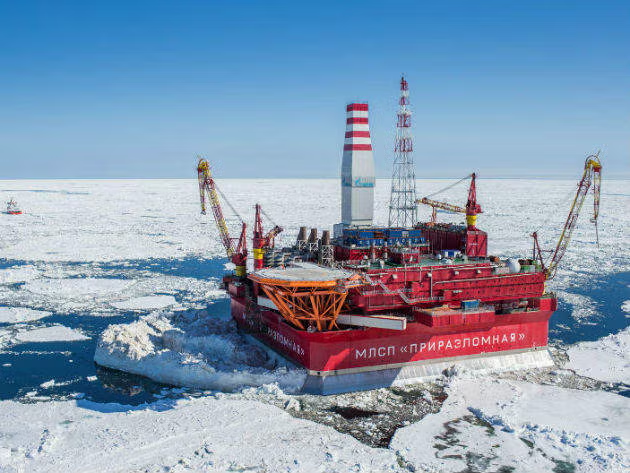
Norway supplies 30 percent of Europe’s gas. Its existing fields are declining. It is reopening wells shut down in 1998, dropping its renewable energy targets, and drilling into the pristine Barents Sea. This is what an energy security crisis looks like when you trade one geopolitical dependency for another.
Norway Is Drilling in the Arctic. Europe Is Letting It Happen.
Norway supplies 30 percent of Europe’s gas. Its existing fields are declining. It is reopening wells shut down in 1998, dropping its renewable energy targets, and drilling into the pristine Barents Sea. This is what an energy security crisis looks like when you trade one geopolitical dependency for another.
| 30% of EU and UK gas supplied by Norway | €1.8B invested to reopen 3 North Sea fields closed since 1998 | 2035 Norway’s target to maintain current production levels | 0 EU countries that have blocked Norwegian Arctic gas sales |
Norway used to call itself Europe’s green battery. The idea was appealing and not entirely wrong: a wealthy Scandinavian nation with vast renewable potential, sovereign wealth funds built on hydrocarbon extraction that were being gradually redirected toward the clean energy future, and a political culture that put climate policy at the center of its public identity. That framing has been quietly retired. Norway’s Energy Minister Terje Aasland told Reuters in August 2026 that his country no longer sees itself as Europe’s green battery, and that it will develop its Barents Sea oil and gas resources regardless of the European Union’s position on an Arctic drilling moratorium. The statement was made at ONS 2026, Norway’s biannual energy conference in Stavanger, before an audience of the people who will execute exactly that development. The green identity is not the priority right now. Security is.
How Europe Traded Russian Gas for Norwegian Gas and Called It Energy Independence
The architecture of European energy dependency shifted dramatically after Russia invaded Ukraine in February 2022. The EU’s systematic decoupling from Russian pipeline gas, which had supplied roughly 40 percent of the continent’s natural gas imports before the war, created a supply gap that had to be filled from somewhere. Norway was the most immediate available answer. Already the continent’s second-largest gas supplier, Norway moved into the top position as Russian volumes collapsed, and it has held that position ever since. Norway now meets approximately 30 percent of both EU and UK gas demand, and its gas production last year was near record levels while oil output reached its highest point since 2009.
The framing of this shift as European energy independence, which has been the dominant political narrative in Brussels and European capitals since 2022, obscures something important: replacing Russian gas dependency with Norwegian gas dependency is a geopolitical improvement but not a structural one. Europe is still organized around a fossil fuel supply chain it does not control, still exposed to the geological realities of a single dominant supplier’s production trajectory, and still one conflict or diplomatic disruption away from the kind of supply shock that the Ukraine war exposed. The Middle East shipping disruptions that have periodically complicated LNG import routes over the past two years are a reminder of how many chokepoints exist in a fossil-fuel-organized global energy system, and Norway’s response to that vulnerability, extracting more from its own territory as rapidly as possible, is the rational response of a supplier that sees its position as both temporary and strategically valuable.
The geological context that drives Norway’s urgency is equally important. Norway’s existing production fields on the continental shelf are mature. Without significant new exploration and the development of frontier resources, production from current fields is projected to decline meaningfully after 2030. Maintaining Norway’s role as Europe’s primary gas supplier through the 2030s and into the 2040s, which is the timeline that European energy security planning now requires, depends on finding and producing new resources at a pace that offsets that natural decline. The Norwegian continental shelf has finite reserves. The Barents Sea, whose exploration has been politically constrained for years, is where the government and its energy industry believe the replacement resources exist.
The Geological Cliff Norway Is Racing Against
Norway’s North Sea production fields are aging infrastructure. The same reservoirs that made Norway one of the world’s most important gas exporters in the 1990s and 2000s are naturally depleting, and without the development of new fields, Norwegian gas production would enter a steep and relatively rapid decline after 2030. The industry and government have identified two strategies to address this: reopening legacy fields that were closed as economically marginal when gas prices were lower, and pushing into frontier areas like the Barents Sea where exploration has been limited and reserves are potentially large. Both strategies are being pursued simultaneously and with significant urgency.
They Are Reopening Gas Fields That Were Shut Down in 1998. That Is the Scale of the Problem.
The most striking concrete illustration of Norway’s current energy posture is the decision to invest approximately €1.8 billion to reopen three North Sea gas fields, Albuskjell, Vest Ekofisk, and Tommeliten Gamma, that were shut down nearly 30 years ago. Operated by ConocoPhillips and its partners, these fields were closed in 1998 because their production had declined to the point where continued operation was not economically justified at the gas prices of that era. The combination of much higher gas prices, improved extraction technology, and urgent European demand has changed that calculation entirely. The three fields are projected to come online for UK and German supply by 2028, providing a meaningful but finite addition to Norwegian output.
Equinor, Norway’s state-backed energy company and by far its largest gas producer, has made a parallel strategic adjustment that reflects the same logic at the corporate level. The company had been moving toward a portfolio with a significantly larger renewable energy component, publicly committing to aggressive intermediate targets for clean energy investment as part of a positioning strategy that aligned with the European political environment of a few years ago. Those targets have been scaled back. Equinor has redirected investment priorities back toward extracting hydrocarbons from the Norwegian continental shelf, a decision that company leadership has described as a response to the energy security requirements of its primary customer base, which is European governments that need gas and need it reliably.
The technology piece of this industrial pivot is also worth noting. Norway is deploying advanced robotics, AI-assisted geological mapping, and aquatic drone technology to extract maximum output from fields that legacy production methods would have left partially depleted. The Norwegian government is even exploring the establishment of a university campus in Hammerfest, the remote northern city near the Equinor Melkoeya LNG facility, specifically to build the workforce capable of operating the frontier Barents Sea infrastructure that its longer-term strategy requires. This is not an improvised response to a short-term energy crunch. It is a structured national bet that fossil fuel production is Norway’s strategic asset for at least the next decade and possibly longer.
Norway Is Going to Drill in the Arctic. The EU Can Buy the Gas or It Can Not Buy the Gas.
The EU has since 2021 maintained a commitment to work toward an international moratorium on Arctic oil and gas drilling, grounded in the particular environmental sensitivity of Arctic ecosystems, the catastrophic potential consequences of a major oil spill in Arctic waters, and the broader climate argument that new Arctic fossil fuel development is inconsistent with net-zero emissions trajectories that the EU has committed to as a matter of law. That commitment is currently under review by the European Commission, which is revising its Arctic strategy in light of the energy security situation that the Ukraine war produced. The revision is not complete, and it is not clear what it will produce. What is clear is that Norway is not waiting for its outcome.
Energy Minister Aasland told Reuters that Norway would develop its Barents Sea resources regardless of the EU’s position on a moratorium, and that it was Norway’s sovereign right to make that determination. Equinor CEO Anders Opedal made the leverage position explicit: if the EU chooses not to buy Norwegian Arctic gas, Norway will sell it elsewhere. The Melkoeya LNG plant near Hammerfest can liquefy Barents Sea gas for global shipping. The oil can go to any market that will buy it. The only entity that would suffer from an EU decision not to purchase Norwegian Arctic production, Opedal argued, is European security.
The International Energy Agency’s executive director, Fatih Birol, has added institutional weight to Norway’s position by urging the EU to reconsider its opposition to new Arctic oil and gas development on energy security grounds. That a body whose stated mission includes accelerating the clean energy transition is arguing for relaxing restrictions on Arctic fossil fuel development is a measure of how severely the geopolitical disruption of the past four years has scrambled the priorities of energy institutions that previously maintained a clearer hierarchy of climate versus security concerns. Critics of the Barents Sea push note that new Arctic projects take many years to come online and would do little to address Europe’s near-term supply challenges, which is accurate but perhaps not the point. Norway is planning for 2030 and beyond, not for next winter.
Norway’s argument to EU officials about the environmental character of its Barents Sea operations is worth noting in full, because it is the argument that is apparently making some progress in Brussels: the parts of the Barents Sea where Norway has received drilling approvals are ice-free, unlike more remote Arctic regions, and are therefore less prone to the oil spill and environmental contamination risks that Arctic drilling elsewhere carries. The argument is not frivolous. The Barents Sea in its southern reaches is genuinely different from the high Arctic in environmental terms. But it is also an argument that could be applied progressively to justify successive expansions of drilling into areas that are currently more sensitive, and its acceptance as an EU policy basis would establish a precedent that environmental groups in Norway and across Europe have identified as the primary strategic concern.
The Green Paradox at the Heart of Norwegian Energy Policy
Norway has among the most ambitious domestic climate policies in the world. Its internal electricity system is almost entirely powered by hydroelectric generation. Its government has mandated electric vehicle adoption at rates that far exceed any other country. Its sovereign wealth fund, built on four decades of petroleum revenue, has divested from the most carbon-intensive industries and is increasingly oriented toward sustainable investment. And Norway simultaneously operates one of the largest per capita fossil fuel production industries on earth, exporting the vast majority of the oil and gas it produces to markets that burn it. The country has always acknowledged this paradox, but the energy security argument has given it a political cover it did not previously enjoy, and the current government appears to have stopped treating the paradox as a problem that requires resolution.
The Climate Cost of Europe’s Security Strategy Is Being Deferred. It Will Not Stay Deferred.
The climate implications of Norway’s fossil fuel expansion are not invisible to anyone making these decisions, and they are not being dismissed. They are being deferred, which is a different and more specific problem. The argument being made by Norwegian officials, Equinor’s leadership, and sympathetic voices in EU energy policy circles is that the transition to clean energy requires a bridging period of continued fossil fuel dependence, that Norway’s gas is the cleanest available bridge fuel in the sense of being less carbon-intensive than coal and more reliable than current renewable alternatives at the scale Europe requires, and that undermining European gas supply in the name of climate principles would produce near-term energy poverty and geopolitical instability that would ultimately set the energy transition back further than continued Norwegian gas production does.
That argument is not incoherent. It reflects a genuine tension in climate policy between the urgency of decarbonization and the political and physical reality of a world where the clean energy infrastructure that could replace fossil fuel supply does not yet exist at the scale the transition requires. The renewable buildout in Europe has been accelerating, solar and wind capacity additions have been significant, and battery storage is improving. But the grid stability and seasonal storage challenges that make renewable-only energy systems difficult to operate have not been solved at the scale of a continent-sized economy, and the honest answer to whether Europe could meet its heating and industrial energy needs through the 2030s without Norwegian gas is more complicated than clean energy advocates sometimes acknowledge.
What is also true is that the Barents Sea drilling push, the Equinor renewable energy target reduction, and the €1.8 billion investment in reopening 30-year-old fields are not decisions that can easily be reversed once the infrastructure, contracts, and supply relationships are in place. Energy infrastructure decisions create path dependencies that outlast the political conditions that produced them. A gas field that comes online in 2028 and is committed to long-term supply contracts with German utilities will be operating in 2038 whether or not the 2030 climate targets that Europe has committed to have been met, and its operation will be an argument against the additional investment in renewable capacity that would otherwise accelerate toward those targets.
The Trump administration’s contribution to this dynamic, which the Politico headline that prompted this article references, is indirect but real. The withdrawal of American climate leadership, the undermining of the international agreements and clean energy investment frameworks that were accelerating the renewable transition, and the political signal that fossil fuel expansion is once again an acceptable and even virtuous policy choice have collectively made the energy security argument for Norwegian gas expansion easier to advance in European political contexts that might otherwise have pushed harder against it. Norway’s fossil fuel pivot is not Trump’s creation, but it is easier to sustain in a world where the United States has stopped insisting that the transition away from fossil fuels is urgent.
The Case for Not Accepting the Bridge Fuel Frame as the Final Word
At Sustainable Action Now, we cover energy and climate together because they are not separate conversations. The Norwegian gas situation is a genuinely difficult case precisely because it does not resolve cleanly into a narrative of good guys and bad guys. Norway is not cynically sabotaging the climate transition. It is responding rationally to a security crisis that the invasion of Ukraine created, to market signals that reward fossil fuel production at a scale renewable energy cannot yet match, and to the legitimate needs of European populations that require heat, electricity, and industrial energy that the current renewable buildout cannot fully supply on the timelines available.
What we do not accept is the framing that energy security and climate ambition are genuinely incompatible, that the choice between them is binary, or that the current trajectory of expanded fossil fuel production is the only available response to Europe’s supply challenge. The clean energy investments that would reduce European dependence on Norwegian gas, including the continued acceleration of onshore and offshore wind, utility-scale battery storage, heat pump deployment, and the energy efficiency improvements that reduce demand are investments that produce energy security directly and permanently rather than by substituting one geopolitical dependency for another. The argument that those investments cannot happen fast enough to matter in the near term is an argument for urgency, not for abandoning the trajectory.
Norway’s 2035 production target, the reopened North Sea fields, the Barents Sea push, and the scaled-back renewable commitments at Equinor are all decisions that will shape European energy for decades. They are being made right now, in response to pressures that are real and in political contexts that reward security over climate. The question for every person who cares about the planet’s temperature trajectory is what political and economic pressure can credibly compete with the immediate, visceral pressure of energy insecurity in shaping those decisions. That is the actual work of the current moment, and it is significantly harder than the work of identifying what the right answer is.
Sustainable Action Now: Energy and Climate Politics
We cover the energy transition, climate policy, and the geopolitical forces shaping both. Norway is drilling in the Arctic. Europe is buying the gas. The clean energy alternative is being built, more slowly than it needs to be. We will keep covering all of it.
Visit SAN Politics and Energy Coverage