
The Tank Is Not a Home. The Science of Why Marine Captivity Is Cruel.
Orcas swim up to 100 miles a day. Dolphins navigate the ocean with a sonar system that bounces off concrete walls in a tank. Captive cetaceans exhibit the same psychological distress markers as humans in solitary confinement. Marine parks have known all of this for decades. The tanks haven’t changed.
| 100 mi Daily range of a wild orca | <0.0001% Of natural range represented by even the largest tank | Lifelong Bond of a wild orca pod that capture destroys | ~35 yrs Average wild orca male lifespan vs. early deaths in captivity |
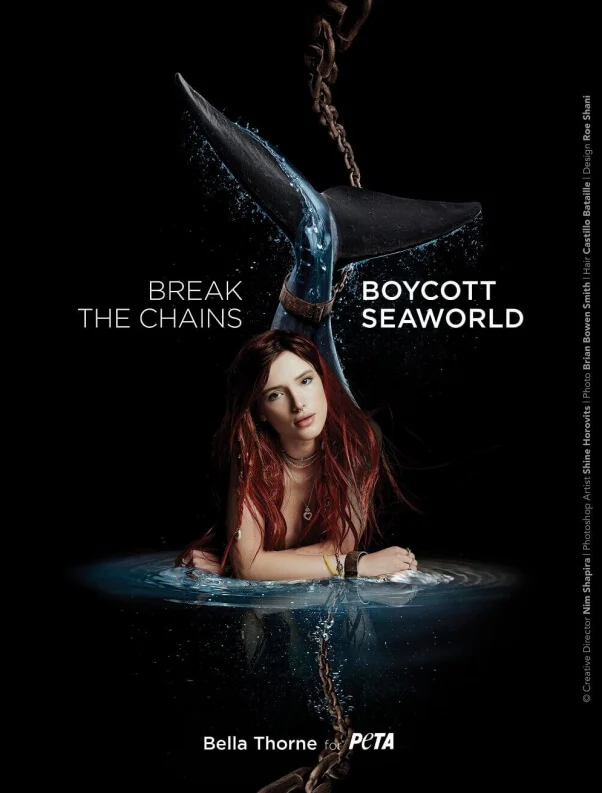
Bella Thorne Has Never Been Afraid to Say What SeaWorld Actually Is. Happy Birthday to Her.
Marine animals belong in the ocean, not in tanks. Bella Thorne has been saying it for years.
Singer, actor, and model Bella Thorne has used her platform to speak consistently and publicly against the captivity of dolphins, orcas, and other marine animals at parks like SeaWorld, and she has done it with the kind of directness that the subject deserves rather than the soft hedging that celebrity animal advocacy often defaults to. She says what the science says: marine animals belong in the ocean. The tank is not an enriched environment, not a sanctuary, and not a defensible alternative to the habitat these animals evolved over millions of years to inhabit. It is a concrete box with filtered water, and the animals in it suffer for it in ways that marine biologists have documented comprehensively across decades of research.
Celebrity advocacy on animal welfare issues gets dismissed easily, often as superficial or performative, and sometimes that criticism is fair. But Bella Thorne’s position on marine captivity is not difficult to maintain once you understand what captivity actually involves for the animals experiencing it. The harder position to maintain, on the basis of available evidence, is the one that defends marine parks as providing a legitimate and humane home for intelligent, socially complex, wide-ranging animals who swim a hundred miles a day in the wild and are given a tank that represents less than a ten-thousandth of a percent of their natural daily range. Here is what the science says about what those animals actually experience.
The Capture: What Actually Happens When a Marine Park Decides It Needs a New Animal
SeaWorld ceased capturing orcas in U.S. waters in the 1980s, largely under the pressure of public opposition that began building after the first generation of Blackfish-era documentation of what those captures involved. The captures did not end globally. Russia, Japan, and other countries have continued the practice, and the marine park industry worldwide continues to source new animals from wild capture operations, often through chains of resale and transfer that obscure the original acquisition method from the end buyer. What capture actually involves, the part that the park’s marketing about conservation and education tends not to describe in detail, is a coordinated marine operation using fast boats and nets to chase a pod of orcas or dolphins, separate younger animals from the group while the family attempts to protect them, haul the chosen animals out of the water, and transport them in crates to an entirely foreign environment.
Orcas and dolphins are among the most socially sophisticated animals on earth. They live in matriarchal family units called pods, and those relationships are lifelong in the same way that human family bonds are lifelong. Pod members communicate in individualized dialects that researchers have documented as culturally transmitted across generations, hunt cooperatively using strategies that have been passed down within families, and maintain social relationships that show measurable signs of grief when a member dies or is removed. The behavior of pods during capture operations, which researchers have observed and documented extensively, includes family members pursuing the capture vessels and calling to the young animal being taken. That is not anthropomorphism. It is observed behavior that has been filmed, studied, and published in peer-reviewed research.
The Bathtub: What a Tank Is to an Orca Who Swims a Hundred Miles a Day
A wild orca swims up to a hundred miles per day across open ocean, diving hundreds of feet deep in three-dimensional space that is effectively boundless relative to any animal’s navigational capacity. Dolphins cover tens of miles daily through varied open-water environments that provide constant novel sensory input, social encounters, prey to hunt, and physical challenges that their bodies evolved specifically to meet. The marine biologist and cetacean researcher comparison that has become standard in the field is the bathtub analogy: the largest tank that any marine park has ever built represents less than one ten-thousandth of one percent of an orca’s natural daily home range. A human being confined to a bathtub for life would experience psychological devastation that we would recognize immediately as extreme cruelty. The spatial relationship between the tank and the animal’s needs is the same.
The physical consequence of spatial confinement that is most visually apparent to the public, and that marine parks have consistently struggled to explain away, is dorsal fin collapse in captive orcas. In the wild, a male orca’s dorsal fin stands upright and can reach six feet tall, supported by the dense, fibrous connective tissue of an animal that swims constantly through open-ocean water pressure in varied directions and depths. In captivity, where animals swim in circles in a tank, the dorsal fin collapses to one side under its own weight, unsupported by the pressure dynamics of natural swimming patterns. Virtually all captive male orcas develop collapsed dorsal fins. In the wild, the condition occurs in fewer than one percent of the population and is associated with injury or illness. At SeaWorld and similar parks, it is effectively universal. Marine parks have attempted for decades to characterize this as a natural variation. It is a physical symptom of an environment that cannot support the animal’s basic physiological needs.
The Sensory Torture That Doesn’t Show Up in the Show: What a Concrete Tank Does to an Animal That Thinks in Sound
Dolphins and orcas do not primarily experience the world visually the way humans do. They experience it acoustically. Echolocation, the biological sonar system that allows cetaceans to navigate, hunt, and socially communicate, works by emitting high-frequency clicks and interpreting the returning echoes to build a three-dimensional picture of the environment with extraordinary precision. In open ocean, this system functions as it evolved to function: sound waves travel in complex patterns through water with variable density and temperature, reflect off prey and other objects at useful distances, and return to the animal with the information needed to orient and interact with the environment. In a concrete tank, those same sound waves immediately hit flat, hard walls and return in a chaotic tangle of overlapping echoes. The animal’s primary sensory system becomes a source of constant disorientation rather than information. Marine biologists describe this as living inside an echo chamber that the animal cannot escape and cannot filter out.
The behavioral consequence of chronic sensory deprivation, spatial confinement, social stress, and the inability to engage in any of the hunting, navigating, or social behaviors that the animal’s neurology evolved to perform is what animal behaviorists call zoochosis, a pattern of repetitive, stereotypic behaviors that indicate severe psychological distress. In captive cetaceans, this manifests most visibly in repetitive circling, head-bobbing, and the behavior that marine park veterinary staff have to manage routinely and that marine parks have consistently minimized in their public communications: compulsive chewing on the concrete edges, iron bars, and metal fixtures of tanks. This is an anxiety-driven self-destructive behavior with a directly harmful physical consequence. The chewing wears and fractures the animals’ teeth, requiring veterinary staff to perform regular drilling procedures on the exposed tooth pulp to prevent infection. The animals chewing their teeth down on the walls of their tanks are exhibiting the same behavioral profile as humans in solitary confinement who develop self-harming behaviors from the psychological pressure of isolation and confinement.
The Training Reality: What “Positive Reinforcement” Actually Means When You Control the Food
Marine parks describe their animal training programs using the language of behavioral science, specifically positive reinforcement, a term that sounds benign and implies a voluntary, mutually beneficial relationship between trainer and animal. The actual structure of the training relationship at marine parks depends on a prerequisite condition that positive reinforcement rhetoric tends to leave unexamined: the animals are not fed by hunting live prey in an ocean. They are fed dead, frozen fish, and they receive that food from their trainers. An animal that performs a trick in a show receives a fish reward. An animal that does not perform receives no reward. This is not a neutral relationship between a well-fed animal that chooses to engage with enriching training for reasons of stimulation or bonding. It is a system in which the trainer controls the animal’s access to basic sustenance, and the animal’s performance in shows is its method of obtaining that sustenance.
The aggression that captive cetaceans direct at each other in tank environments represents a distinct welfare problem that arises directly from the impossibility of natural social navigation in a small enclosure. In the wild, incompatible dolphins or orcas resolve social tension through the simplest possible mechanism: they swim away from each other into the expanse of open ocean. Their social groups are maintained by choice, and the choice to leave is always available. In a tank, there is no leaving. Animals from different regions, different pods, different dialects, who would never naturally interact, are placed together and cannot escape each other. The territorial aggression and dominance behavior that results has caused serious injuries and deaths among captive cetaceans at facilities worldwide, leaving rake marks, wounds, and in severe cases fatal injuries on animals with no ability to remove themselves from the conflict.
The Alternative Exists. It Is Called a Seaside Sanctuary and It Is What Genuine Care Looks Like.
The argument that marine parks are necessary because captive cetaceans cannot survive a return to the wild is not without some merit in specific individual cases: animals that have spent their entire lives in tanks, that were born in captivity, or that have medical conditions requiring ongoing veterinary management genuinely cannot be released into open ocean without preparation and support that may not always be achievable. But the conclusion that parks defenders draw from this reality, that a concrete tank is therefore the best available option for those animals, bypasses an alternative that conservation organizations and animal welfare advocates have been developing and promoting for years: seaside sanctuaries.
A seaside sanctuary places former captive cetaceans in a netted natural seawater enclosure in an actual ocean, allowing the animals access to real water with its natural acoustic properties, tidal movement, variable temperatures, and the presence of wild fish and other marine life, while maintaining the veterinary access and feeding support that long-term captive animals require. The Whale Sanctuary Project has been working to establish the first North American cetacean sanctuary of this kind, and the model has been demonstrated in other contexts. It is not the same as ocean release, but it provides conditions that are categorically different from a concrete tank in every dimension that matters for the animal’s welfare: acoustics, spatial range, sensory richness, and the capacity to express behaviors that the tank environment suppresses entirely. The question of whether marine parks have genuinely explored this alternative, and why the industry has not moved toward it faster, is one that the parks’ claims to care about conservation and animal welfare require them to answer.
What You Can Do
| → | Don’t buy a ticket to any marine park that keeps orcas or dolphins in tank-based entertainment shows. Revenue is the primary mechanism the industry responds to. |
| → | Share the science. The behavioral research on cetacean cognition and welfare in captivity is published, peer-reviewed, and accessible. Making it visible in conversations about marine park visits changes the framing from entertainment to ethics. |
| → | Support seaside sanctuary development. The Whale Sanctuary Project and similar organizations are building the alternative infrastructure that makes genuine marine mammal rehabilitation possible without concrete tanks. |
| → | Keep talking about it the way Bella Thorne does, without softening the argument to make it more palatable to people who don’t want to hear that a place they visited as a child is built on animal suffering. The discomfort is appropriate. |
Sustainable Action Now: Animal Welfare Coverage
We cover the science, the activism, and the policy fights around animal welfare in captivity and in the wild. Marine animals belong in the ocean. The research is not ambiguous. The only question is how long the industry gets to pretend otherwise.
Visit SAN Animal Welfare and MoreBella Thorne is right. The animals in those tanks are not thriving. They are not in a sanctuary. They are not ambassadors for conservation in any sense that marine biologists have found convincing upon examination. They are highly intelligent, socially complex, acoustically sophisticated animals living in an environment that fails them on every measurable dimension, performing tricks for food because it is the only way they have access to food, in a tank that represents less than a ten-thousandth of a percent of the range they would inhabit if they had never been removed from the ocean. Happy birthday, Bella. Keep saying it.