
For Two Weeks, Neighbors Heard Her Crying Under the House Every Night. Then Someone Found Hope For Paws.
Dulce De Leche was homeless, terrified of fireworks, and had found the only shelter she could: the crawl space under someone else’s house. She cried there every night for two weeks before anyone called for help. When they did, Eldad crawled in after her. What happened next is the reason this network exists.
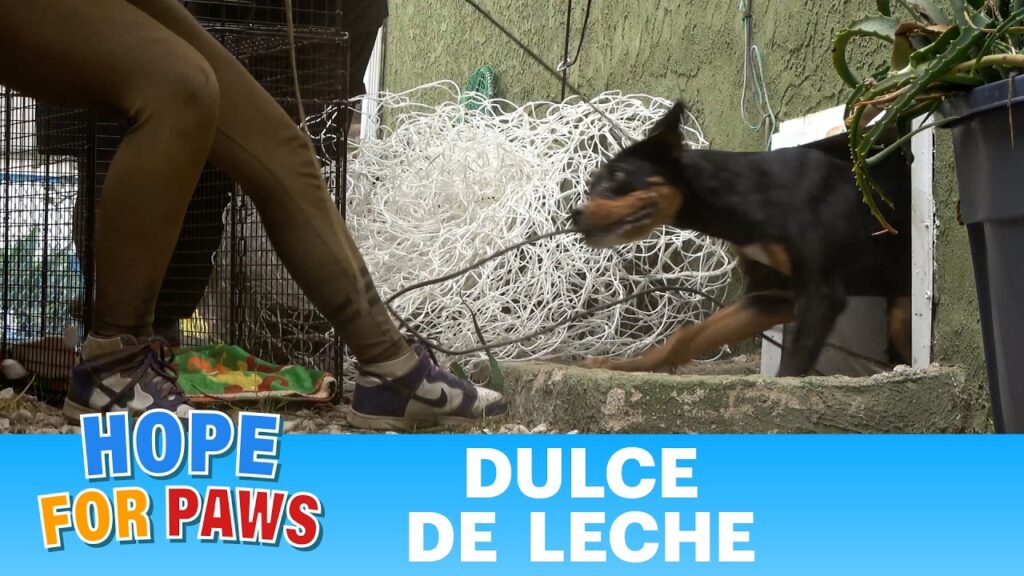
Two weeks. Every night, the neighbors could hear her crying from under the house. They knew something was under there, something scared and hurting, and for two weeks the situation stayed exactly as it was: a homeless dog hiding in the only enclosed dark space she had been able to find, terrified of fireworks, alone, and crying in a way that the people above her could hear clearly enough that it had become a nightly fact of their lives. The homeowner eventually found Hope For Paws, made the call, and Eldad came. Then he got down on the ground and crawled in after her. Watch what happened.
Two weeks of crying under a house. One call to Hope For Paws. One crawl into the dark. And then: Dulce De Leche.
What Two Weeks Under a House Actually Means for a Scared Homeless Dog
The image of a dog hiding under a house is not abstract. It is a specific behavioral response to a specific set of pressures, and understanding what produced it is part of understanding what Dulce De Leche’s rescue actually required. Dogs who are homeless and experiencing noise phobia, particularly fireworks phobia, which is among the most common and most severe anxiety presentations in the domestic dog population, will seek the most enclosed, acoustically dampened space available to them when triggered. A crawl space under a house meets that description precisely: it is enclosed, it muffles external sound, it has multiple potential exit routes that the animal can monitor from a fixed position, and it is dark, all of which are environmental features that an anxious dog reads as safety cues even when the space itself offers no food, water, or warmth.
Dulce De Leche had been in that crawl space for two weeks when the call came in. Two weeks is a long time for a dog to remain in an enclosed hiding space, and it tells you something about the intensity of whatever she was running from and the severity of the anxiety driving her behavior. Dogs who are simply uncomfortable with their environment do not stay hidden for two weeks. They explore, they approach, they look for resources and contact. A dog who stays hidden for two weeks, crying audibly at night while the neighborhood sleeps, is a dog who is genuinely frightened at a level that overrides her other needs. She was hungry under there. She was thirsty. And she was still more afraid of the world outside the crawl space than she was of what staying inside it meant for her body.
Fireworks phobia is documented in an estimated 40 to 50 percent of the domestic dog population at varying levels of severity, making it one of the most prevalent anxiety conditions in companion animals. The Fourth of July and New Year’s Eve produce predictable nationwide surges in dog disappearances, as terrified animals break through fences, jump from arms, slip leashes, and run from whatever location they were in when the first explosions started. Shelters consistently report their highest intake volumes in the days immediately following major fireworks events. The dogs who disappear during these events are not all homeless to begin with: many are owned, loved, and well cared for, and the fireworks event is simply more than their nervous systems can process while remaining in place. Dulce De Leche was homeless when the fireworks drove her under the house, which meant there was no familiar home address for her to try to return to when the sounds stopped. The crawl space became her entire world.
What Fireworks Do to Dogs: The Science
Fireworks produce a combination of sensory stimuli that dogs are neurologically poorly equipped to process: sudden, unpredictable loud noises at frequencies that dogs perceive more acutely than humans do, accompanied by bright flashes, the smell of gunpowder, and vibrations that travel through the ground. Dogs cannot rationalize the source the way humans can, and they have no mechanism for predicting when the sounds will stop. The unpredictability is a specific amplifier of fear response in animals: research on noise phobia in dogs consistently identifies the inability to predict or control the stimulus as a primary driver of the severity of the anxiety response. A dog hiding under a house during fireworks is not overreacting. She is responding to a genuinely overwhelming sensory event with the only behavioral tool available to her: finding the most sheltered space she can reach and staying in it.
Getting Under the House: The Part of Rescue Work Nobody Films for the Glamour
Crawl space rescues are one of the least glamorous and most physically demanding categories of work that Hope For Paws performs, and Eldad describes them with the same matter-of-fact transparency he brings to every aspect of the rescue operations the organization documents. It’s tight and dusty. Animals can move around much more easily than the humans trying to reach them. The rescuer is physically constrained in a space designed for pipes and insulation, not for a full-grown adult with rescue equipment, trying to move slowly and calmly enough to not further frighten an animal who has specifically chosen this space because she perceived it as unreachable. The physics of the situation consistently favor the dog.
The Lucky Leash, Hope For Paws’ designed tool for exactly these situations, is worth understanding because it reflects the specific engineering of rescue technique that Eldad has developed over nearly two decades of encountering the full range of scenarios that street rescue produces. It is a loop leash system designed to be extended toward an animal that cannot be approached directly, allowing the rescue team to secure the animal without requiring physical contact until the leash is around the neck and the animal can be guided rather than chased. In a crawl space, where the rescuer cannot stand, cannot move quickly, and cannot position themselves advantageously relative to a frightened and mobile dog, the Lucky Leash is the tool that bridges the gap between proximity and safety.
🐾 Want to Help? Two Ways to Get Involved with Hope For Paws
| → | Crawl with the team. Hope For Paws accepts volunteers specifically for under-house and tight-space rescues. If you’re willing to get dusty in the service of a frightened dog who needs someone small enough and patient enough to reach her, sign up at HopeForPaws.org/join. |
| → | Can’t crawl? Donate instead. A small recurring donation funds the veterinary care, transportation, and rescue equipment that makes the crawl worth doing. Every response to a call like Dulce De Leche’s requires both people willing to get on the ground and the financial base that keeps the organization operational between rescues. Donate at HopeForPaws.org/donate. |
| → | Get a Lucky Leash. The same tool Hope For Paws uses in crawl space rescues is available to the public, shipped free. If you encounter a frightened or loose animal and want the best possible tool for approaching them safely, order one here. |
From Under the House to a Forever Home: The Foster Family Who Decided to Keep Her
Her name is Dulce De Leche. The name is not incidental: someone at Hope For Paws looked at this dog who had been crying in the dark for two weeks, who had been too frightened to come out for food or human contact, who had been homeless and scared and alone in a crawl space, and gave her a name that means sweetness. That is a deliberate act of characterization, and it turns out to be accurate. Dulce De Leche went into foster care with LA Animal Rescue, the partner organization that Hope For Paws works with for post-rescue placement, and her foster mom and dad discovered exactly what the name implied. They decided to adopt her.
The foster-to-adoption outcome is the best possible result in the rescue-to-placement pipeline, and it happens specifically because the foster period gives people the chance to discover the dog rather than choose a dog from a distance. Adopting a dog from a shelter or rescue organization involves some degree of uncertainty: you know the dog’s history as the rescue organization has been able to document it, you know how the dog has presented in the shelter environment, and you make a decision based on that limited information. Fostering a dog means living with them in a home environment, seeing who they are without the shelter context, learning their specific personality and preferences and behavioral patterns, and discovering whether the dog that was hiding under a house two weeks ago turns out to be exactly the dog you wanted in your home. Dulce De Leche’s foster family discovered that she was. The adoption was the natural conclusion of that discovery.
The trajectory from “crying under a house every night for two weeks” to “adopted by a foster family who fell in love with her” is the one that rescue advocates try to describe when they talk about why the work matters and why the network behind it matters. Dulce De Leche did not get that outcome because someone happened to be walking past the right house at the right time. She got it because the homeowner knew enough to search for a rescue organization rather than simply waiting, because Hope For Paws had built the reputation and the searchability that allowed a person in that specific situation to find them, because Eldad and the team were willing to get on the ground and crawl into a dark, tight, dusty space after a frightened dog who might move further away from them with every inch they advanced, and because LA Animal Rescue had the capacity and the people to provide the foster home that became her permanent one. Every part of that chain had to work. It did.
Dulce De Leche Has Found Her Home. LA Animal Rescue Has Many Others Still Waiting.
If you’re ready to add a dog or cat to your life, LA Animal Rescue has many other animals in their care who are looking for exactly what Dulce De Leche found: a foster family willing to get to know them, and then a forever home to stay in.
Visit LA Animal RescueThe Rescue That Happens When Everyone Does Their Part
Dulce De Leche’s rescue is a good illustration of what the Hope For Paws network model actually requires. A homeowner who heard a dog crying and chose to find a rescue organization rather than ignore the sound or call animal control and hope for the best. A rescue team willing to do the physically uncomfortable work of a crawl space entry. A partner organization with the foster capacity to receive the dog immediately after rescue and provide her with the home environment her recovery required. And a foster family who showed up for what they thought was a temporary commitment and discovered that Dulce De Leche was exactly the dog they had been looking for. Every link in that chain is the result of deliberate organizational investment: in reputation, in community trust, in partner relationships, and in the ongoing donor support that keeps the whole structure operational.
The scale at which Hope For Paws operates, responding to individual calls about individual animals in individual crawl spaces and storm drains and freeways and shelter situations across Los Angeles, is the scale that makes the broadest reach possible while maintaining the individual attention that each animal requires. They are not processing animals through a system. They are responding to specific situations with specific tools, specific knowledge, and the accumulated experience of nearly two decades of doing exactly this. Dulce De Leche got Eldad on his hands and knees in the dark because that is what her situation required, and that willingness is not incidental to what Hope For Paws is. It is the whole of it.
Support the Next Dulce De Leche
Dulce De Leche was crying under a house for two weeks. She has a home now. The next dog like her is out there right now, and whether Hope For Paws can reach her depends on whether this community shows up. Crawl with the team, donate to support the work, or get a Lucky Leash so you’re ready when you need it.
Donate to Hope For Paws Volunteer to Crawl Get a Lucky Leash (Free Shipping)Two weeks of crying in the dark. One call. One crawl. One foster family who decided they weren’t giving her back. Dulce De Leche got every part of the chain she needed, and the chain held because the people and organizations in it do this work every single day. Watch the video. Share it. And if you’re looking for a dog to add to your life, LA Animal Rescue has plenty more who are waiting for exactly the kind of person who watches a rescue video and thinks: that one.
Sustainable Action Now Rescue Network
We follow Hope For Paws, LA Animal Rescue, and every organization in the network doing this work. Dulce De Leche’s story is one. There are thousands more.
Visit the SAN Rescue Network