
Rescue Network · Moon Bears
Millie the Moon Bear Leaves Her Tiny Cage After 26 Years, While About 125 Bears Still Wait in Vietnam
For twenty six years the world kept moving and her cage did not. Now a rescued moon bear is learning what a day without bars feels like, and a campaign is asking the people with power to finish the job.
Twenty six years. One tiny cage. Then, finally, a door.
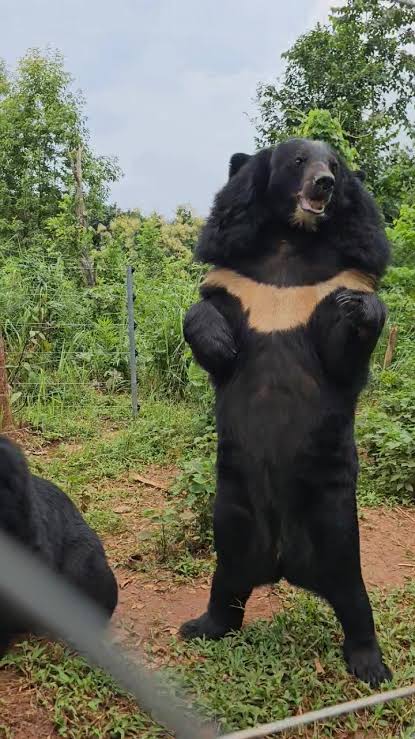
Millie is a moon bear, one of the black bears of Asia named for the pale crescent of fur on her chest. For 26 years she lived in a cage so small that time, as Animals Asia puts it, stood still for her while the world moved on. Her rescue has taken her to Animals Asia’s Bach Ma Bear Sanctuary in central Vietnam, where a very different life begins. She is free of the bars at last, but she is not the last bear who needs to be.
What 26 Years in a Cage Means
Moon bears, also called Asiatic black bears, are forest animals that climb, forage and roam wide ranges in the wild. In Vietnam, thousands were once caged on farms so that their bile could be drained for use in traditional medicine. Extraction is now illegal there, but bears registered years ago remain with their owners, and many have been confined for more than two decades. Animals Asia, which has worked on the issue since 1999, describes cages so cramped that a bear can barely turn, with paws damaged by metal bars and bodies worn by decades of poor food and no sunlight.
Rescued bears often arrive underweight and dehydrated, with fractured or rotted teeth, damaged limbs and calloused paws. One female moon bear rescued in February from the city of Danang after more than 25 years on a business’s premises weighed 120 kilograms and arrived with dental and limb injuries, and went through a 30 day quarantine before being introduced to other bears. Millie’s journey follows the same careful path, because after so many years of confinement, even a gentle step like touching grass can overwhelm a bear.
The cage was small. Her world got smaller. Now it grows.
A New Life at Bach Ma
The Bach Ma Bear Sanctuary, inside Bach Ma National Park near Hue, opened in 2023 as Vietnam moved toward ending the keeping of bears for bile. It is one of three Animals Asia sanctuaries, alongside Tam Dao in northern Vietnam and the original center in Chengdu, China. At Bach Ma, rescued bears are treated for injuries and illnesses, spend time in quarantine, and are slowly introduced to other bears and to semi natural enclosures where they can dig, climb, swim and rest. Each receives lifelong care tailored to its health and temperament, and for many, the first sign of recovery is something as simple as sleeping in a hammock or eating a handful of fruit in the open air.
Animals Asia says it has rescued nearly 300 bears in Vietnam. That is a remarkable number and it is also, in the organization’s words, only part of the job.
The Bears Still Waiting
Vietnam made a commitment in 2017 to end bear bile farming by 2026. This is the year that promise comes due. Animals Asia says roughly 125 bears are still waiting on farms or in private homes, down from more than 150 earlier in the year, and it describes them as older animals with little time left. The group argues the political decision has been made and now has to be carried out, so that every remaining bear can be moved to a sanctuary before it is too late.
Part of what makes it hard is legal. Because bile extraction is banned but the keeping of registered bears is still allowed, owners cannot simply be forced to hand over their animals. Many have kept them for 20 years or more and are reluctant to let go, and rescues often depend on negotiations that last months. One recent rescue in Nghe An province, where two bears known as Cuckoo and Oriole were the last at a single farmer’s home, followed about a year of talks.
Free the Final Bears
Animals Asia’s campaign is asking supporters to reach 100,000 messages of hope for the remaining bears, so that decision makers hear that the public wants the job finished. People who want to take part can add their name and leave a message through the organization’s campaign page. The campaign is a call for action by an advocacy group, and Vietnam’s government has pledged to end the practice but has not published a final timetable that we could verify.
Why Stories Like Millie’s Matter
It’s tempting to read a rescue as an ending. In Millie’s case it is a beginning, and also a reminder of what stands behind it: years of negotiation, a sanctuary that takes decades to build, and caretakers who will tend to one bear for the rest of her life. The same machinery has to be applied to every remaining bear. If the schedule slips, the last ones may die in their cages, and a quiet failure of that kind rarely makes the news.
What Millie’s story shows is how fast an animal can change when the bars come off. A bear who has known nothing but a cage still has the instincts of a forager, a climber and a swimmer. Given a patch of earth, those instincts return. Given about 125 more chances, the same would be true for the rest.
The Road to Freedom
- 1999Animals Asia begins working with Vietnam to end bear bile farming.
- 2017Vietnam commits to ending the practice by 2026.
- 2023The Bach Ma Bear Sanctuary opens.
- 2026Millie is freed after 26 years. About 125 bears remain, and the deadline arrives.