For Nine Months, Leo and Alfie Were Trapped in a War Zone in Khartoum Without Food, Water, or Human Care. Now Watch Them Walk.
Two lions. Nine months in an active Sudanese combat zone. Artillery fire shattering their enclosures. Severely emaciated and traumatized. Then a two-stage international evacuation through military checkpoints, across a second war zone, and finally to LIONSROCK Big Cat Sanctuary in South Africa. This is what hope for a new beginning actually looks like.
| 9 mos Months Leo, Alfie and the pride survived abandoned in Khartoum’s combat zone | 48 Wild animals evacuated in Stage 1 of the FOUR PAWS rescue operation | 11 Sudan lions now living permanently at LIONSROCK in South Africa | 2 Countries the rescue team had to evacuate through before reaching safety |
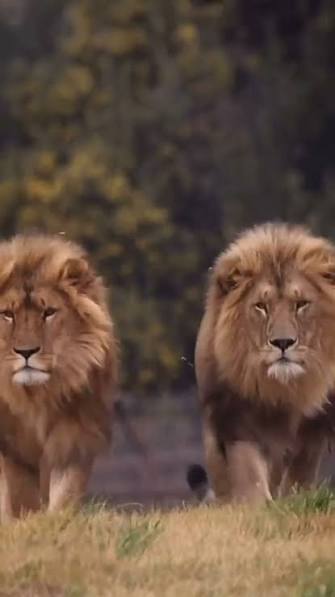
The video that FOUR PAWS International shared recently, and that has been viewed more than 150,000 times, shows two lions walking across their enclosure at LIONSROCK Big Cat Sanctuary in South Africa. It’s been called a “power walk” because that’s exactly what it is: Leo and Alfie moving through their space with the kind of relaxed, confident gait that belongs to an animal who knows where he is, knows he’s safe, and has healed enough to simply exist in his body without the compression of fear. It is a short video. It contains no narration, no dramatic music, no editorial intervention. It doesn’t need any of those things. If you know where these two lions came from, the walk says everything that needs to be said.
Leo and Alfie survived nine months in Sudan’s war zone. This is what they look like now at LIONSROCK Big Cat Sanctuary in South Africa.
What Nine Months in an Active Combat Zone Does to a Lion
The Sudanese Civil War that erupted in April 2023 was not the kind of conflict that unfolds at a careful distance from civilian and animal populations. It was urban warfare at its most immediate, fought directly in the streets, buildings, and facilities of Khartoum, Sudan’s capital city. When the fighting consumed the area where Leo, Alfie, and several other big cats were being held in a local facility, their human caretakers evacuated. The animals didn’t have that option. They were left in their concrete enclosures, unable to leave, as the war happened around them and eventually directly through the structures they were living in.
For nine months, there was no regular food. No clean water. No veterinary attention. Artillery fire shattered the immediate surroundings of their enclosures, producing the sound and physical impact of continuous explosive detonations in the territory a lion naturally reads as its domain. The physical consequences were severe: by the time FOUR PAWS was able to reach them, Leo and Alfie and the rest of the pride were severely emaciated, physically weak from months without adequate nutrition, and carrying the behavioral and physiological signatures of profound and sustained trauma. Lions are apex predators who evolved to project force and occupy territory with confidence. Nine months of constant explosive sound, starvation, and powerlessness leaves marks that don’t disappear quickly, or without deliberate and extended care.
What Trauma Does to a Big Cat: The Physical and Behavioral Picture
Big cats under sustained trauma, defined as chronic exposure to loud noise, threat stimuli, food insecurity, and loss of control over their environment, develop measurable physiological and behavioral changes that are documented across the wildlife rehabilitation literature. Elevated cortisol levels from sustained stress suppress immune function, impair digestion, and reduce muscle mass even when caloric intake is partially maintained. Extended food insecurity compounds this through direct caloric deficit and through the behavioral depression that follows repeated unsuccessful foraging. Continuous loud noise exposure, particularly the percussive sound of artillery and small arms fire, activates the same threat-response systems that proximity to predators would activate in the wild, but without resolution or escape, producing a chronic hyperarousal state that depletes the animal’s physiological reserves over time. What FOUR PAWS found when they reached Leo and Alfie was the physical output of nine months of all of these operating simultaneously.
The Two-Stage Rescue: Getting 48 Wild Animals Out of a War Zone Requires Negotiating With the War
Extracting apex predators from an active urban conflict zone is not an operation that follows a standard rescue protocol, because there is no standard rescue protocol for it. FOUR PAWS International, the global animal welfare organization that led the operation, had to plan a mission that was simultaneously a wildlife rescue, a logistical operation moving large animals through active military territory, and a diplomatic negotiation with parties to a conflict that had no particular reason to prioritize the welfare of captive lions. The mission unfolded in two stages, each of which was itself a significant undertaking, and the second became necessary because the first location of safety stopped being safe.
Stage One: Entering Khartoum · Late 2023
In late 2023, FOUR PAWS successfully negotiated entry into Khartoum, obtaining access to a city that was still an active war zone. The operation extracted 48 wild animals from the holding facility, moving them through volatile military checkpoints under conditions that required constant real-time negotiation and adaptation to a security environment that could change without notice. The animals were transported to a temporary sanctuary in Wad Madani, south of Khartoum, which was outside the immediate combat zone at the time of the evacuation. The 48 animals arrived in Wad Madani malnourished, traumatized, and in need of urgent veterinary attention, but alive and out of the direct line of fire.
Stage Two: When Wad Madani Became a War Zone Too
Shortly after the animals arrived in Wad Madani, fighting expanded into the area, eliminating the temporary sanctuary’s safety. FOUR PAWS had to re-enter the country and conduct a second evacuation under renewed conflict conditions, moving the core pride out of Sudan entirely. The lions were transported to the Al Ma’wa for Nature and Wildlife reserve in Jordan, a partner facility that could provide the medical stabilization and intensive veterinary care the animals needed before any permanent relocation could be planned. Jordan was a staging point, not a destination, but it was where Leo and Alfie began the physical recovery that the LIONSROCK videos are now documenting.
The logistical scope of what FOUR PAWS executed across these two stages is worth holding in full view rather than summarizing quickly past. Moving large, traumatized predators through active military checkpoints requires sedation protocols carefully calibrated to avoid compounding the animals’ already stressed physiological state. It requires vehicles appropriate for transporting large cats that have not been habituated to transport and whose stress responses during handling are unpredictable. It requires negotiation with military personnel who may or may not have been expecting or sanctioned the operation at any given checkpoint. And it requires doing all of this in a wartime environment where the conditions can change in ways that make the planned route impassable within hours. Every stage of this rescue was a genuine field operation, not a managed sanctuary transfer, and the fact that it worked twice is a reflection of FOUR PAWS’ experience and organizational capacity in exactly this kind of high-complexity intervention.
After Jordan, After Jordan, After Khartoum: LIONSROCK Is Where the Walk Became Possible
After medical stabilization in Jordan, the full pride of 11 rescued Sudan lions was permanently relocated to LIONSROCK Big Cat Sanctuary in South Africa’s Free State province. LIONSROCK is a FOUR PAWS facility that has been operating since 2006, providing permanent sanctuary for lions and other big cats rescued from private ownership, roadside zoos, circuses, and conflict zones across Africa, Europe, and the Middle East. It is one of the largest big cat sanctuaries on the African continent, with large, naturalistic enclosures designed to allow cats to express their normal range of behavioral repertoire including exploration, territorial marking, social interaction on their own terms, and the uninterrupted space to move through terrain at their own pace without confinement.
What Leo and Alfie are doing in the viral video is occupying that space with the ease of animals who have metabolized, over months of consistent care and gradually expanding access to their environment, the transformation from the Khartoum holding facility to something that is functionally the opposite of it. The “power walk” reading of what they’re doing is not hyperbole. A lion who is still carrying the behavioral residue of nine months of war zone trauma moves differently, more guardedly, with more scanning of the environment, more hesitation at open ground, more compression in the body. Leo and Alfie in that footage are not moving like that. They are moving like lions who know their territory and feel settled in it, which is the specific behavioral outcome that quality sanctuary care over a sufficient time period can produce even in animals who arrived severely traumatized.
The recovery process for lions who have experienced the specific combination of stressors that Leo and Alfie did, starvation, dehydration, constant noise trauma, and loss of any sense of environmental safety, is not linear and is not quick. FOUR PAWS’ approach at LIONSROCK involves individualized assessment of each animal’s behavioral and physical state, gradual introduction to new enclosure spaces rather than immediate full exposure to the sanctuary’s scale, consistent staffing relationships that allow the animals to develop predictable social bonds with specific caretakers, and veterinary monitoring that tracks recovery metrics over time rather than evaluating readiness at a single point. The 11 Sudan lions didn’t arrive at LIONSROCK and immediately do power walks. The footage represents the output of that sustained care across the months since their arrival, and it represents it accurately.
What Makes a Mission Like This Possible, and How You Can Be Part of the Next One
FOUR PAWS International is a global animal welfare organization founded in Austria in 1988 and now operating across 16 countries, with sanctuaries for big cats, bears, apes, and farm animals, and a team of veterinarians and rescue specialists who have responded to crisis situations across conflict zones, natural disasters, and the collapsing regulatory environments for captive wildlife in multiple countries. The Sudan mission was not FOUR PAWS’ first extraction of animals from an active conflict zone, and the organizational capacity that made it possible, the negotiating relationships with conflict parties, the logistics infrastructure for moving large animals through uncertain environments, the partner network that includes Al Ma’wa in Jordan and LIONSROCK in South Africa, is not built overnight. It is built through years of consistent presence in the field and consistent delivery on the commitments made to partner facilities and to the animals in their care.
The animals who are now at LIONSROCK, including Leo and Alfie doing their power walks across South African sanctuary land, are there because a global network of donors, organizations, and partner facilities made it financially and logistically possible. When you donate to FOUR PAWS, you’re not funding one mission. You’re funding the organizational infrastructure that allows the next mission to happen: the relationships with conflict zone parties that allow negotiated access, the partner sanctuaries with the capacity to receive and stabilize new arrivals, the veterinary staff with the experience to stabilize animals whose health profile is as complicated as Leo and Alfie’s were when they arrived, and the ongoing care costs for 11 lions who are going to live at LIONSROCK for the rest of their lives.
|
💛
Donate to FOUR PAWSSupport the rescue operations, sanctuaries, and ongoing care that made Leo and Alfie’s recovery possible. |
🦁
Adopt a FOUR PAWS AnimalThrough the FOUR PAWS adoption program, your support helps cover the ongoing costs for specific animals in their care. |
🌍
SAN Rescue NetworkLeo and Alfie’s story is part of a global network of rescues we follow at Sustainable Action Now. |
Nine Months in a War Zone. A Power Walk in South Africa. That’s the Arc.
Leo and Alfie are walking across LIONSROCK like they own the place because they do. Every stride in that video is the result of nine months of survival, a two-stage international rescue, months of veterinary rehabilitation, and the sustained care of people who refused to leave them in Khartoum. Watch the video. Share it. And if you can, donate to FOUR PAWS so this kind of rescue can happen again.
Donate to FOUR PAWS Visit the SAN Rescue NetworkNo matter how tough the journey has been, FOUR PAWS says, there is always hope for a new beginning. Leo and Alfie were nine months in Khartoum, abandoned in a combat zone, severely emaciated and traumatized, evacuated twice through active conflict areas, stabilized in Jordan, and then sent to South Africa where they now walk with the kind of unhurried, grounded confidence that belongs to a lion in a place he finally recognizes as his. That arc is real. It took an international organization, two countries’ cooperation, a partner sanctuary, and months of dedicated veterinary and behavioral care to produce it. Watch the walk. It’s earned.