

Climate · Energy and Infrastructure
Texas Issues Air Permit for SpaceX’s $24 Billion Starbase Data Center and Gas Power Plant Weeks Before a New Governor Takes Office
State regulators cleared the plant’s 35 gas turbines after ending a data center permitting pause ahead of schedule. A second application, a county tax break rejected by a single vote, and a governor-elect pledging a moratorium now frame what happens next.
The air permit is in hand. The tax break is not, and the political ground is about to shift.
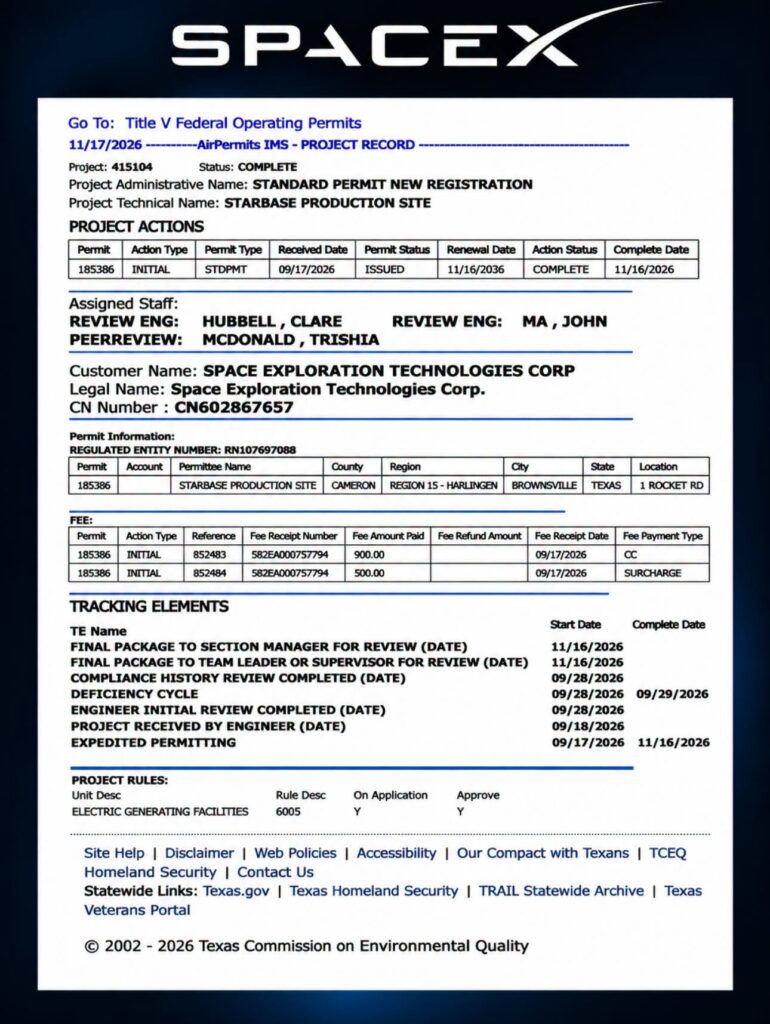
The Texas Commission on Environmental Quality has approved the air pollution authorization for the natural gas power plant that would run SpaceX’s planned artificial intelligence data center at Starbase, near Brownsville. The agency’s records show the registration was completed on Monday, November 16, and news of it spread the following day. The decision removes one of the largest regulatory hurdles facing a project the company describes as a $24 billion investment, and it arrives only weeks before Gina Hinojosa, a Democrat who campaigned on halting new data center approvals, is sworn in as governor on January 19, 2027. It also follows a pause on data center permitting that the outgoing governor, Greg Abbott, had imposed in September and that regulators lifted earlier than first expected. For continuing coverage of the energy choices shaping the climate, visit the Sustainable Action Now climate reporting.
What the Permit Covers
The approval covers a gas fired power plant that would generate electricity solely for the data center campus without connecting to the public grid. Filings describe an initial fleet of 35 natural gas turbines with a combined capacity of roughly 750 megawatts, reported in some accounts as 748 megawatts. According to reporting on the application, those units are temporary, refurbished machines that would eventually be replaced by eight permanent GE Vernova 7E turbines with a combined output of about 708 megawatts. The authorization was issued as a registration under a standard permit that Texas uses for certain gas turbine projects, which is a faster route than a full individual permit with a contested case hearing. A University of Houston law center analysis of the state’s data center boom notes that Texas has no state siting statute and no state environmental policy act for such projects, so the preconstruction air permit has become, as a practical matter, the main state approval a developer needs.
Reporting on the permit says it caps emissions of smog forming nitrogen oxides at 248 tons per year, two tons below the 250 ton level at which stricter federal Clean Air Act review applies. That figure comes from news coverage of the permit and has not been independently checked here. The $24 billion price tag is also worth handling carefully. It comes from a notice issued by the city of Starbase and from SpaceX’s own statements, not from the environmental agency, and Cameron County’s paperwork lists a lower figure of $17.9 billion without explaining the difference. SpaceX has said it plans to invest more than $24 billion in new supercomputing infrastructure in the Rio Grande Valley, building on more than $15 billion it says it has already invested in Starship and related facilities at Starbase.
A Pause That Ended Early
The timing is the center of the political argument. On August 3, Governor Abbott directed the Public Utility Commission of Texas and the state grid operator, the Electric Reliability Council of Texas, to audit data center projects seeking grid connections, and in September he halted new data center permits at the environmental agency until that audit was completed. ERCOT had said it expected its review to finish in December, with reporting pointing to a December 10 deadline. Regulators resumed data center permit reviews weeks ahead of that date after ERCOT told them it had gathered the preliminary information it needed, according to accounts of the decision. Supporters of the resumption can argue that the agency followed the audit’s progress and that a project built to supply its own power puts less strain on the shared grid, which is the reason SpaceX gives for the design.
Critics read the sequence differently. Hinojosa called the pause a political ploy meant to protect Abbott’s election chances, and she predicted before the vote that it would be reversed once the campaign ended. She won the governor’s race on November 3, and during the campaign she promised a moratorium on all data center approvals until the Legislature passes what she called real protections for Texans, along with an end to tax breaks for the industry and a say for local communities in whether facilities are built. John Hall, president of the Houston Advanced Research Center, told KUT that extending a moratorium is largely within a governor’s authority and that many observers expect her to try. Whether any new freeze could reach a permit that has already been issued is not addressed in the reporting reviewed for this article.
A Second Application and Questions About Thresholds
Two days after the first approval, on November 18, SpaceX filed a second air permit application for the same site, according to reporting by Politico. Watchdog groups including Public Citizen and FracTracker Alliance say the company is dividing its air authorizations into separate permits to stay beneath federal review thresholds, and they allege that construction began before the permits were granted. Public Citizen has also called on the environmental agency’s commissioners to resign. SpaceX’s response to those specific allegations was not available in the coverage reviewed here, and the company’s position, as described in its public statements, is that the project is designed to generate its own power and limit its draw on the grid. The practice of filing multiple authorizations for a single site is not unique to this project, and whether the filings should be treated as one source for federal purposes is exactly the kind of question the critics want answered in public.
The Tax Break That Did Not Advance
The permit was not SpaceX’s only decision that week. On Tuesday, November 17, the Cameron County Commissioners Court voted 3 to 2 against holding a public hearing on the company’s request for a 10 year, 100 percent property tax abatement for the project. County Judge Eddie Treviño Jr. and Commissioner Joey Lopez voted in favor of moving forward, and the vote means the proposal does not advance at the county level. SpaceX’s earlier county abatement, which dated to 2014, expired in December 2025. The company has fared differently elsewhere in Texas. In June, Grimes County commissioners voted 4 to 1 to approve a reinvestment zone and a 100 percent abatement for SpaceX’s proposed $55 billion Terafab chip manufacturing facility, over objections from residents who asked for more time.
The county’s decision does not end every route to a tax break at Starbase. As reported in earlier coverage, the city of Starbase, whose three member commission includes two SpaceX employees, had scheduled its own public meeting for December 9 to consider an abatement and a related economic development agreement for the same project. Critics describe that structure as the company deciding its own subsidy, while the arrangement is lawful under Texas law and SpaceX has not been reported to dispute that.
What to Watch Next
Four dates and decisions will shape the project. The environmental agency must act on the second air permit application. ERCOT is expected to finish its audit in December. Starbase’s commission is scheduled to take up the abatement on December 9. And on January 19, Governor Hinojosa takes office with a promised moratorium and a Legislature that will meet soon after to consider data center rules.
The Starbase project has become a test of how Texas balances its pursuit of artificial intelligence investment against the cost of powering it. Supporters point to billions of dollars in capital spending, local jobs and a self supplied power plant that would not add load to the grid. Opponents point to hundreds of megawatts of new gas combustion, emissions held just beneath a federal trigger, and a permit cleared in the final weeks of an outgoing administration. Both accounts rest on documents that are still being filed, and the next few weeks will show which one the state’s regulators, its county officials and its next governor are prepared to accept. More analysis of the energy and infrastructure decisions behind that tradeoff is collected in the Sustainable Action Now climate section.