
Rescue Network · Moon Bears
Rescued Moon Bears Throw a Pool Party After Years in Cages: Inside the Animals Asia Sanctuaries in Vietnam and China
A video of four rescued bears sharing a single pool shows what recovery looks like after years of confinement on bile farms. Behind the splashing is a network of sanctuaries, a record setting relocation across China and a growing list of individual survivors.
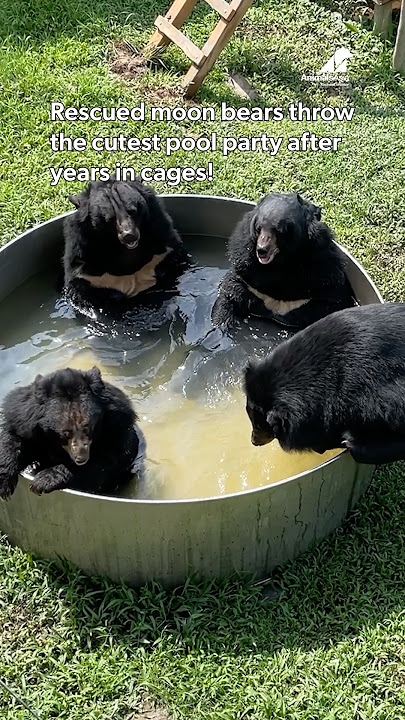
Four bears. One pool. No personal space, and every reason to be there.
The footage is simple and instantly lovable. Four rescued Asiatic black bears, better known as moon bears for the pale crescent of fur on their chests, pile into one pool at a sanctuary run by the conservation charity Animals Asia, paddling, splashing and crowding each other with the ease of animals who have finally been allowed to be bears. The charity shared the clip with a caption that has made the rounds: four bears, one pool and zero personal space. What gives the scene its weight is the history of the animals in it. Moon bears like these are typically rescued from bile farms, circuses and illegal captivity, places where a bear may spend decades in a cage barely larger than its own body. A pool party is not a novelty for them. It is evidence of a second life, and it is one of many such stories collected in the Sustainable Action Now rescue network coverage.
Why These Bears Need a Sanctuary
Bear bile farming involves confining bears so that bile can be extracted from the gallbladder for use in traditional medicine. Animals Asia, a charity founded in 1998 and headquartered in Hong Kong, has spent decades working to end the practice and to give rescued animals lifelong homes. The organization operates sanctuaries in Vietnam and China, and it describes its Chengdu centre as the only bear sanctuary in China. Rescued bears often arrive with the marks of long confinement, including severe physical trauma, chronic joint pain, dehydration and, in many cases, blindness. Animals Asia has reported, for example, that a large share of the bears at its China sanctuary live with some form of eye disease that needs continuing specialist care.
Recovery follows a deliberate order. New arrivals are first held in quarantine so that veterinarians can assess and treat them. Caregivers then introduce them gradually to what captivity denied them: grass underfoot, direct sunlight, water to wade into and, eventually, other bears. Introductions are managed according to personality, age, body weight, health and sex, which is why the sight of four bears sharing a pool is a milestone rather than an accident. For an animal that has only known solitary confinement, choosing to play beside a companion is the end point of months or years of patient work.
Three Sanctuaries, Two Countries
The Tam Dao sanctuary in northern Vietnam was the charity’s first in that country. It sits in the valley of Tam Dao National Park, a few hours from Hanoi, and according to Animals Asia it is now home to around 200 moon bears and sun bears rescued from the bile trade. Earlier descriptions of the site put it at about 11 hectares with nearly 30,000 square metres of semi natural outdoor enclosures designed to encourage natural behaviour. As Tam Dao approached capacity, the charity built a third sanctuary in Bach Ma National Park in central Vietnam, following an agreement with the Vietnamese government to end bear bile farming. Bach Ma covers 12.7 hectares, opened in 2023 with Armstrong, Buzz and Apollo as its first residents, and is run entirely by Vietnamese staff. It includes dens, outdoor enclosures, a veterinary hospital, a quarantine area and a bear kitchen.
In China, the Chengdu Bear Rescue Centre houses bears rescued across the country, and it was the destination for the largest operation of its kind ever attempted. The story began in 2013, when a new owner of a bile farm in Nanning decided he no longer wanted to profit from the industry and contacted Animals Asia. The charity cared for the more than one hundred bears on the property for years while it sought permission to move them. Permits were finally secured in April 2021, and in three phases between April and the end of May, convoys carried 101 moon bears across roughly 1,200 kilometres, about 750 miles, to Chengdu. When the last bear had left, the gates of the Nanning farm were closed for good. Animals Asia has called it the biggest bear rescue in history.
The Bears Behind the Headlines
Individual stories explain why people follow these rescues so closely. Sen, a moon bear named for the lotus flower, was freed on May 23, 2025, from a cage he had lived in since 1998. His rescue closed a bile farm in one of the last hotspots of the trade in Vietnam, and he went on to Bach Ma, where Animals Asia describes him as curious, energetic and food loving. Dawn spent about 20 years on a bile farm before her rescue in February 2023 from Phung Thuong, a village long associated with bear farming. The charity called her the most traumatized bear it had ever seen, yet a year later she was counted among the happiest residents at Tam Dao. Celeste also spent 20 years in a cage before beginning a new life in Vietnam, and Armstrong, one of the first bears at Bach Ma, spent two decades on a bile farm before reaching sanctuary.
Grace arrived at Tam Dao from the illegal wildlife trade completely blind, her right eye surgically removed and her left clouded by a cataract. Given her own den and enclosure and time to map her surroundings, she slowly learned to cope with group life and now thrives. Tatzi, who was moved to an Animals Asia sanctuary in 2009, is the elder statesman of the group. At more than 36 years old he is believed to be the oldest living moon bear in the world, and almost certainly the oldest survivor of bear farming. His age brings health problems, but his care team marked his 36th birthday with a celebration at the China sanctuary. More recent arrivals include Nova and Lyra, rescued in April 2025 as part of eight bears brought to Animals Asia’s Vietnamese sanctuaries in the first half of that year.
The Work Is Not Finished
Animals Asia says Vietnam is close to ending bear bile farming, but it also reports that many of the remaining caged bears are old and frail, and that each rescue still depends on negotiation with owners and on securing space and veterinary care. Sanctuary residents are a lifetime commitment, since they cannot be released into the wild after decades in captivity. Other organizations in the region also run rescues of bile farm bears, so the picture is wider than any single charity.
What the Pool Party Really Shows
It is easy to treat a video like this as a bit of internet joy, and it is certainly that. It is also a measure of a rescue system that works. A bear who once lived without light, companionship or room to turn around is now splashing in the water beside friends, which tells caregivers that the physical and psychological recovery has gone deep. Readers who want to follow individual stories can browse the Animals Asia directory of rescued bears or the charity’s bear rescue journeys, where recent arrivals are profiled. For more stories of animals rescued and rehabilitated around the world, the Sustainable Action Now rescue network section collects them in one place.