

Climate & Energy · Permitting Reform
Senate Passes Permitting Overhaul 62 to 33: What the Bipartisan American Affordability and Jobs Act Does and Why the House Fight Is Next
The most significant energy and permitting bill to clear the Senate since 2022 would set deadlines for federal reviews, shorten the window for lawsuits and speed both gas pipelines and clean power lines. It now goes to a House with a crowded calendar and little time before the new Congress arrives.
Both sides agree that building in America takes too long. They disagree about what should be given up to fix it.
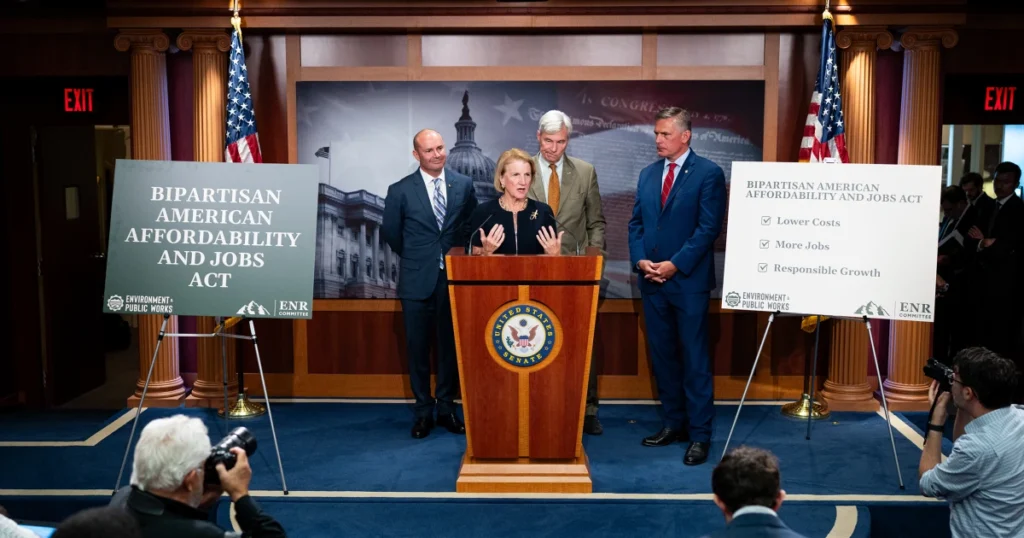
On the night of Thursday, November 19, 2026, the U.S. Senate voted 62 to 33 to pass the Bipartisan American Affordability and Jobs Act of 2026, a broad rewrite of how the federal government approves energy, housing and infrastructure projects. The measure began as Senate Bill 5653, introduced on September 30 by Senators Shelley Moore Capito, a West Virginia Republican, Mike Lee, a Utah Republican, Martin Heinrich, a New Mexico Democrat, and Sheldon Whitehouse, a Rhode Island Democrat. Supporters call it the biggest permitting overhaul in years and say it will lower costs. Opponents, including a majority of Senate Democrats and many environmental and tribal organizations, say it weakens protections that communities rely on. The bill is not law, and what happens in the House will decide whether it becomes law this year. Continuing coverage of energy and environmental policy is collected in the Sustainable Action Now climate section.
How the Bill Got Through the Senate
The path to passage was quick by the standards of a major bill. The Senate voted 73 to 25 on November 9 to advance it, cut off debate the following week, and adopted the final substitute text by 69 to 27 on November 18 before the 62 to 33 passage vote a day later. Senators carried the legislation on H.R. 2347, a bill that originated in the House, which means the House must now vote on the Senate’s version instead of taking up a separate Senate bill. Democrats were divided at every step. Senate Minority Leader Chuck Schumer joined the group of Democrats who voted yes, and reports put that group at roughly 14 or 15 Democrats on final passage, while a majority of the caucus, including Senators Jeff Merkley, Ed Markey and Catherine Cortez Masto, voted no. Two Republicans, Josh Hawley and Mike Rounds, also opposed it. Some delegations split, as Wisconsin’s did, with Republican Ron Johnson voting yes and Democrat Tammy Baldwin voting no. Vote counts differ across outlets because several procedural votes preceded passage, so readers who need exact numbers should consult the Senate roll call.
What the Bill Would Change
At the center of the package is the National Environmental Policy Act, the 1970 law that requires agencies to study the environmental effects of major federal actions. The bill narrows which actions trigger a full review and which alternatives an agency must consider, sets enforceable deadlines for completing reviews, and exempts certain housing and federal grant and loan projects from automatic review. Analyses of the text describe a 45 day limit for a final permit decision after a review ends. The bill also shortens the time allowed to sue. Legal challenges would have to be filed within 150 days, compared with a window that the Center for Climate and Energy Solutions puts at six years today for challenges under the environmental review law. If a court finds a flaw in a review, the agency would generally have up to 180 days to correct it, and the project could generally keep moving in the meantime.
A second major piece concerns the permits themselves. Under the text as described by analysts, agencies would generally be barred from revoking, suspending or changing a federal authorization held by a nonfederal project sponsor, with exceptions for court orders, material violations, fraud and urgent threats. A sponsor harmed by bad faith interference could recover part of its costs. The Wildlife Society, citing the Congressional Research Service, reports that future administrations would find it hard to revoke or change permits for projects approved on or after November 6. Environmental and sporting groups have raised concerns about that durability, noting that a court’s power to stop or cancel a permit would be limited even when an agency failed to complete a review properly.
On water, the bill limits the scope of state water quality reviews under Section 401 of the Clean Water Act. For interstate natural gas pipelines, those reviews would cover only direct discharges from point sources, and a state would have at most nine months. It also lengthens certain federal water discharge permit terms from five to 10 years. The National Historic Preservation Act would apply to fewer projects, and the bill shortens consultation timelines under the Endangered Species Act. In energy, it removes the federal drilling permit requirement for onshore wells on nonfederal land where the government owns only a minority of the minerals, while state and other requirements still apply, and it speeds approvals for offshore renewable, geothermal and hydropower projects.
The same bill that speeds a gas pipeline also speeds the transmission line that a solar farm needs to reach customers.
Supporters stress the grid provisions. The bill gives the Federal Energy Regulatory Commission stronger backstop authority to approve interstate electric transmission lines, a long standing goal of clean energy developers who say that power cannot reach customers without new wires. It also addresses the electricity demand from artificial intelligence. Large data centers would have to pay the full incremental cost of the generation, transmission and distribution built to serve them, utilities would collect financial assurances before building, and a customer that leaves early would still owe unrecovered costs. According to a legal analysis, those rules would apply to sites that connect after enactment, and earlier arrangements would stay in place, though states could revise them where state law allows.
The Case For and Against
The coalition behind the bill is unusually broad. It includes the Trump administration, nearly all Senate Republicans, the Democratic sponsors and their allies, labor unions, and business groups such as the National Association of Home Builders, the National Association of Realtors, the National Association of Manufacturers and the American Cement Association. Home builders say that cutting regulatory costs and delays will expand supply and lower costs for buyers and renters, with NAHB Chairman Bill Owens calling it landmark legislation and urging the House to act without delay. Manufacturers have estimated that the reforms could cut their permitting expenses by 35 percent, or about 4.2 billion dollars a year, which is an industry projection and not an independent finding. Capito has said critical investments have been stalled by endless red tape, duplicative reviews and regulatory uncertainty.
What supporters say
Faster approvals lower construction and energy costs, add supply and let the grid keep pace with data center demand. The bill speeds clean energy, transmission and housing as well as fossil fuel projects, and data centers must pay their own grid costs.
What critics say
Shorter lawsuit windows and limits on court remedies weaken public oversight. Clean water, historic preservation and tribal consultation protections shrink, and gas pipelines and data centers could advance with less scrutiny.
Opponents include the Sierra Club and the Natural Resources Defense Council, tribal leaders, and, according to reporting, 17 Democratic state attorneys general. About 100 environmental and energy law scholars wrote to Senate Democratic leaders warning that the bill would inflict lasting damage on core environmental laws. Indigenous leaders have objected to provisions they say reduce tribal input on projects and weaken protections for sacred and historic sites, even after last minute changes meant to address their concerns. The Theodore Roosevelt Conservation Partnership, which represents hunters and anglers, said progress should not come at the expense of conservation safeguards, and argued that land managers need to be able to respond when monitoring reveals unanticipated impacts to fish, wildlife, water or access. The Wildlife Society has pointed to a data center built in sensitive habitat as an example of a project that could be hard to unwind even if the importance of the habitat was not fully assessed. Several groups had urged the Senate to wait until Democrats take control of Congress in January.
Some Democrats who voted for the bill have said it needs further work, and the text itself reflects negotiation. Whitehouse has described it as a compromise that brings clean, affordable power to the grid while making computing hubs share the cost of the system they rely on, and Heinrich has said it will help reach a yes or a no on projects faster while protecting environmental safeguards and tribal consultation. Whether those assurances hold depends partly on rulemaking. A law firm analysis notes that many provisions would need agency rules before they take effect, and that the House can change the text.
What the House Will Decide
The next step is in the House of Representatives, where the bill competes for scarce time. A forecast in mid November counted 17 House session days left in the lame duck, and lawmakers must also deal with a government funding deadline on December 11 to avoid a shutdown. Republican Speaker Mike Johnson has said the House will pass the bill once Senate issues settle, and he has weighed a fast track vote under suspension rules, which requires a two thirds majority and therefore needs substantial Democratic support. House Minority Leader Hakeem Jeffries has said the current text needs changes on environmental review and tribal provisions before it earns broad Democratic backing, and the Congressional Progressive Caucus has opposed it. If the House amends the bill, it must return to the Senate. A bill that does not clear both chambers by the end of this Congress dies and must restart in the next, which will have different majorities, and Democrats will hold both chambers in January.
That timing explains the pressure on both sides. Supporters argue that the compromise is more likely to survive now than after the new Congress arrives, while critics argue that a Democratic majority could write a stronger bill. President Trump has reportedly backed the deal and would be expected to sign it if it reaches his desk. Even then, the legislation would not produce faster projects overnight. Agencies must write rules, courts must interpret new deadlines, and developers must still win financing and local acceptance.
Key Dates
- September 30, 2026The four senators introduce S. 5653.
- November 9The Senate votes 73 to 25 to begin debate.
- November 18Senators adopt the substitute text, 69 to 27.
- November 19The Senate passes the bill, 62 to 33.
- December 11Government funding deadline that competes for House floor time.
- January 2027The new Congress convenes with Democratic majorities.
For readers following energy policy, the vote marks a turning point for an issue that was once a niche subject for lawyers and utility planners. Permitting now sits at the center of debates over electricity prices, climate goals, housing costs and the buildout of data centers. The bill’s fate will show whether a bipartisan compromise written under one balance of power can survive the arrival of another.