
Shortly before midnight on July 22, 2026, a California sea lion resting on the low protective wall at La Jolla Cove in San Diego was approached by a young man who squared up in front of the animal, laughed, and kicked it. When the animal tried to escape down the adjacent sidewalk, the individual pursued it and continued to strike and kick it. A second person, visible in the background of the footage, can be heard laughing while recording the incident on a separate phone.
The video, originally posted as a private Snapchat story, spread quickly across Instagram, TikTok, and local news outlets in the days that followed. By July 25, it had become a national news story, prompted hundreds of public calls for prosecution, generated outrage across Reddit’s San Diego community, and triggered a formal federal investigation by the National Oceanic and Atmospheric Administration’s Office of Law Enforcement, with the U.S. Fish and Wildlife Service confirming NOAA’s lead role in determining whether criminal charges should be filed.
At Sustainable Action Now, this story demands direct, unambiguous coverage, because what happened at La Jolla Cove in the early hours of July 23 is not a gray area. It is documented abuse of a federally protected animal, captured on video, witnessed by at least one additional person who found it entertaining. The investigation is appropriate. The outrage is appropriate. And the broader conversation this incident has reignited about the structural failure of overnight protections at one of California’s most important marine mammal habitats is a conversation that requires more than a news cycle to resolve.
What the Video Shows
The footage is specific enough to describe without ambiguity. A young man approaches a California sea lion resting on the low barrier wall that separates the walkway from the coastal area at La Jolla Cove. He adopts a deliberate posture before laughing and kicking the animal with apparent force. The sea lion, startled and attempting to escape, moves down the sidewalk away from the attacker. The individual follows the animal and continues to kick and strike it rather than stopping when the animal attempts to flee. In the background, at least one other person is audible laughing and documenting the incident on a separate recording device.
The footage was recorded at approximately 11:50 PM, in the dark, in an area that lacks overnight security presence. That timing is not incidental. It reflects the specific vulnerability that advocates and rangers at La Jolla Cove have been documenting and warning about for years: that the wildlife who rest at the cove during nighttime hours are uniquely exposed to human interference precisely because the oversight infrastructure that provides some protection during daylight is absent at night.
<cite index=”47-1″>Online watchdog groups and animal advocacy organizations, including the Sierra Club’s Seal Society, worked quickly to identify the individual shown in the footage, and the name Greyson Kifer began circulating widely across social media platforms within hours of the video spreading.</cite> The San Diego Police Department, aware of the incident through the volume of social media tags and messages directed at the department, issued a public statement confirming that the behavior shown is completely unacceptable. The department noted that the incident had not been originally reported to them through standard channels and confirmed that the investigation had been handed to federal authorities given the animal’s protected status under federal law.
The Marine Mammal Protection Act and What It Means for This Case
California sea lions are not merely locally protected animals. They are federally protected under the Marine Mammal Protection Act, the landmark 1972 legislation that prohibits the harassment, hunting, capture, or killing of marine mammals in United States waters and by United States citizens. The MMPA’s definition of harassment is deliberately broad: <cite index=”48-1″>any act of pursuit, torment, or annoyance which has the potential to disturb a marine mammal or marine mammal stock in the wild by causing disruption of behavioral patterns, including, but not limited to, migration, breathing, nursing, breeding, feeding, or sheltering.</cite>
The footage from La Jolla Cove on July 22 documents conduct that meets this definition comprehensively. Kicking a resting sea lion is an act of direct physical contact that constitutes harassment under the statute. Pursuing a fleeing sea lion and continuing to strike it is pursuit in the plainest possible meaning of the term. The fact that the individual on camera appears to have found the animal’s attempts to escape amusing rather than distressing is relevant to the question of intent, which can bear on the severity of charges under the statute.
Federal penalties under the MMPA include civil fines of up to $11,000 per violation and criminal prosecution that can result in fines of up to $100,000 and imprisonment of up to one year for individuals found to have knowingly violated the Act. The NOAA Office of Law Enforcement is the primary federal agency responsible for investigating and enforcing MMPA violations, and <cite index=”44-1″>NOAA has confirmed that an investigation is currently underway.</cite>
The U.S. Fish and Wildlife Service, which shares jurisdiction over certain categories of marine mammal under the MMPA, has confirmed its coordination with NOAA on this case. Anyone with firsthand information, photographs, or additional video related to the incident is encouraged to contact NOAA’s Office of Law Enforcement through the NOAA Enforcement Hotline at 800-853-1964.
<cite index=”47-1″>Robyn Davidoff, chair of the Sierra Club’s Seal Society, stated the position of animal advocates directly: that kind of behavior is not acceptable, whether it is a person being punched or an animal. The sea lions are a protected species, and what occurred was an assault that warrants prosecution.</cite>
La Jolla Cove: What Makes This Place So Important and So Vulnerable
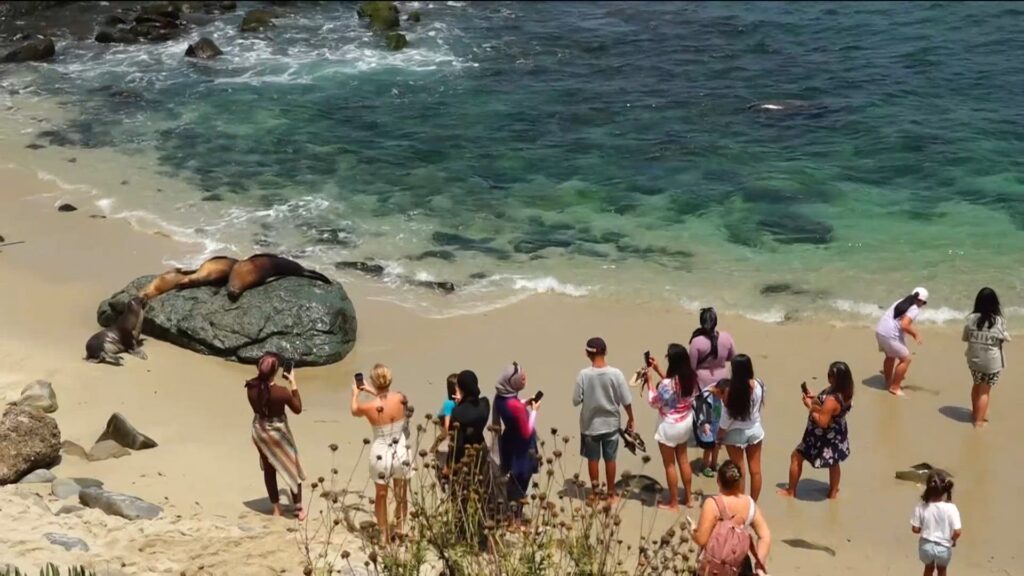
La Jolla Cove, situated along the rugged coastline of the La Jolla neighborhood of San Diego, is one of the most significant California sea lion rookeries in the southern part of the state. The rocky outcroppings and protective walls along the cove provide the hauling-out habitat that sea lions require for rest, thermoregulation, nursing, and social interaction. During summer, which corresponds to the height of breeding season for California sea lions, the population at the cove includes both adult animals and pups at highly sensitive stages of development.
<cite index=”47-1″>The Sierra Club’s Seal Society estimates that ten sea lion pups have died at La Jolla Cove in 2026 alone.</cite> Not all of those deaths are attributable to direct human interference. But a significant portion of the mortality pressure on La Jolla Cove pups is directly connected to human behavior patterns that disrupt nursing relationships and cause maternal abandonment. When a mother sea lion is startled, harassed, or forced into the water by human activity, the disruption to the nursing bond can be permanent. Sea lion mothers identify their pups by sound and scent, and a disruption of sufficient severity during a critical bonding period can result in a mother who cannot or will not return to a pup she has lost contact with. In practical terms, this means that harassment that does not directly injure a pup can still kill it by severing the relationship with the mother who would have sustained its survival.
<cite index=”47-1″>Disturbing resting sea lions causes unnecessary stress, forces them back into the water prematurely, separates mothers from pups, and can provoke defensive behavior that creates safety risks for both the animals and the humans nearby.</cite> The fact that this particular incident involved kicking an adult animal rather than approaching a pup does not reduce its significance in this ecosystem context. Adult animals that are harassed at rest sites contribute to the overall disturbance profile of the location, and a sea lion that associates its resting site with physical assault is an animal under chronic stress in a space it should experience as safe.
The timing of this specific incident, near midnight during the height of summer breeding season, maximizes the potential for harm. The animals at the cove at that hour are resting. They are not threat-presenting. They are not blocking a public right of way in any meaningful sense. They are doing what marine mammals do at protected sites during the hours when human traffic is supposed to be minimal: resting, nursing, existing in a location they have every legal and ecological right to inhabit.
The Infrastructure Gap: Why This Keeps Happening at Night
The incident of July 22 is not the first documented case of after-hours harassment at La Jolla Cove, and advocates who monitor the site have been raising the alarm about the structural inadequacy of nighttime protections for years. The cove operates under the oversight of San Diego city park rangers during daytime hours, and those rangers provide an important visible deterrent and educational presence that reduces, though does not eliminate, inappropriate human-wildlife interactions during the day. After ranger hours end, the cove and the animals resting there are largely unmonitored.
<cite index=”47-1″>Animal rights advocates are now calling for a NOAA officer to patrol the beach. The specific ask from those who have been monitoring the cove is straightforward: even a temporary NOAA enforcement presence for a few weeks could result in a handful of formal citations that, through both the financial consequence and the publicized deterrent effect, might meaningfully change the behavior of people who currently believe that after-hours harassment at La Jolla Cove carries no real risk of consequence.</cite>
The viral nature of the July 22 video has accelerated this advocacy conversation in ways that years of documented incidents at lower visibility did not. Local rangers, wildlife advocates, and elected officials who have been making the case for overnight surveillance infrastructure and physical closure measures at the cove after dark have now found their argument illustrated by footage that anyone with a social media account can watch. The political cost of continuing to defer on nighttime protections at La Jolla Cove has increased substantially.
The specific measures being discussed include physical overnight closure of the area of the protective wall where animals habitually haul out, extended ranger coverage into the early evening hours when the overlap between tourist traffic and sea lion presence is highest, and the installation of camera monitoring systems that would allow both real-time oversight and documentation of incidents for enforcement purposes. These are not exotic or expensive interventions relative to the value of what they would protect. They are the kind of standard wildlife protection infrastructure that any serious commitment to the Marine Mammal Protection Act’s mandate should produce at a site of this ecological significance.
What Public Outrage Can and Cannot Do
The community response to the La Jolla Cove video has been swift, strong, and genuinely representative of the disgust that most Americans feel when they encounter documented abuse of protected wildlife. Social media comments demanding prosecution, Reddit threads with thousands of responses, local news coverage, and the involvement of advocacy organizations like the Sierra Club’s Seal Society have all contributed to the pressure that elevated this case from an after-dark incident to a federal investigation within 48 hours.
Public pressure is not a substitute for the enforcement and physical protection infrastructure that La Jolla Cove needs, but it has been essential in this case for ensuring that the incident was not quietly absorbed into the category of undocumented wildlife harassment that occurs at popular marine mammal sites throughout the summer and is rarely if ever prosecuted. The willingness of the San Diego community to identify, document, and report what it saw has made an investigation possible. The NOAA Enforcement Hotline is still active and still receiving information. <cite index=”47-1″>The investigating agencies have specifically encouraged anyone with relevant information to come forward.</cite>
What the outrage cannot do, and what the broader community response should be careful not to conflate with justice, is substitute for the legal process that will determine whether the individual or individuals shown in the footage are charged, and if so, under what statute and with what consequence. The Marine Mammal Protection Act provides the legal framework. NOAA’s Office of Law Enforcement is the appropriate investigative authority. The courts are the appropriate venue for whatever follows. The public’s role is to provide information, to apply pressure that ensures the investigation is taken seriously, and to use the visibility of this specific incident to advance the permanent infrastructure improvements at La Jolla Cove that would reduce the probability of the next incident.
The Larger Pattern This Case Represents
La Jolla Cove is not unique in experiencing the tension between protected marine mammal habitat and high-volume recreational use in a densely visited coastal area. It is, however, one of the most visible and most documented examples of what that tension produces when the infrastructure of protection does not keep pace with the pressure of tourist access. The summer of 2026 has already seen multiple documented human-sea lion interaction incidents at the cove before the July 22 kicking video, each contributing to the cumulative disturbance profile that the breeding population there is experiencing at a moment when pup survival rates are already under stress.
The MMPA was enacted in 1972 because Congress recognized that marine mammals were being depleted to unsustainable levels by human activity and that federal protection was necessary to allow populations to recover. The California sea lion population has benefited from that protection and has grown significantly since the Act’s passage. The continued health of that population depends on the protection actually functioning at the level of enforcement, not merely at the level of statute. A law that is rarely enforced is not a functioning protection. A protected site that lacks overnight oversight is not a functioning sanctuary.
The investigation that NOAA has opened into the July 22 incident is the appropriate federal response to documented federal law violation. The advocacy campaign for permanent nighttime protection improvements at La Jolla Cove is the appropriate structural response to the conditions that made July 22 possible. Both are necessary. Neither is sufficient alone.
The California sea lions at La Jolla Cove will be back on the wall tonight. Some of them will be mothers nursing pups who are still in the most vulnerable period of their early lives. The federal law that is supposed to protect them from harassment has not changed. What remains to be determined is whether the enforcement and infrastructure that give that law operational meaning will be in place before the next incident occurs.
Sustainable Action Now will continue following this investigation and the broader campaign for permanent protective infrastructure at La Jolla Cove. Anyone with relevant information about the July 22 incident is urged to contact the NOAA Enforcement Hotline at 800-853-1964.
Sustainable Action Now covers wildlife protection, federal enforcement of the Marine Mammal Protection Act, and the broader fight against animal abuse and neglect across the United States.