
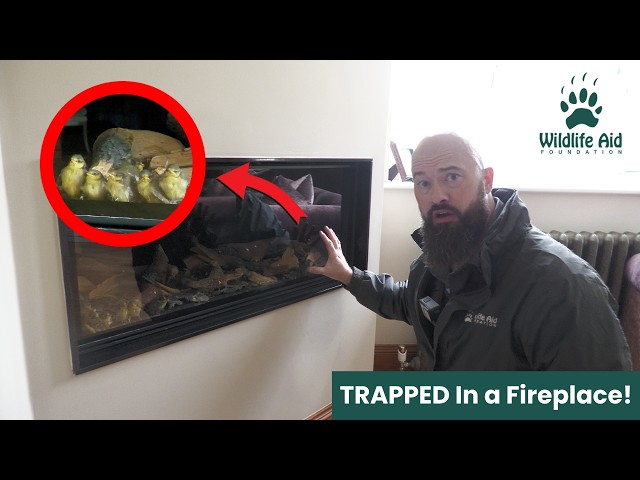
Some rescues arrive with the urgency of a clock running down, and this was one of them. Somewhere inside a residential chimney in Surrey, a family of baby blue tits had fallen. The fledglings were grounded in the ash and soot at the base of a chimney pipe, unable to fly out and unable to do anything other than call out in the only language available to them. Outside the house, just a few feet away on the other side of a wall and a sheet of glass, their mother was doing what every animal mother does in that situation: she was trying to get back to them. She could hear them. She could not reach them. And every second that passed was a second of needless separation for a family that had been intact until the moment one fledgling made a wrong turn and the others followed.
The Wildlife Aid Foundation received the call, and Louis responded.
What followed over the next several minutes was a rescue that required the particular combination of gentleness, patience, and speed that Wildlife Aid’s team has developed across years of responding to exactly these situations: small birds in impossible places, frightened and fragile, requiring human hands steady enough to extract them without causing the harm that clumsy handling would guarantee. Blue tits are among the smallest birds in the British garden, and fledglings of this species are at a stage of development where every physical encounter with the world is formative. Louis understood that, and it shaped the entire character of the intervention.
Blue Tits in British Gardens: Who These Birds Are
Before the specific urgency of this rescue, it is worth understanding what kind of animals were inside that chimney, because blue tits are not the generic category of small birds that they might superficially appear to be to anyone who has not paid them close attention.
The Eurasian blue tit is among the most recognizable and most studied garden birds in the United Kingdom. Its combination of vivid yellow breast, white cheeks, and the distinctive blue cap that gives the species its name makes it unmistakable at a feeder or in a hedgerow. It is also one of the most behaviorally sophisticated small passerines in the British avifauna. Blue tit pairs form strong seasonal bonds, and both parents share the work of feeding nestlings and fledglings through the demanding weeks when the young birds are transitioning from the nest to independent flight. The calls that fledglings use to communicate their location to parents are specific and consistent, allowing mothers to locate individual young birds in dense vegetation or, in this case, inside a chimney.
Blue tits nest in cavities, which is the biological background that makes chimney entrapments an annual Wildlife Aid category. A chimney is, from the perspective of a blue tit assessing nesting sites in early spring, not obviously different from a natural tree cavity: it is enclosed, it is elevated, and it has an opening at the top. Whether they nest directly in chimneys or whether fledglings from nearby nests end up inside them through exploratory flights that go wrong, the Wildlife Aid Foundation deals with chimney bird entrapments with regularity throughout the spring and summer. The blue tit’s choice of nesting habitat, in combination with the built environment of the British countryside and its many chimneys, creates a predictable and recurring rescue category.
The fledgling stage is the specific point in a young bird’s development when chimney entrapments are most likely. A true nestling, not yet capable of any independent movement, would not leave the nest site. But fledglings are in the transitional period when they can move around on surfaces, can hop and flutter, and are beginning to develop the flight capacity that will eventually allow them to navigate the three-dimensional world of open air. They are curious, they are mobile, and they have not yet developed the environmental judgment that experience eventually provides. A chimney opening, from the perspective of a newly mobile blue tit fledgling who has not yet learned to recognize it as a vertical drop into a closed space, is simply an interesting place to investigate.
The Rescue: Careful, Quick, Deliberate
Louis arrived at the property and was directed to the fireplace where the fledglings had come to rest. The specific challenge of a fireplace rescue is the combination of confinement and fragility that the situation presents. The space is small, the ash and soot create an unstable, dark surface, and the birds are frightened enough to flutter and struggle in ways that can cause injury if the person reaching for them is not moving with appropriate care and control.
Louis worked through the rescue systematically, freeing each fledgling individually rather than attempting to gather them all at once in a way that would have increased the stress and the risk of harm. Each tiny bird was lifted clear of the ashy interior, assessed briefly, and carried to the exterior of the property. The goal was not simply to remove them from the fireplace. The goal was to place them in a location visible from the outside where their mother could find them, in conditions where she would have the space and the confidence to approach and resume the feeding that the entrapment had interrupted.
This placement decision is one of the most important elements of a fledgling rescue, and it is one of the things that distinguishes Wildlife Aid’s approach from well-intentioned but counterproductive interventions by members of the public who find fledglings and assume, incorrectly, that a bird on the ground has been abandoned. Fledgling birds are almost never abandoned. In the vast majority of cases, a parent is nearby, monitoring the fledgling’s location and waiting for the human presence around it to recede before returning to feed it. The Wildlife Aid guidance, consistent with that of every major British wildlife organization, is to leave fledglings where they are found unless they are in immediate physical danger, because the mother’s presence and continued feeding are far more valuable to the fledgling’s survival than any human intervention.
In this specific case, the fledglings needed to be moved because a fireplace is by definition a physically dangerous environment that offered no opportunity for the mother to reach them. The move itself was therefore the minimum necessary intervention: get the birds out of the inaccessible space, place them in an accessible one, and then step back and wait.
The Wait
Anyone who has watched a Wildlife Aid rescue video will recognize the particular quality of the waiting period that follows the initial intervention. It is not dramatic in any conventional sense. The action has happened. The people are still. The outcome is not yet determined.
Louis and the Wildlife Aid team waited to see whether the mother blue tit would return. This is not a brief wait: it requires the kind of patience that is possible only when you understand what you are waiting for and why it matters. A mother bird who has been separated from her fledglings by a sudden human crisis, and who has been watching a human being handle her young and move them to a new location, does not return in the first thirty seconds. She needs to assess the situation, confirm that the human threat has receded, locate her fledglings by their calls, and make the judgment that approaching is safe. All of that takes time, and the time can feel, as the Wildlife Aid team described it, like watching a child walk through the door of school on their first day: full of hope and full of the particular anxiety of a moment whose outcome you cannot control.
Then the mother came back.
She returned to her fledglings, located them, and resumed feeding them. The family was reunited. What had been a crisis inside a fireplace, with young birds calling in the dark and a mother on the other side of the glass unable to reach them, resolved into a family intact and functional again in the garden where they belonged. The fledglings went on being fledglings, being fed by the mother who had been separated from them and who had not stopped trying to get back.
This is what the rescue was for.
Why Stories Like This One Matter
The blue tit rescue is not, in the taxonomy of Wildlife Aid calls, an unusual or especially complex situation. Louis and the team have handled hundreds of bird entrapments in chimneys, fireplaces, and other enclosed domestic spaces. The specific calls that the Wildlife Aid Foundation receives across a spring and summer in Surrey and the surrounding counties span every species and every kind of crisis that the proximity of British wildlife and the British built environment creates. The blue tit family is one data point in a year that will involve tens of thousands of individual wildlife incidents.
And yet the specific story of this family, the calling fledglings in the ash, the mother outside the glass, Louis’s careful hands moving each one to safety, the waiting, the return, matters in ways that the aggregate statistics of 20,000 annual incidents cannot capture. It matters because it is about a specific family of specific birds whose survival was, on that day, a genuinely open question for a period of time, and whose reunion was the direct result of people who had developed the skills, the organization, and the sustained commitment to show up when the call came in.
The Wildlife Aid Foundation has been doing this work since 1979. It runs Surrey County’s only dedicated wildlife hospital, handles calls across all species and all seasons, and maintains the expertise, the vehicles, the equipment, and the volunteer and staff capacity that makes a response to a blue tit in a fireplace possible within the kind of timeframe that matters for a family of birds who cannot wait for a convenient scheduling window.
This capacity exists because of donors. The Wildlife Aid Foundation is a charity, which means that every emergency line call that gets answered, every rescue vehicle that goes out, every hour of veterinary care that is provided to an animal that has been admitted to the hospital, and every training session that prepares the next generation of wildlife rescuers is funded by people who have decided that British wildlife deserves this level of organized, expert, sustained attention. The blue tit mother who got her fledglings back is not a beneficiary of a public service. She is a beneficiary of a community of supporters who make the Wildlife Aid Foundation possible.
Supporting the Work
If you have watched a Wildlife Aid video and felt something, which is the experience of most people who encounter their content for the first time, that feeling is the appropriate foundation for becoming part of the community that makes these rescues happen. The Wildlife Aid Foundation accepts donations through its website, and the impact of those donations is directly visible in the videos the team produces: each rescue is a funded response, and each funded response is an animal or a family that got a different outcome than it would have had without the call being answered.
The WAF emergency line is available for Surrey residents and the surrounding counties at 01372 360404, operating from 9 AM to 9 PM with volunteer monitoring through the night for situations that cannot wait. If you find an injured, sick, or orphaned wild animal in the region covered by Wildlife Aid, that number is the right first call.
And if a blue tit is calling from inside your fireplace this spring, now you know exactly what to do: call Wildlife Aid, and wait for Louis.
Sustainable Action Now features the Wildlife Aid Foundation as part of our Rescue Network coverage of the organizations doing this work across the United Kingdom and globally.