

No, 2 Percent of the Population Does Not Cause 91 Percent of America’s Crime
It’s a tidy number. Easy to say at a podium, easy to remember, easy to turn into a policy pitch. It’s also not real, and the actual math behind it reveals more about how statistics get bent into slogans than it does about crime in America.
It’s a great line. It’s also wrong.
President Trump has repeated this claim at multiple recent events, framing American crime as the work of a tiny, identifiable sliver of the population, one small enough to simply remove. The appeal is obvious. A problem that size sounds solvable. Round up two percent, the logic goes, and the other ninety-eight percent gets to live in peace.
Researchers at the Prison Policy Initiative went looking for where the number actually came from. What they found wasn’t a hidden database of super-criminals. It was a mix-up, two mix-ups, stacked on top of each other.
Where the Number Actually Comes From
When pressed to back up the claim, the White House pointed to Prison Policy Initiative’s own research. Specifically, a figure showing that roughly 5.6 million people are booked into local jails every year. That works out to somewhere between 1.7 and 2 percent of the U.S. population. The percentage lines up. The conclusion drawn from it does not.
A jail booking is not a conviction. It’s often not even a crime in the way most people picture one. Plenty of those 5.6 million bookings are for traffic violations, unpaid fines, or low-level offenses that never result in a charge sticking. Many people booked are released within days without ever being convicted of anything. Treating “booked into jail” as interchangeable with “committed 91 percent of all crime” isn’t a rounding error. It’s a different statistic entirely, repurposed to fit a narrative it was never built for.
The Swedish Study Nobody Actually Cited Correctly
There’s a second, more academically respectable number tangled up in this claim, and it’s worth understanding because the underlying research is real. A widely cited study tracking Swedish citizens over several decades found that a small group of persistent violent offenders, about 1 percent of the population studied, accounted for 63.2 percent of violent crime convictions in that country.
That finding is genuine, and criminologists broadly accept the underlying pattern it points to: a relatively small number of repeat offenders are responsible for a disproportionate share of violent crime specifically. But that’s a narrow, well-defined claim about violent crime convictions in one country’s justice system over a multi-decade window. It is not a claim about all crime, in any country, and it does not scale up to “91 percent of American crime” just because both numbers happen to involve small percentages.
Stretching a narrow, country-specific finding about violent offenders into a sweeping claim about all crime nationwide is exactly the kind of leap that gives a statistic the appearance of rigor while stripping out everything that made it accurate in the first place.
Why the Real Numbers Tell a Different Story
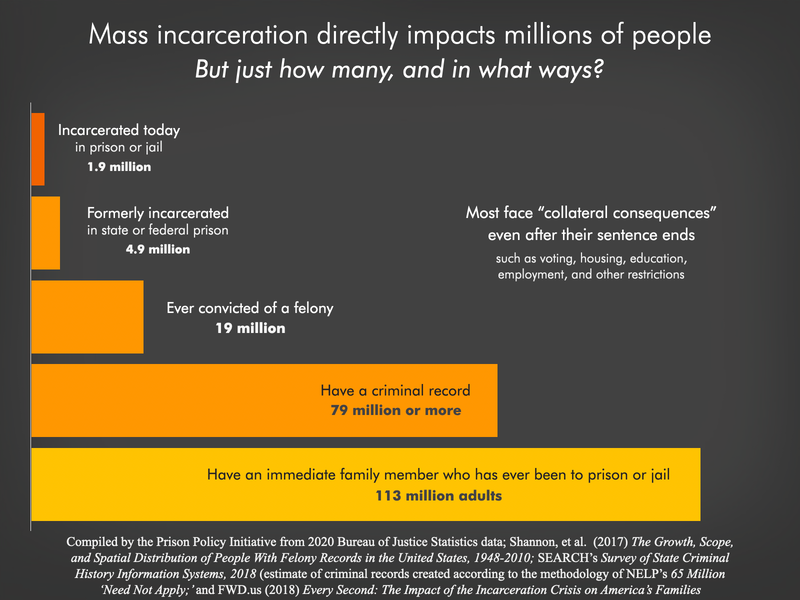
Here’s the part that actually undercuts the claim on its own terms. Criminalization in the United States isn’t a rare, isolated phenomenon confined to a tiny sliver of society. It’s remarkably widespread. Roughly 79 million Americans, close to a quarter of the entire country, have a criminal record of some kind. Of those, 19 million have a felony conviction specifically. And according to research from FWD.us, nearly half of all American adults have had an immediate family member spend time in prison or jail.
Put those numbers next to each other and the “tiny two percent” framing falls apart fast. You cannot simultaneously argue that crime is the product of a small, removable subset of the population while the data shows that a quarter of the country carries a record and half the country has a close family connection to incarceration. Those are not compatible pictures of the same country.
The Claim’s Logic
Crime is concentrated in a small, identifiable group. Remove that group, and the crime problem is largely solved.
What the Data Shows
Nearly a quarter of Americans have a criminal record, and nearly half have a close family member who has been incarcerated. Criminalization is broad, not narrow.
What the claim leaves out entirely: corporate and white-collar crime, drug-related offenses tied to addiction cycles rather than career criminality, and localized, situational street crime all fall outside any tidy demographic bucket. None of it disappears if a specific 2 percent of the population is removed from society, because none of it was ever concentrated there to begin with.
The honest version of this story is less satisfying.
Crime in America doesn’t come from a small, exportable group of “super-criminals” waiting to be identified and removed. It comes from a mix of causes, some concentrated among repeat offenders, plenty more scattered across addiction, economic desperation, corporate malfeasance, and ordinary human conflict, none of which fits neatly into a two percent solution. Criminologists do agree that a relatively small share of repeat offenders drives a disproportionate share of violent crime specifically. That’s a real, useful finding. It is simply not the same claim the president has been making, and no amount of repetition turns one into the other.
Bad statistics make for easy slogans and bad policy in equal measure.
Follow more coverage in the Sustainable Action Now criminal justice section.