

Florida’s Record Pace of Executions Continues With Three More Scheduled This September
Governor Ron DeSantis has signed death warrants for three men whose cases span five decades, keeping Florida on track to match or exceed last year’s modern record, while advocates and faith leaders prepare vigils and one case draws renewed attention over a still pending claim of innocence.
Florida’s death chamber has rarely gone quiet this year. In 2025, Governor Ron DeSantis signed a modern record 19 death warrants that resulted in execution, more than double the state’s previous high of eight in a single year. Twenty twenty six has continued at nearly the same pace. On August 18, William Silvia was put to death for the 2006 murder of his estranged wife, Patricia Silvia, becoming the thirteenth person executed in Florida this year. Now three more executions are scheduled for September, and if all three proceed, they will push the state’s total for the year to sixteen.
The cases share little beyond their outcome. One involves a man who has spent nearly fifty years on death row and recently chose to stop fighting his sentence. Another involves a conviction that the condemned man has never stopped disputing, with a request for new DNA testing still pending when his death warrant was signed. The third is a case from the mid 1990s that has drawn less public attention so far but follows the same accelerated legal timeline that has defined DeSantis’s approach to capital punishment.
Three Executions, Three Decades of Cases
Scheduled September 1
Now 74, Lucas has spent nearly half a century on death row for the 1976 murder of his girlfriend, Jill Piper, whom he shot after the two became embroiled in a heated argument, also wounding two of her friends in the same attack. He was first sentenced to death in 1977. Citing court records, advocates note that the Florida Supreme Court overturned that sentence four separate times over the following decades, and each time prosecutors returned to seek death again rather than allow a life sentence, resulting in five separate death sentences for the same crime. Lucas has recently chosen to waive his remaining appeals.
Scheduled September 10
Conahan, 72, was convicted of kidnapping and strangling Richard Montgomery, a man he had paid to pose for photographs, in 1994. Authorities have long suspected him in similar killings from that period in southwest Florida, though he has never been charged in connection with those cases. Conahan has maintained his innocence in the Montgomery killing throughout nearly three decades of appeals, and his attorneys had a request for new DNA testing pending in court when the death warrant was signed. His defense argues that the case against him rested heavily on testimony from a jailhouse informant rather than physical evidence, a claim prosecutors dispute.
Scheduled September 29
Beasley was sentenced to death for the 1995 murder of Carolyn Monfort. His execution, set for 6 p.m., would be the sixteenth carried out in Florida this year if it proceeds as scheduled, following closely behind the Lucas and Conahan cases earlier in the month.
Why Advocates Are Watching Closely
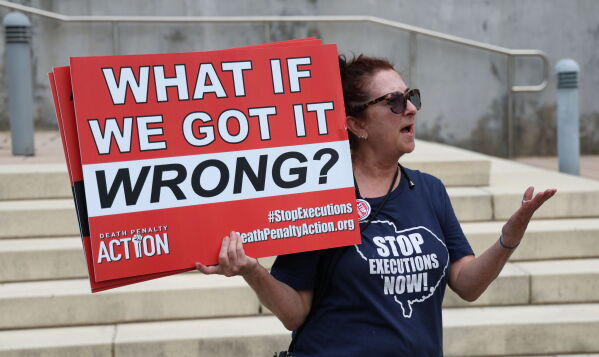
Florida’s accelerated pace has drawn sustained attention from anti death penalty groups, most visibly Floridians for Alternatives to the Death Penalty, which organizes vigils outside Florida State Prison in Starke for nearly every scheduled execution in the state. Members of the group describe the vigils as a mix of prayer, reflection, and public witness intended to keep individual cases from disappearing into a broader statistic. During Silvia’s execution on August 18, a severe storm forced attendees to shelter inside a bus provided by a local Catholic church, and organizers later said that a clap of thunder at the moment the execution was carried out left a lasting impression on those present.
DeSantis has defended the accelerated schedule directly, framing it as an overdue reckoning for victims’ families who have waited decades for sentences to be carried out. He has also said publicly that he would not allow an execution to proceed if he genuinely believed the person was innocent, a statement that puts particular scrutiny on cases like Conahan’s, where an innocence claim remains actively contested in court rather than settled.
How a case moves from sentencing to execution: Florida’s process includes automatic direct appeal to the state’s highest court, post-conviction review where defense attorneys can raise new evidence or claims of inadequate representation, and the option of federal court review on constitutional grounds. A governor’s decision to sign a death warrant typically triggers one final, compressed round of emergency appeals before an execution date becomes final, which is why the weeks immediately following a warrant tend to see the most legal activity in a case.
That compressed appeals window is itself part of the controversy. Defense attorneys and advocacy groups argue that signing warrants in cases with unresolved evidentiary questions, such as a pending DNA testing request, forces courts to rule quickly on issues that would otherwise receive more deliberate review. State officials counter that every case scheduled for execution has already passed through years, and in some cases decades, of direct appeals, post-conviction review, and federal court scrutiny before a warrant is ever signed.
Whatever position one takes on the pace of Florida’s executions, the practical effect is that three men with cases spanning three different decades are now scheduled to die within a four week window this September. For their families, for the families of the people they were convicted of killing, and for the advocates and officials who have spent years arguing over how these cases should be resolved, the coming weeks will bring that long running debate back into sharp, immediate focus.
Capital punishment policy continues to generate active legal and public debate nationwide.
Follow more coverage in the Sustainable Action Now death penalty section.