
Marine Conservation | Feature Report
The Tanks Are Emptying: Inside the Global Collapse of the Dolphin Captivity Industry
Bankruptcies, criminal investigations, and a wave of new laws are doing in a few years what decades of protest could not. The dolphin entertainment business is running out of road.
Something has shifted in 2026. Not gradually, either. Marine parks that survived generations of public pressure are folding within months of each other, and the animals inside them are being counted, catalogued, and shipped across borders like assets on a balance sheet, because in more than one case, that is exactly what they have become.
For half a century, the dolphin show was a fixture of family vacations, a guaranteed crowd-pleaser wedged between the water park and the gift shop. That era is ending, and it is ending faster than almost anyone predicted. Governments are banning the practice outright. Courts are liquidating the companies that built their business models around it. And in several deeply troubling cases, dolphins have died in front of paying audiences, forcing regulators to do what advocacy campaigns alone could not.
None of this is happening cleanly. For every headline announcing a ban or a closure, there is a harder, messier story underneath it about where the animals actually go once the gates shut. That tension, between legal victory and logistical reality, is the story of dolphin captivity in 2026.
350
dolphins still in tanks after Mexico’s ban
87
dolphins & manatees held as bankruptcy collateral
30
beluga whales airlifted out of Marineland Canada
Mexico’s Historic Ban, and the 350 Dolphins Still Waiting
Mexico passed one of the most sweeping animal welfare reforms in the country’s history this year, outlawing dolphin shows, captive breeding programs, and the swim-with-dolphins encounters that had made resorts in Cancún and the Riviera Maya a global hub for the industry. On paper, it is a landmark law. In practice, it has created a strange and uncomfortable pause.
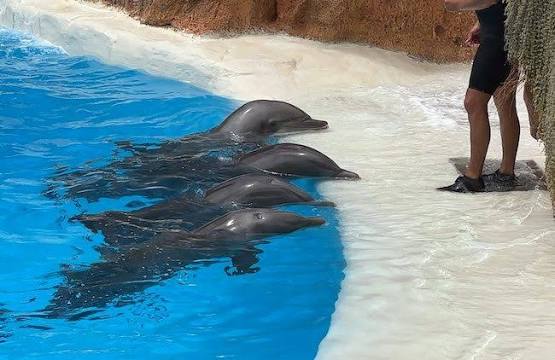
Roughly 350 dolphins remain in concrete pools across the country right now, technically covered by a ban that has already taken effect, while officials work out how, and where, to move them. Seaside sanctuaries, the more natural, ocean-enclosed spaces that welfare groups have pushed for as an alternative to traditional tanks, are still mostly theoretical in Mexico. Building one takes money, permits, and time. None of those things move as fast as legislation does. So the dolphins wait, technically freed by law but physically unmoved, in facilities that were never meant to be permanent housing under a captivity ban.
It is a pattern worth remembering, because it repeats itself almost everywhere a ban has passed. Winning the legal fight turns out to be the easier half of the battle.
France Closes the Curtain, and Eight Dolphins Fly to Spain
France’s reckoning has been years in the making. A 2021 animal welfare law set a firm end date for dolphin and orca performances, and this year the deadline finally arrived at Marineland Antibes, once one of Europe’s largest marine parks. The gates closed. The crowds stopped coming. And then came the part nobody likes to talk about at the press conference: what happens to the animals themselves.
Eight dolphins were flown out of France to a facility in Spain, a logistically complicated and stressful undertaking for any marine mammal, let alone one that has spent its life in a single enclosure. The move exposed an uncomfortable gap between the intention of France’s law and the infrastructure needed to carry it out responsibly. A ban without a fully built exit plan does not free an animal. It relocates a problem, sometimes across an international border, and asks the next facility to absorb it.
Critics of how the closure was handled have been blunt about it: banning the show is the easy part. Figuring out where thirty-year-old dolphins go afterward, animals who in many cases could never survive release into open water, is the part that actually requires planning, funding, and a sanctuary system that mostly does not exist yet.
Taiwan Retrains Its Trainers
Taiwan has taken a quieter, arguably smarter approach. Captive dolphin performances there are being phased out on a set timeline, but instead of simply laying off the staff who worked with the animals for years, the country is converting former trainers into full-time caretakers. It is a small detail, but it matters. The people who understand these animals best, who can read their stress signals and health needs, are staying in the room. They are just no longer being asked to put on a show.
When the Dolphins Become Collateral
Then there is money, which turns out to be a far more effective regulator than any single piece of legislation. The Dolphin Company, once one of the largest operators of marine parks and swim-with-dolphins attractions in the world, filed for bankruptcy this year. A United States court is now sorting through the wreckage, and the fight over the company’s assets includes a detail that should stop anyone reading it: 87 captive dolphins and manatees are being treated as financial collateral in a legal dispute with the company’s former chief executive.
Living animals, some of them intelligent enough to recognize themselves in a mirror, are line items in a bankruptcy proceeding.
Their fate is currently tangled up in the same courtroom battle deciding who gets paid first among the company’s creditors. It is hard to imagine a clearer illustration of what the captive dolphin industry actually is at its core: not conservation, not education, but a business, and one that is now failing in exactly the way businesses fail, with the most vulnerable stakeholders having no voice in the outcome at all.
Gulf World and the Death of Jett
Panama City Beach’s Gulf World Marine Park had been a Florida fixture for decades. It is permanently closed now, and the reason is not a graceful business decision. A bottlenose dolphin named Jett suffered a fatal head trauma during a live public performance, an injury severe enough to trigger a criminal investigation. Visitors who came expecting an afternoon of entertainment instead witnessed the kind of incident that no amount of public relations can soften.
The park never reopened. Regulators moved in. And a facility that had operated for generations became, almost overnight, a cautionary example cited in welfare debates around the world.
Marineland Canada’s Emergency Airlift
In Ontario, the shutdown of Marineland in Niagara Falls set off one of the largest coordinated animal relocations in recent memory. With the park closed, authorities in the United States approved an emergency plan to move its remaining 30 beluga whales and four dolphins south, into major American facilities including the Georgia Aquarium and SeaWorld San Diego.
Calling it a rescue is fair. Calling it simple would not be. Relocating thirty beluga whales is an enormous undertaking involving transport crates, veterinary teams, and receiving facilities large enough to absorb that many animals at once. It is also a reminder that even when a park closes and a captivity operation ends, the animals inside it do not simply get to go home. There is no ocean waiting for a beluga born and raised in a Canadian tank. There is only the next facility, and the hope that it is better than the last one.
Chelsea and Cecil: Two Deaths, One Uncomfortable Question
Two individual dolphins became the emotional center of this year’s captivity debate, and their stories, while different, point at the same underlying problem.
At Six Flags Discovery Kingdom in Vallejo, California, a 40-year-old dolphin named Chelsea was euthanized. She had been a fixture of the park for years, familiar enough to regular visitors that her death made local and national news within hours. PETA responded immediately, renewing its long-standing demand that Six Flags end its swim-with-dolphins encounters entirely and relocate the animals still living there.
At Kolmården Zoo in Sweden, a 42-year-old bottlenose dolphin named Cecil was euthanized after his immune system began failing with age. Marine conservation groups seized on his death to raise a question that captivity defenders have never fully answered: what does it actually mean to keep an animal alive into old age inside a concrete enclosure, decades removed from the ocean, the pod, and the environment its entire biology evolved for?
Chelsea and Cecil did not die from abuse or neglect in the way those words are usually used. They died of old age, cared for by staff who by most accounts were attentive and invested. And that is precisely what makes their deaths so uncomfortable to sit with. It suggests the problem was never only about cruelty in the dramatic, headline-grabbing sense. It is about confinement itself, sustained for forty-plus years, regardless of how well the water is filtered or how many fish are handed out on schedule.
Stolen From the Ocean for a Show
It is worth pausing on the basic premise here, because it is easy to lose under all the legal and financial detail. Dolphins are wild, highly social, cognitively complex animals. Many of the ones living in marine parks today were either captured from open water or bred specifically to be raised in tanks and trained to perform. Either way, the arrangement asks an animal built for open-ocean travel, echolocation, and pod-based social life to spend its entire existence in a fraction of that space, on a schedule designed around ticket sales.
Dolphins belong in the ocean. Not in a pool. Not on a stage. That is not a controversial statement inside the scientific community studying cetacean cognition and behavior, even if it remains a controversial business model for the parks still trying to hold onto their remaining shows.
The easiest thing in the world is to close a marine park. The hardest thing is to figure out where forty years of captivity actually ends.
Where This Leaves Us
Put the pieces of 2026 side by side and a pattern emerges that is bigger than any single park or any single country. Mexico banned the practice and is now scrambling to build somewhere for 350 dolphins to actually go. France closed its most famous marine park and had to fly its remaining animals out of the country. Taiwan is retraining rather than firing its staff. A major operator went bankrupt with dozens of animals treated as collateral in a corporate dispute. A dolphin died on stage in Florida and took an entire park down with him. Thirty belugas needed an emergency airlift out of Canada. And two elderly dolphins, an ocean apart, died of the kind of decline that only decades of confinement can produce.
The industry is not disappearing because public opinion finally caught up with it, although that is part of it. It is disappearing because the economics, the legal exposure, and the sheer logistical burden of housing large marine mammals for forty or fifty years have become impossible to justify, whether the pressure comes from a courtroom, a criminal investigation, or a new law. What comes next matters enormously. A ban that leaves 350 dolphins sitting in the same tanks they were supposed to be freed from is not a solution. It is a delay. Building real, funded, ocean-based sanctuary space has to be the next fight, because the animals already living out their lives in captivity are not going to simply vanish along with the industry that put them there.
We’ve been tracking this shift closely, park by park and case by case, and our ongoing coverage of the dolphin captivity crisis goes deeper into what happens after the headlines fade, including which sanctuaries are actually being built and which parks are still fighting to keep their tanks full.
Never buy a ticket to a marine park that exploits dolphins.
Every ticket sold to a captivity-based show funds another year in the tank. Choose ocean tours, sanctuary visits, and conservation-based experiences instead, and ask parks in your area what their long-term plan is for the animals they currently hold.
#Dolphins #EmptyTheTanks #EndCaptivity