
Three stories from FOUR PAWS this week: a leopard who escaped death by luck, a big cat who destroyed a cardboard puzzle in record time, and a law so contradictory it has to be seen to be believed.
The Leopard Who Was Labelled a “Problem Animal” Has Been Home for 20 Years
Three stories from FOUR PAWS this week: a leopard who escaped death by luck, a big cat who destroyed a cardboard puzzle in record time, and a law so contradictory it has to be seen to be believed.
FOUR PAWS International produced three pieces of content this week that, read together, capture the full range of what large-scale animal welfare work looks like in practice: the long-term care of an individual animal whose existence at LIONSROCK Big Cat Sanctuary is the direct result of someone choosing not to kill him, the creative daily work of the caretakers at FELIDA Big Cat Sanctuary who build enrichment that a determined leopard will cheerfully dismantle in minutes, and a new film that exposes one of the most logically incoherent regulatory situations in UK law.
Leopard Mike Was Called a “Problem Animal.” LIONSROCK Called Him Something Else: Home.
Leopard Mike at LIONSROCK Big Cat Sanctuary, where he has lived since 2005.
In 2005, a leopard was caught in a live trap in the landscape where wild animals and human settlements overlap in South Africa, in the specific geography where that overlap produces what wildlife managers classify as conflict. He was given a label that gets applied with bureaucratic regularity to wild animals who cross the invisible line between acceptable presence and inconvenient presence: “problem animal.” The label is almost always the last administrative step before a killing order. For this leopard, it was not. Someone made a different call. He arrived at LIONSROCK Big Cat Sanctuary in the Free State instead of dying in the field. His name at the sanctuary became Mike, and in 2025 he marked twenty years of living there.
The phrase “problem animal” carries institutional logic that makes it sound more neutral than it is. A leopard that raids livestock, or that establishes territory bringing it into regular contact with human activity, is classified as a problem animal, triggering management responses that include relocation, lethal control, or live capture for trade. The classification reflects the interests of the humans in the conflict scenario, which is understandable, but it treats the animal’s presence in shared landscape as a problem the animal created rather than as a consequence of the progressive reduction in wild habitat that has been ongoing across sub-Saharan Africa for generations. The leopard did not expand into human territory. Human development expanded into leopard territory, and the leopard born in that territory is the one labeled the problem.
Mike has been at LIONSROCK for two decades, making him one of the longer-tenured residents at a sanctuary that now houses more than 70 lions and other big cat species. His life at the sanctuary bears no resemblance to what his life as a free leopard would have been. He will not hunt again. He will not establish territory the way his species is designed to. What he has is safety, consistent veterinary care, nutrition, a species-appropriate environment, and the particular peace of an animal whose presence no longer puts his life in danger every time he makes contact with the human world.
Captured in a live trap, labeled a “problem animal”
Instead of being killed, Mike was transferred to LIONSROCK Big Cat Sanctuary, where FOUR PAWS operates a large-scale permanent care facility for big cats rescued from exploitation and human-wildlife conflict.
Twenty years at LIONSROCK
Mike has spent two decades as a permanent resident, receiving expert veterinary care, appropriate nutrition, and daily enrichment from caretakers who know him as an individual.
Twenty-year anniversary
FOUR PAWS shared Mike’s story this week as part of its advocacy around human-wildlife conflict and the alternatives to lethal management that sanctuary infrastructure can provide.
Human-Wildlife Conflict and the Scale of the Problem
Human-wildlife conflict is one of the most significant conservation challenges of the current century, driven primarily by the expansion of agricultural and settlement land into habitat previously available to wild species. Leopards across Africa and Asia are among the species most affected because their adaptability allows them to persist in fragmented landscapes, bringing them into regular proximity with human populations and livestock. Lethal control remains the dominant response in most jurisdictions. Sanctuary infrastructure and non-lethal conflict mitigation tools represent an alternative that requires investment most regional wildlife management systems have not yet prioritized at the required scale.
Support Mike and the Animals at LIONSROCK
FOUR PAWS operates LIONSROCK for more than 70 big cats rescued from conflict and the illegal wildlife trade. Every animal there is there for life. Supporting that commitment means being part of what keeps Mike’s story going.
Donate to FOUR PAWS Adopt a Big CatManuschka vs. the Cardboard Puzzle: A Story About Enrichment, Patience, and a Very Determined Leopard
Tess built it. Manuschka dismantled it. This is what excellent animal care actually looks like.
At FELIDA Big Cat Sanctuary in Nijeberkoop, Netherlands, a caretaker named Tess spent hours building a cardboard puzzle enrichment for a leopard named Manuschka. Manuschka spent considerably less time taking it apart. The FOUR PAWS video documenting the encounter has the structure of a comedy, but what it actually documents is something considerably more important than a funny moment, and it is worth explaining why.
Enrichment is not a supplementary nicety in big cat sanctuary care. It is a welfare necessity, grounded in the behavioral science of what happens to cognitively complex animals when they are denied the mental and physical stimulation their biology requires. Wild leopards spend the majority of their active hours hunting, establishing territory, and investigating environmental stimuli. In a sanctuary enclosure, however spacious, none of those activities is available in the form a wild leopard experiences them. Enrichment is the mechanism through which caretakers address that deprivation, creating novel objects, puzzles, and physical challenges that engage the same cognitive systems that hunting and territorial behavior engage in the wild.
The fact that Manuschka’s cardboard puzzle doesn’t survive the encounter intact is not a failure. It is evidence that it worked. An engaged animal applied focused effort to an environmental challenge, which is precisely what the enrichment was designed to produce. The cardboard is replaceable. The behavioral health that the engagement supports is what matters.
|
🧠
Cognitive StimulationPuzzle enrichment engages problem-solving capacity and keeps cognitive function active in animals whose wild counterparts spend hours daily navigating complex spatial and hunting challenges. |
🐾
Physical ActivityManipulating and investigating enrichment objects provides physical engagement that supplements the movement animals would get through territorial behavior in the wild. |
|
🌿
Natural BehaviorsEnrichment designed around predatory behaviors and scent investigation allows animals to express behavioral repertoires that captive environments otherwise suppress. |
😊
Psychological WellbeingRegular enrichment reduces stereotypic pacing and repetitive behaviors that develop in chronically under-stimulated captive animals. |
About FELIDA Big Cat Sanctuary
FELIDA Big Cat Sanctuary in Nijeberkoop, Netherlands, operates as FOUR PAWS’s specialist intake and rehabilitation facility for big cats rescued from exploitation across Europe and beyond. It houses lions, leopards, tigers, and other big cat species in a setting designed for intensive, individualized care, with a caretaker team whose approach centers on building genuine trust with animals who have every reason not to extend it.
Hunting Trophies Are Allowed. Certain Everyday Foods Are Not. The UK Government Needs to Explain Itself.
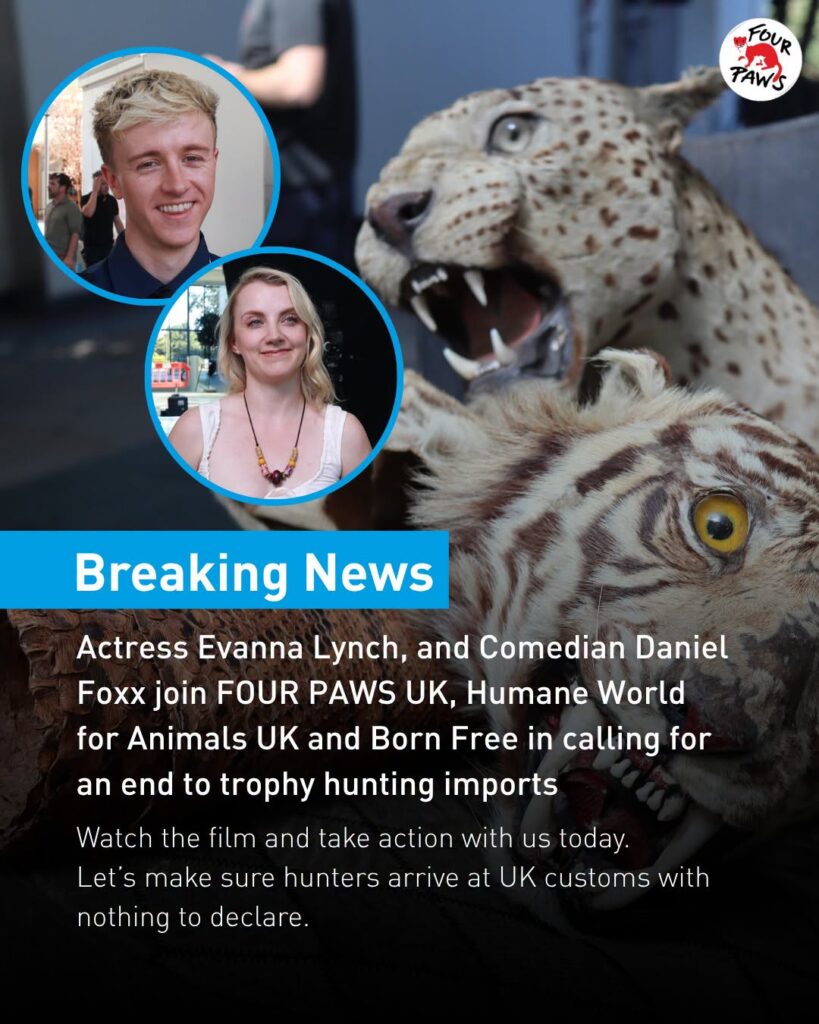
Daniel Foxx and Evanna Lynch on the UK’s inconsistent import rules and why a hunting trophy ban is long overdue.
FOUR PAWS UK, in coalition with Humane World for Animals UK and Born Free, has released a new film featuring actors Daniel Foxx and Evanna Lynch that places two categories of imported goods side by side and asks the UK Government to explain the logic. Hunting trophies, which include the body parts of lions, elephants, leopards, rhinoceroses, and other threatened species killed specifically for sport, are legal imports into the United Kingdom. Certain common food products face import restrictions so strict that bringing them across the border can result in confiscation and fines. The film is titled “Nothing to Declare.”
The hunting trophy import debate in the United Kingdom has produced a series of legislative attempts that stalled or were watered down in passage through Parliament. The Hunting Trophies (Import Prohibition) Bill passed its second reading in the House of Commons with broad cross-party support, only to be stalled in committee and effectively shelved without becoming law. The coalition behind “Nothing to Declare” is now directly challenging the government’s continued inaction.
| 700 lions killed annually for trophy hunting | 20,000 wild lions remaining in Africa | 70% decline in wild lion populations over 50 years | 0 comprehensive trophy bans enacted in UK law |
What a Hunting Trophy Import Ban Would Do
A comprehensive UK ban on the import of hunting trophies from threatened species would prohibit British nationals from bringing back parts of animals killed in trophy hunts abroad, removing the UK from the demand side of the international trophy trade. The UK is one of the largest destination markets for hunting trophies globally, and removing its participation would reduce demand meaningfully while signaling international norms that other countries have historically followed.
Take Action on the Hunting Trophy Ban
Watch “Nothing to Declare,” share it, and use the campaign action link to contact your elected representatives. The UK Government has the authority to end this inconsistency. The only thing it lacks is sufficient public pressure.
Take Action Now Follow FOUR PAWS UKSustainable Action Now Rescue Network
Leopard Mike’s twenty years at LIONSROCK. Manuschka’s cardboard puzzle. A film that exposes a legal absurdity. These are the stories the SAN Rescue Network exists to amplify.
Visit the SAN Rescue NetworkSustainable Action Now: FOUR PAWS Coverage
We cover FOUR PAWS, LIONSROCK, FELIDA, and the full network of organizations doing long-term rescue, rehabilitation, and advocacy work globally. Mike has been home for twenty years. Manuschka destroyed the cardboard. The film is out. Share all of it.