

Death Penalty · Statement
Statement on the Execution of Thomas Mitchell Overton
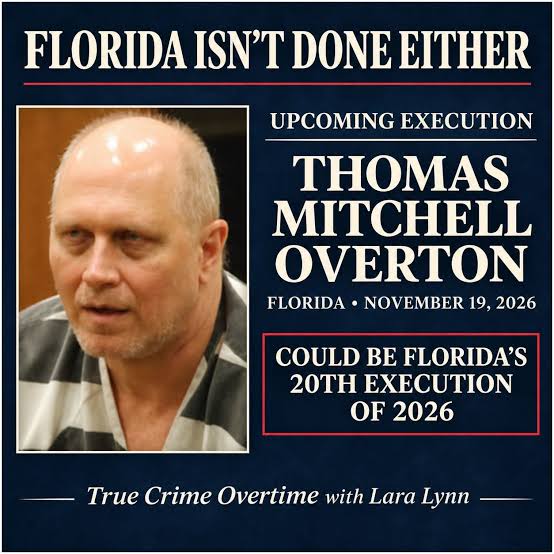
Tonight, We the People of the State of Florida executed Thomas Mitchell Overton for the 1991 murders of Michael and Susan “Missy” MacIvor. He was simultaneously convicted in the death of their unborn child. Thomas’s execution set a grim record. It was Florida’s 20th execution this year, breaking the record set just last year and cementing Ron DeSantis’s place as the deadliest governor in Florida’s history. Thomas’s case exposes nearly every shameful crack in Florida’s death penalty system and lays bare the steady cruelty with which this administration has chosen the condemned.
The murders of Michael and Missy MacIvor were brutal. They were in the prime of their lives, eagerly anticipating the birth of their son and looking forward to the years ahead. Instead, they were killed in a gruesome and devastating way. We grieve for them tonight, just as we know their loved ones have grieved for the past 35 years. The MacIvors deserved a full and transparent investigation into their deaths. Instead, a confluence of failures, any one of which should have given the State pause, carried this case all the way from a compromised crime scene to the execution chamber.
Thomas survived childhood abuse at the hands of the State of Florida at the Dozier School for Boys. He went on to serve our country in the United States Army. He has always maintained his innocence, and he was ultimately convicted and sentenced to death on the back of snitch testimony, prosecutorial misconduct, and perhaps one of the most random and arbitrary death penalty rulings in Florida Supreme Court history.
Thomas’s jury could not unanimously agree that the death penalty was the appropriate punishment, voting 8-4 and 9-3 for death. This is incredibly common in cases where jurors harbor residual doubt about a defendant’s guilt. Florida, which holds the national record for death row exonerations, has every reason to take those votes seriously. Of Florida’s death row exoneration cases with known jury votes, over 90% of them were either non-unanimous jury verdicts for death or unanimous verdicts for life which were overridden by a judge.
The arbitrariness of Thomas’s death sentence did not stop with his divided jury. After the U.S. Supreme Court struck down Florida’s capital sentencing scheme in Hurst v. Florida, the Florida Supreme Court drew a line at June 24, 2002, to decide who on death row could get a new sentencing hearing. Thomas’s death sentences became final just 42 days before that cutoff. Had his direct appeal taken a few weeks longer, he would have stood before a new jury, and all twelve jurors would have had to agree that he should die. More than 100 people qualified for relief, and more than 75% of them ultimately received sentences of life or less. For Thomas, the wholly random timing of his appellate denial may well have determined whether he lived or died.
Had he not been arbitrarily denied based on a random calendar date, Thomas would have also had more time to prove what he and his lawyers have long argued – that he did not commit this crime. The investigative and prosecutorial conduct in this case is astounding. The sheriff’s office entrusted key evidence to a veterinarian who tested it in his spare bedroom, stored samples in his personal refrigerator, and brought evidence to a psychic who handled it without gloves. Among the items the psychic handled was a pipe consistent with Michael MacIvor’s injuries. Prints recovered from the pipe and an address book did not match Thomas, and hairs found on the tape used to bind the victims have never been DNA tested. Investigators initially suspected multiple attackers and examined a possible connection to international drug smuggling. Yet prosecutors built their case around semen attributed to Thomas that was found on a mattress pad beneath a fitted sheet. His lawyers argue that the sperm cells could not have passed through the sheet as prosecutors suggested, and that a chemical associated with spermicidal condoms found on the bedding supports Thomas’s claim that the evidence was planted. Prosecutors also relied on jailhouse informants, one of whom reportedly told a defense investigator that authorities threatened him with criminal charges and coached his testimony.
Thomas never wavered in his claim of innocence, and became a strong self-advocate during his years on death row. He also found a way to look out for children who, like him, had found themselves in the care of the State. When he learned that one of his penpals worked with children in foster care, he began drawing cards for her to give them as they moved from one home to the next. He called them “Goodbye Cards,” and filled them with cartoon characters he hoped would make them smile. The children did not know his name or his situation, but there is no doubt that they found encouragement in having something that had been made just for them.
Governor DeSantis hopes to be remembered as the governor who carried out more executions than any other in Florida’s history. He will be. But his legacy will be measured by what he was willing to overlook to claim that record. As more of the country leaves the death penalty behind, he has used the final years of his governorship to desperately keep Florida clinging to it. Tonight, he chose to execute a man whose jury could not agree he should die, whose chance at a new sentencing hearing turned on 42 days, and whose claim of innocence could still have been tested. In his pursuit of a place in Florida history, Governor DeSantis has secured one on the wrong side of it.