
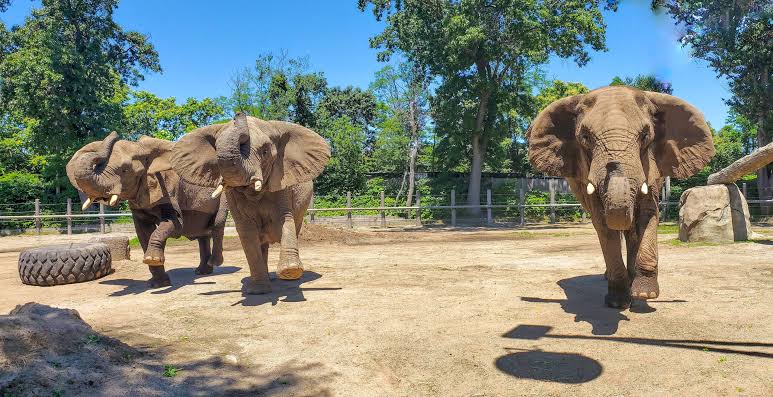
On June 30, 2026, Roger Williams Park Zoo in Providence, Rhode Island, announced the most significant decision it has made in decades: Alice, Ginny, and Kate, the three African elephants who have called the zoo home since October 1990, will be relocated to The Elephant Sanctuary in Tennessee in late 2027. The three animals, who are the only African elephants in New England and have lived together as a bonded trio for their entire lives at the zoo, will complete their days in Hohenwald, Tennessee, on 3,060 acres of natural habitat that is the largest refuge of its kind in the United States built specifically to care for African and Asian elephants.
The announcement has been welcomed by animal welfare advocates who have been watching and waiting for decades for institutions to make exactly this kind of decision: proactive, driven by the animals’ needs rather than by crisis, and executed with enough lead time to do it right. It is, as the zoo’s own leadership has framed it, a decision made while all three elephants are healthy and still together, in order to prevent the scenario that every keeper of aging bonded elephants fears most: that one animal will die while in the zoo’s care, leaving surviving companions without the long-term social structure that elephant welfare requires.
At Sustainable Action Now, we have been covering the campaign for elephant welfare in captivity consistently because it represents one of the clearest illustrations of the fundamental incompatibility between what elephants need and what zoo settings can provide. The decision by Roger Williams Park Zoo to send Alice, Ginny, and Kate to sanctuary is not simply a news item about a zoo closing its elephant program. It is a model decision, one that reflects genuine institutional commitment to the animals’ long-term welfare rather than to the institution’s interests in retaining exhibit animals. And the logistics of how that decision will be executed over the next year and a half contain lessons about what responsible sanctuary transfer actually requires that the broader conversation about zoo elephants often overlooks.
Who Alice, Ginny, and Kate Are
Three decades in a single place is a long time to be anywhere, and by that measure Alice, Ginny, and Kate have been Rhode Islanders longer than most of the people who have watched them through the zoo’s viewing areas have been alive. The three African elephants first arrived at Roger Williams Park Zoo in October 1990. They have been inseparable ever since, a closed social trio whose bond has deepened across 36 years of shared daily experience in the same enclosure, with the same keepers, through Rhode Island’s full range of seasons.
African elephants in the wild form societies organized around matrilineal family groups that remain together across generations. The matriarch of a herd carries knowledge that younger animals rely on, including navigational memory of water sources and seasonal migration routes, cultural behaviors transmitted through observation, and the social authority that comes from being the most experienced animal in a group. The three animals at Roger Williams Park Zoo have lived in a version of this social structure compressed into a much smaller world, but the bonds they have formed are no less real for operating within captive constraints. They are a family.
Alice is the oldest member of the trio, at over 50 years of age. At that age, an African elephant in the wild would be among the most respected and relied-upon members of her herd. Her knowledge and experience would be the resource her family group organized around. At Roger Williams Park Zoo, she has been well cared for across her decades there, but the zoo can provide none of what her age and experience would mean in a wild context. What it can do, and what it is doing through this announcement, is give her the best available alternative for her remaining years: a 3,000-acre landscape where she and her companions can move freely, make choices about where to go and what to do, and exist in conditions that respect what they are in ways that no zoo enclosure can fully achieve.
Stacey Johnson, executive director of Roger Williams Park Zoo, stated the zoo’s reasoning directly: the priority has always been keeping Alice, Ginny, and Kate together. The Elephant Sanctuary offers an environment designed specifically for elephants and provides opportunities for them to live alongside other elephants while receiving expert care as they grow older.</cite>
Amy Roberts, the zoo’s chief zoological officer, added that after the team visited The Elephant Sanctuary and saw its approach firsthand, they became confident it offers the environment and care that best meets the three animals’ needs as they age.
The Elephant Sanctuary in Tennessee: What Awaits Them
The Elephant Sanctuary in Tennessee, located in Hohenwald, approximately 85 miles southwest of Nashville, is the largest natural-habitat elephant refuge in the United States. The sanctuary’s stated mission is to provide home, herd, rest, refuge, and care for life to the elephants it receives. Its 3,060 acres are divided into distinct habitat areas that separate different groups of elephants based on their individual histories, health needs, and social compatibility, allowing each animal to have meaningful space and meaningful choice about how to use it.
Unlike a zoo, The Elephant Sanctuary does not charge admission and does not exhibit its animals to the public. The elephants are monitored through a camera system, and supporters can watch live footage of the sanctuary’s habitats, but no visitor has physical access to the animals. This is the design principle that defines the difference between a sanctuary and a zoological institution: the animals’ needs, not visitor experience, are the organizing principle of every decision. Feeding schedules, social groupings, medical interventions, and habitat management are all calibrated to what is best for the individual elephants, not to what makes them most visible or appealing to an audience.
The sanctuary is accredited by the Association of Zoos and Aquariums, which is the same body that accredits Roger Williams Park Zoo. This accreditation matters for practical reasons: it means the sanctuary operates under the same rigorous welfare and management standards that govern the best zoo operations, rather than the self-assessed and often inadequate standards that characterize many facilities that use the word sanctuary without institutional accountability.
For Alice, Ginny, and Kate specifically, the sanctuary’s response to the June 30 announcement included a commitment to prepare dedicated habitat space for the trio. The Elephant Sanctuary has stated that it is honored to have been selected as the future home for Alice, Ginny, and Kate, and looks forward to working closely with the zoo as it prepares to welcome them. The preparation required includes not simply allocating existing space but developing infrastructure suited to three African elephants arriving as a bonded group, which means constructing the heated barns, reinforced fencing, and habitat access systems that their specific needs require. This construction is one of the primary reasons the move is scheduled for late 2027 rather than occurring immediately.
Why the Timeline Is More Than a Year Away
The more than one-year gap between the June 2026 announcement and the planned late 2027 transfer is not bureaucratic delay. It reflects three genuine logistical requirements that cannot be compressed without creating real risk to the animals’ welfare, and understanding what those requirements are illuminates the complexity of moving elderly elephants across several states.
The most fundamental constraint is transport training. Elephants cannot be sedated for long-distance road transport. This fact is not widely understood outside the field, but its implications are decisive: the body weight of a large elephant, if the animal were sedated and lying down inside a trailer for a journey of many hours, would place such extreme pressure on internal organs and major blood vessels that the animal could suffer serious injury or die. The animals must therefore travel upright, standing in specialized transport crates, for the entire duration of the journey from Providence, Rhode Island, to Hohenwald, Tennessee.
Getting an elephant to stand calmly inside a steel transport crate for hours requires training that cannot be rushed. The process begins by placing the transport crates inside the animals’ familiar habitat so they can investigate them at their own pace over days and weeks. Gradually, using positive reinforcement with favored foods, keepers coax the elephants to step voluntarily into the crates. Over weeks and then months, the training progresses to closing the doors for short periods, extending those periods, and ultimately achieving the sustained calm inside the crate that demonstrates the animal is genuinely comfortable rather than merely compliant. Getting three elephants, all of different temperaments and at different stages of readiness, to this point simultaneously takes many months.
The second constraint is infrastructure construction at the sanctuary. The Elephant Sanctuary cannot simply reassign existing space to Alice, Ginny, and Kate. The organization’s approach to managing its elephant population means that each group of animals has a dedicated habitat area with its own heated barn, water access, enrichment provisions, and perimeter fencing. Because the sanctuary operates entirely on public donations, raising the capital for and physically constructing the multi-million dollar infrastructure required to receive a new trio of large African elephants takes over a year of construction scheduling and fundraising.This is a legitimate constraint on an institution that does not charge admission and depends entirely on philanthropic support.
The third constraint is the seasonal window for safe transport. All three animals are elderly, with Alice at over 50 years old representing the most acute health management concern. The transport route from Providence runs south through New England, through New Jersey, and into Tennessee, a journey of more than 1,000 miles by road. The temperature inside a transport trailer is affected by ambient conditions and cannot be precisely controlled in the way a climate-controlled room can be. Transporting elderly elephants in the freezing conditions of a Northeast winter creates risk of thermal stress. Transporting them in the peak heat of summer creates the same risk in the opposite direction. The late autumn of 2027 provides the weather window that minimizes both of these risks, with moderate temperatures across the full route.
The combination of these three requirements produces the late 2027 timeline, and it is a timeline calibrated to getting three elderly animals to their destination alive and in good health. The urgency of getting them there is real; the urgency of getting them there safely is more real.
The Broader Significance: A Decision Made Proactively
What distinguishes the Roger Williams Park Zoo announcement from the majority of zoo elephant transfers that make news is that it was made proactively. The zoo did not wait for a crisis, did not wait for one of the three animals to die and leave the others companionless, and did not wait for public pressure to make the announcement unavoidable. <cite index=”55-1″>The zoo’s leadership made the decision now, while all three elephants are healthy and together, specifically to avoid the scenario where one animal is lost while the others remain in a situation that cannot meet their long-term social needs.</cite>
This kind of institutional foresight is exactly what animal welfare advocates have been asking zoo leadership to exercise for decades, and exactly what most zoo leadership has declined to exercise because the short-term institutional costs of ending an elephant program, the loss of a marquee exhibit, the disruption to visitor expectations and revenue, are more visible and more immediately felt than the long-term welfare benefits to the animals. Roger Williams Park Zoo has made the institutional calculation differently. Whether that reflects a shift in values at leadership level, the particular circumstances of an aging herd in a facility that has reached the limit of what it can provide for elephants approaching the end of their lives, or the growing public recognition that zoo elephants belong in sanctuaries, the outcome is the same: three African elephants are going to 3,000 acres in Tennessee.
The zoo has stated explicitly that its commitment to Alice, Ginny, and Kate does not end when they leave Roger Williams Park Zoo, and that staff will work closely with The Elephant Sanctuary throughout the transition to prepare the animals for their next chapter.</cite> The zoo’s leadership has framed the move not as an ending but as the fulfillment of the commitment the institution made to these animals when it brought them to Providence in 1990.
That framing is not merely institutional communication strategy. It reflects something genuine about what it means to be responsible for animals who outlive the original context in which they were acquired. Roger Williams Park Zoo acquired Alice, Ginny, and Kate in 1990, in an era when zoo elephant programs were standard and the understanding of elephant welfare needs in captivity was considerably less developed than it is today. The science of what elephants need, the data on captive elephant health outcomes, the growing consensus among elephant specialists and welfare scientists that no zoo enclosure can provide what 3,000 acres of open natural habitat provides, have all advanced substantially in the 36 years since these three animals arrived in Rhode Island. Acting on that science, at the moment when action is still available before a crisis makes it unavoidable, is what good institutional stewardship looks like.
What Happens to Rhode Island’s Only African Elephants
Between now and late 2027, Alice, Ginny, and Kate will continue living at Roger Williams Park Zoo, receiving the same care they have always received from the team that has known them for decades. The transport training will progress on a schedule determined by each animal’s readiness rather than by an administrative deadline. Staff from the zoo and The Elephant Sanctuary will work in coordination throughout the preparation period to ensure continuity of care approach and veterinary record transfer.
Rhode Island will lose, in this transfer, the only African elephants in New England. That is a genuine loss for the educational and conservation value the zoo has been able to demonstrate through its elephant program. The zoo’s leadership has acknowledged this directly, and the zoo is exploring what programming and engagement will follow the elephants’ departure. None of that exploration changes the calculus that produced the transfer decision, because the calculus that produced the transfer decision was about Alice, Ginny, and Kate, not about what Rhode Island visitors will have to see when the exhibit is empty.
The Elephant Sanctuary is preparing their habitat. The funding campaign for the necessary construction is underway. The transport training will begin. And sometime in the autumn of 2027, three African elephants who have lived together in Rhode Island for 36 years will begin the road journey to 3,000 acres of Tennessee habitat, where the only obligation they will have is to be elephants for as long as they live.
That is the right outcome. It came later than it should have, as it always does. And it is happening while all three animals are healthy enough to make the journey together, which is the only outcome that matters now.
Sustainable Action Now will continue following the transfer preparation and the eventual arrival of Alice, Ginny, and Kate at The Elephant Sanctuary in Tennessee.