

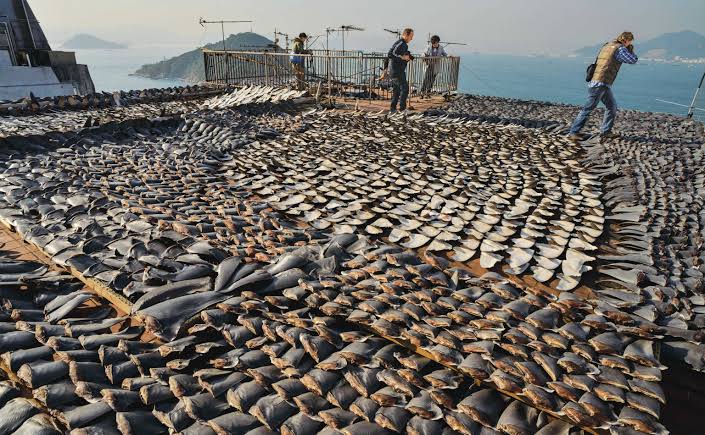
Millions of people eat shark meat without knowing it. Hundreds of thousands of sharks are killed annually for a soup ingredient that has no flavor. And somewhere right now, a restaurant is letting someone order a live shark killed at the table as a luxury experience. Here is the full picture.
I Had No Idea People Ate Sharks. Then I Learned About Shark Finning, and It Got Worse.
Millions of people eat shark meat without knowing it. Hundreds of thousands of sharks are killed annually for a soup ingredient that has no flavor. And somewhere right now, a restaurant is letting someone order a live shark killed at the table as a luxury experience. Here is the full picture.
| 100M+ Sharks killed per year globally | #1 World’s largest shark meat consumer: Brazil | $400+ Per pound of dried shark fin on the black market | 0 Flavor contributed by shark fin to shark fin soup |
Honestly, it never occurred to me that people ate sharks. I knew shark fin soup was a thing, in the abstract way that most people know it exists without knowing what it actually involves, but the broader reality of shark meat as a global commodity moving through grocery stores and fish-and-chip shops and supermarket freezer sections under completely different names was not something I had thought about. Then I started looking into it, and what I found is genuinely alarming on multiple levels: the scale of global shark consumption, the ecological consequences of it, the specific horror of finning, and the particularly disturbing trend of restaurants offering live shark kills as a table-side luxury experience. The video below starts with that last practice, and it is worth watching before reading further.
For the shark, this is not an experience, a meal, or content. It is their life.
Most People Who Eat Shark Don’t Know They’re Eating It. That Is by Design.
Shark meat is a global multi-million-dollar industry, and its most effective marketing strategy is not to call it shark. Because shark carries cultural associations with danger and conservation concern that make it a difficult sell in many markets, the trade has historically relied on a patchwork of regional names that obscure the product’s identity from the people buying it. In Brazil, the world’s largest per capita consumer of shark meat, it is sold as cação, a generic term for saltwater fish that millions of Brazilians buy regularly without any awareness that they are purchasing a shark. In the United Kingdom, species including spiny dogfish and catshark appear on traditional fish-and-chip shop menus as huss, flake, or rock salmon, all names that communicate nothing about what the fish actually is. In southern Spain, a dish called cazón en adobo, featuring marinated and deep-fried shark, is a beloved regional staple whose popularity has survived precisely because the ingredient is understood as a local fish rather than as the apex ocean predator whose conservation status is genuinely precarious.
Japan’s relationship with shark meat is more complex and historically grounded. In mountainous inland regions like Tochigi, shark has been eaten for centuries under the names Muka or Same, and the historical rationale is one of the more interesting food history details I came across in researching this: before refrigeration made cold storage possible across long distances, the natural ammonia in shark flesh, which results from the way sharks store urea in their muscle tissue rather than excreting it, actually functioned as a preservation mechanism. Shark meat could survive the long journey from coastal areas to inland mountain communities without spoiling in the way that other fish would. The same chemical property that makes fresh shark meat distinctly unpleasant to prepare is what made it valuable for distribution across terrain that no other seafood could reliably reach. Iceland’s hákarl, the fermented Greenland shark that has been buried and cured for months before eating, is the most extreme expression of this preservation tradition and one of the most aggressively challenging foods in the world by most accounts.
The Ammonia Problem: Why Shark Meat Smells Like Cleaning Products
Sharks do not excrete urea the way most vertebrates do. Instead, they store it in their muscle tissue as a mechanism for managing the osmotic pressure of saltwater. When a shark dies, that stored urea rapidly converts to ammonia. A shark that is not bled and gutted immediately after being caught will develop a strong ammonia smell that most people would recognize from household cleaning products. To prepare shark meat for consumption, processors and chefs must soak it in milk, buttermilk, vinegar, or lemon juice for extended periods to neutralize the odor and harsh chemical taste that the ammonia produces. The fact that so many markets and restaurants go through this labor-intensive process rather than simply choosing a different fish is a measure of how commercially valuable shark remains despite the preparation challenges.
Finning: The Most Wasteful and Cruel Fishing Practice in the Ocean
Shark finning is the practice of removing a shark’s fins at sea and discarding the remainder of the animal back into the water. The economic logic is straightforward and deeply perverse: shark fins are extraordinarily valuable, selling for hundreds of dollars per pound in dried form, while shark meat is heavy, takes up valuable freezer space on fishing vessels, and is worth a tiny fraction of the price that the fins command. Removing the fins and discarding the body allows fishing crews to maximize the value of their available storage and return to port with a much more compact and profitable cargo than a hold full of whole shark bodies would represent.
The consequence for the shark is one of the most drawn-out and distressing deaths in the ocean. Without its fins, a shark cannot swim. Most shark species must maintain constant forward motion to push water through their gills and extract the oxygen they need to survive; a finless shark sinks to the ocean floor and suffocates slowly, or is consumed alive by other predators while it is still living but entirely unable to escape. The practice is documented, widespread, and drives the deaths of tens of millions of sharks annually, making it one of the primary contributors to the population collapses that have seen global shark populations decline by more than 70 percent since 1970.
The cultural context for shark fin soup is genuinely historical. The dish dates to China’s Song Dynasty, roughly a thousand years ago, and became established as a symbol of wealth and generosity served at banquets and wedding celebrations because of the extraordinary effort required to source and prepare the fins. The fin itself contributes virtually no flavor to the soup. Its culinary function is textural: the collagen in the dried and rehydrated fin produces a soft, gelatinous strand that contributes a specific mouthfeel prized in the dish’s cultural context. A diner eating shark fin soup for the flavor of the shark fin is eating it for an ingredient that tastes of nothing. The broth around it provides the flavor. The fin is pure status signaling, which makes the scale of destruction it has enabled one of the more extraordinary examples in the history of human consumption of an ecological catastrophe generated by social performance rather than nutritional need.
What Happens to a Finned Shark
|
1
|
Fins are sliced off at sea while the shark may still be alive. |
|
2
|
The still-living shark is thrown back into the ocean. Its body is discarded as worthless because meat takes up valuable freezer space and earns a fraction of the fin’s value. |
|
3
|
Without fins, the shark cannot swim. Most species require constant forward motion to breathe. The shark sinks to the ocean floor. |
|
4
|
The shark slowly suffocates from lack of oxygen, or is eaten alive by other predators while still living but unable to escape. |
Why Killing Sharks at Scale Is Killing the Ocean, and Why Eating Them Is Also Killing Yourself
Sharks are apex predators. They occupy the top of marine food chains that took hundreds of millions of years to evolve into their current form, and they regulate those chains in ways that are not replaceable by any other mechanism the ocean has developed. When apex predators are removed from an ecosystem, the populations of the species they prey on expand rapidly and without constraint. Those expanded populations then overconsume the species they prey on, cascading the imbalance down through the food chain in a process ecologists call a trophic cascade. In ocean systems, the removal of sharks has been documented to produce population explosions of rays and other intermediate predators that then devastate shellfish and other bottom-level species, collapsing the reef and seagrass ecosystems that depend on those populations for structural stability. The health of coral reefs and seagrass beds, both of which are critical carbon sinks and nursery habitats for the majority of commercial fish species, is directly linked to the presence of functioning shark populations above them in the food chain.
The health argument against eating shark meat deserves its own direct treatment, because it adds a layer of consequence to the consumption decision that the ecological argument alone does not cover. Sharks, as apex predators, accumulate the mercury and heavy metals that are present in every organism they eat across their lifetimes, a process called bioaccumulation. By the time a shark reaches maturity, its muscle tissue may contain mercury concentrations that are among the highest of any seafood available in global markets. The U.S. Food and Drug Administration specifically advises pregnant women and young children to avoid shark meat entirely, citing the neurological risks associated with high mercury exposure. The same bioaccumulation process that makes sharks ecologically irreplaceable as predators makes them potentially dangerous as food, which is an irony the seafood industry’s practice of selling shark under more appealing names does not advertise.
The Campaigns Are Working. The Demand Is Dropping. The Black Market Still Exists.
The global response to finning has produced a genuinely meaningful set of legislative and cultural changes over the past two decades, and the evidence that those changes are having real effects on demand and behavior is more substantial than conservation campaigns in other areas can often demonstrate. The United States passed the Shark Fin Sales Elimination Act, making it illegal to buy, sell, or possess shark fins nationwide, removing one of the world’s wealthiest consumer markets from the fin trade’s demand side. Many countries and regions have implemented similar sales and possession bans. International fishing agreements have increasingly required “fins naturally attached” policies that prohibit the removal of fins at sea and require sharks to be brought to port whole, which fundamentally alters the economic calculus that made finning profitable: you cannot maximize your catch by finning and discarding if you are required to retain the entire animal.
The cultural shift in mainland China, Hong Kong, and Taiwan has been one of the more remarkable conservation communication success stories of the past decade. The late Yao Ming, the NBA player whose stature in Chinese public life was extraordinary, became one of the most visible advocates for ending shark fin consumption and brought the issue to an audience that Western conservation groups had struggled to reach. WildAid and other organizations built sustained campaigns around celebrity advocacy that reframed shark fin soup not as a symbol of generosity and status but as an ecologically destructive practice associated with outdated values. The younger generation in China and across the Chinese diaspora has largely rejected the dish. It was officially banned at Chinese state banquets in 2013. Import volumes into Hong Kong, historically the world’s largest shark fin trading hub, have declined dramatically.
|
🇺🇸
Shark Fin Sales Elimination ActFederal U.S. law making it illegal to buy, sell, or possess shark fins. Removes the world’s wealthiest consumer economy from the fin trade demand side. |
🐟
“Fins Naturally Attached” PoliciesInternational fishing regulations requiring sharks to be landed whole. Eliminates the economic incentive for finning by preventing the high-value-only harvest model. |
🌏
Cultural Shift in ChinaState banquet ban since 2013. Younger generation rejection driven by Yao Ming’s campaigns with WildAid. Import volumes into Hong Kong have declined dramatically since peak years. |
The honest accounting of where the campaign stands is that the victories are real and the problem persists. An illegal black market in shark fins remains active in regions where enforcement is weak and prices remain high enough to justify the legal risk. The broader shark meat trade, most of which does not involve fins at all but rather the body meat sold under disguised names in global seafood markets, continues at scale and with minimal consumer awareness of what is being purchased. Brazil’s position as the world’s largest consumer of shark meat is not a product of an explicit preference for shark: it is a product of a market structure that substitutes shark for a more expensive white fish under a name that provides no information about the product’s identity. The consumer in the Brazilian market buying cação has almost certainly not made a deliberate choice to support shark fishing. They have been denied the information that would allow them to make a conscious choice at all.
What You Can Actually Do
|
1
|
Ask what fish you are buying. In markets that sell shark under local names, asking directly what species you are purchasing puts pressure on retailers to be transparent and gives you the information you need to make a conscious choice. |
|
2
|
Never order shark fin soup. The fin contributes no flavor. The only thing it contributes is a status signal that is no longer appropriate given what producing it costs the ocean. |
|
3
|
Support fins-attached legislation in your country if it has not yet passed, and support organizations doing the enforcement and advocacy work that makes the laws that have passed actually function. |
|
4
|
Share the video. The cultural shift in China happened because conservation advocates found messengers their audience trusted and gave those messengers content worth sharing. The same mechanism works everywhere. |
Sharks have survived for 450 million years. They predate trees. They survived five mass extinction events that eliminated the majority of life on earth. The current rate of killing is the one thing their evolutionary history did not prepare them for, because nothing in their 450-million-year history produced a predator that could remove tens of millions of them from the ocean annually in exchange for a bowl of soup whose primary ingredient the fin itself contributes nothing to the flavor of. That is the specific absurdity at the center of this. The choice to end it is available. The video above is where to start.