
Mollie’s Pack Survived Wyoming’s Wolf Hunt. Here Is How Close It Actually Was.
The last surviving wolf family with an unbroken genetic lineage from the historic 1995 Yellowstone reintroduction wandered outside the park’s borders just as Wyoming’s hunting season opened. Anti-wolf groups publicly announced their intention to target the pack. Four other wolves were killed. And then the pack came home.
| 30 yrs Unbroken genetic lineage Mollie’s Pack carries | 12 yrs Age of matriarch 1090F, one of the oldest wild wolves ever documented | 5 Pups the pack was raising outside park borders | 4 Other Wyoming wolves killed before the hunt closed |
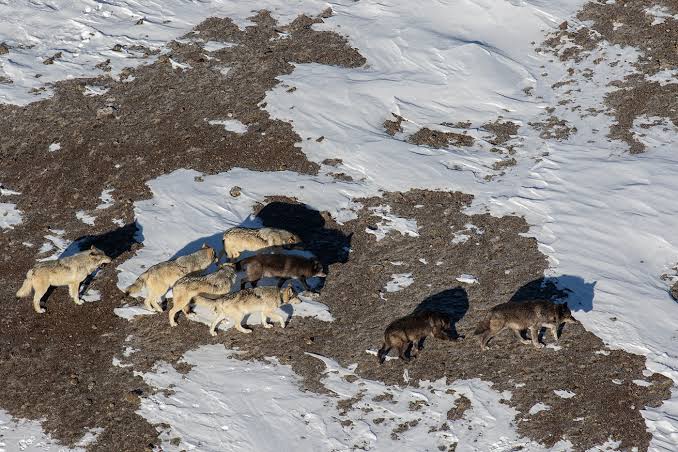
In mid-September 2026, the wolf conservation community entered a state of acute alarm when it became clear that Mollie’s Pack, the last remaining wolf family in North America with an unbroken genetic lineage tracing directly to the 1995 Yellowstone reintroduction, had wandered outside the protected boundaries of Yellowstone National Park and into Wyoming’s active wolf hunting zone. Anti-wolf groups and trophy hunters had publicly identified the pack and its famous elderly matriarch as targets. Wyoming’s Game and Fish Commission denied emergency petitions to close the hunting zone. Four wolves were killed. And then, through a combination of the pack’s own instincts and the brutal arithmetic of Wyoming’s mortality quota, Mollie’s Pack came back across the border intact. This is the story of what happened, what it means for wolf conservation, and why the four-day window when the fate of a thirty-year genetic lineage hung on the decisions of trophy hunters in a Wyoming national forest will not be the last time this situation arises.
Who Mollie’s Pack Is, and Why Losing Them Would Be Irreversible
The 1995 Yellowstone wolf reintroduction was one of the most consequential and scientifically significant wildlife restoration efforts in American history. After more than seventy years of absence, fourteen grey wolves were transported from Canada and released into Yellowstone National Park, beginning a recovery that has been studied, documented, and cited across decades of ecological research as a primary case study in the transformative effects of apex predator restoration on an entire ecosystem. The wolves that were reintroduced in 1995 set in motion the most-studied trophic cascade in modern conservation biology: the presence of wolves changed elk behavior, which changed where and how long elk grazed, which allowed riverbank vegetation to recover, which stabilized riverbanks, which changed the course of rivers. The wolf reintroduction literally changed the physical geography of Yellowstone. Mollie’s Pack is the direct genetic descendant of those original animals. They are, in the most precise biological sense, the living continuation of a thirty-year experiment in ecological restoration.
The pack was originally known as the Crystal Creek Pack, one of the first groups established in the park following the reintroduction. It was renamed Mollie’s Pack in honor of Mollie Beattie, the first woman to serve as director of the U.S. Fish and Wildlife Service, who championed the reintroduction before her death in 1996. The name has carried across generations of animals, through the natural succession of alpha pairs and the births and deaths of pups across three decades, to the current pack whose genetic lineage remains unbroken from the original 1995 animals. This is not a symbolic distinction. It is a specific genetic resource that carries the longest continuously documented wolf ancestry in North American wildlife management history, and it cannot be reconstituted if it is lost.
Twelve Years Old. One of the Oldest Wild Wolves Ever Documented. The Pack’s Irreplaceable Core.
Alpha female 1090F is the matriarch of Mollie’s Pack and one of the oldest known wild wolves ever recorded in the Greater Yellowstone Ecosystem. Wild wolves rarely survive beyond 8 to 10 years in nature; at 12, she is an extraordinary outlier whose survival represents both exceptional individual fitness and the relative protection afforded by life within Yellowstone’s borders. She carries not only the genetic heritage of the original reintroduction animals but also the accumulated ecological knowledge of three decades: migration routes, denning locations, prey strategies, and the spatial understanding of a landscape that she has navigated her entire life. Her loss would not simply remove one animal from the pack. It would remove the learned institutional memory of the pack’s matriarch, which wildlife biologists consistently identify as one of the most significant forms of ecological information loss in social predator species.
The Problem With Invisible Borders: Why Park Protection Means Nothing When Wolves Cross Into Wyoming
Inside Yellowstone National Park, wolves are strictly protected. There is no legal hunting, no trapping, and no targeted removal. The protection is absolute within the park’s boundaries. The wolves, of course, do not know where those boundaries are. They have never been told about them. They navigate a landscape according to prey availability, denning suitability, pack dynamics, and the seasonal rhythms that their ancestors traveled across the same terrain. When prey is scarce inside the park, as it was following a mild winter in early 2026 that reduced the ungulate populations Mollie’s Pack depends on, they follow the animals they need to survive across terrain that looks identical on either side of a line that exists only on a map.
This is exactly what happened in 2026. A mild winter reduced prey availability inside the park. Mollie’s Pack traveled into the Shoshone National Forest outside Yellowstone’s eastern boundary to dig a den and raise five pups born in the spring. The Shoshone National Forest sits squarely inside Wyoming’s Wolf Hunt Area 1, where the state’s hunting season opened on September 15, 2026. The pack was now legally killable by any licensed hunter who encountered them, four days after the formal opening of the hunt.
The particular vulnerability of park wolves in hunting zones is not an accident of geography. It is a documented and predictable consequence of the behavioral difference between wolves that grew up inside a protected area and wolves that grew up outside one. Yellowstone wolves have spent their lives in proximity to humans who posed no threat to them. Tourists with cameras, researchers with radio-tracking equipment, photographers with long lenses, park staff in vehicles: these are the human encounters that shaped the pack’s behavioral relationship with people. Wild wolves outside the park, by contrast, develop a strong avoidance response to humans based on the actual experience of being hunted. Yellowstone wolves simply do not have that experience. Anti-wolf groups and trophy hunters were explicit in naming Mollie’s Pack and alpha female 1090F as targets, understanding precisely this vulnerability.
Conservation organizations filed formal petitions with the Wyoming Game and Fish Commission asking for a temporary emergency closure of Hunt Area 1 to protect the pack while they remained outside the park. The Commission denied those petitions. Wyoming’s official position was that the hunting season would proceed as scheduled, with the existing mortality quota of four wolves as the only operational constraint on how many animals could be killed in the zone before it closed automatically.
Pack moves outside the park to den and raise five pups
A mild winter reduces prey availability inside Yellowstone. Mollie’s Pack moves into the Shoshone National Forest, inside Wyoming Hunt Area 1, and establishes a den. Five pups are born.
Conservation community raises alarm
Wildlife advocates, researchers, and conservation organizations publicly raise alarm about the pack’s location and the opening of Wyoming’s wolf hunting season in the same zone. Petitions are filed with the Wyoming Game and Fish Commission to close Hunt Area 1. The Commission denies them.
Wyoming wolf hunt opens in Area 1
The hunting season opens. Anti-wolf groups and trophy hunters have publicly stated their intention to target the pack and specifically alpha female 1090F.
Mollie’s Pack crosses back into Yellowstone
Just as the hunting season commences, the pack naturally migrates back across the park boundary into the protected zone. The timing is fortuitous, not planned, and it could easily have been otherwise.
Four wolves killed, quota reached, Hunt Area 1 closes
Hunters kill four other wolves in Hunt Area 1, reaching the mortality quota and triggering the automatic closure of the hunting zone for the remainder of the season. These four animals were not members of Mollie’s Pack, but they were killed within days of the season opening.
Why Losing Mollie’s Pack Would Have Been a Conservation Catastrophe, Not Just a Wildlife Tragedy
The 1995 Yellowstone wolf reintroduction is one of the most studied examples of ecological cascade in the history of wildlife science, and Mollie’s Pack sits at the genetic origin of that entire thirty-year experiment. What the reintroduction demonstrated, and what decades of subsequent research have documented in granular detail, is that the presence of wolves in Yellowstone changed not just the predator-prey relationship between wolves and elk, but the physical structure of the ecosystem itself. Wolves changed where elk grazed. Elk that grazed in open areas with wolves present became more vigilant and spent less time in any single location, allowing riverbank vegetation that had been heavily browsed by resident elk populations to regenerate. That vegetation stabilized the riverbanks. The stabilized riverbanks changed erosion patterns. Changed erosion patterns literally altered the courses of rivers. The wolves did not just come back. They began, over three decades, to restore the physical geography of a landscape that had been shaped by their seventy-year absence.
The specific loss of Mollie’s Pack would not end wolf presence in Yellowstone. There are other packs in the park, and the ecosystem’s wolf population is self-sustaining within the park’s boundaries. What it would end is the unbroken genetic lineage that connects the current population to the original 1995 animals, a lineage that researchers have been tracking, studying, and treating as a living laboratory for three decades. It would also end the life of alpha female 1090F, whose age and the accumulated ecological knowledge she carries represent a form of conservation resource that cannot be replaced through any management intervention. And it would happen not because of ecological necessity, not because wolves were threatening livestock or human safety in ways that required management, but because a mortality quota set by a state wildlife agency was not reached quickly enough to close the hunting zone before the pack crossed an invisible line on a map.
The policy argument that conservation organizations have been making for years in response to this recurring situation is straightforward: park wolves that wander outside Yellowstone’s boundaries need a buffer zone of protected territory that accounts for the reality that these animals move according to prey and habitat, not according to administrative maps. The park boundary was drawn around a geographic area, not around a wolf’s annual territory, and the gap between those two things is where the management failures happen. A buffer zone, or at minimum an emergency closure provision that can be triggered when documented Yellowstone pack members are detected in hunting zones, would address the structural problem without eliminating Wyoming’s authority to manage wolf populations outside the park.
The Pack Came Home. The Problem That Put Them in Danger Is Still There.
Four wolves that were not members of Mollie’s Pack were killed in Wyoming Hunt Area 1 during the brief window before the quota closed the season. They are not named in this story because they are less famous, less historically significant in the documentation sense, and less immediately alarming in conservation terms than the animals who were specifically targeted by anti-wolf groups. But they were killed, which matters, and the speed with which the quota was reached, four wolves in a few days, tells you something about the hunting pressure in the area. In a different year, with a different quota, or with the pack still outside the park when the season opened, the outcome for Mollie’s Pack could have been different in ways that cannot be undone.
The relief that wildlife advocates are expressing is real and warranted. The thirty-year lineage survived. The five pups survived. Alpha female 1090F, who is twelve years old and one of the oldest wild wolves ever documented in this ecosystem, is still alive and still the matriarch of a pack whose genetic history cannot be replaced. That is worth celebrating clearly and without qualification. It is also worth being clear that the celebration is about a close call that required favorable timing and a fast mortality quota, not about a policy solution that prevents the same scenario from occurring in 2027, 2028, or any subsequent year in which a mild winter and hungry wolves produce another crossing into Hunt Area 1.
What Would Actually Protect Mollie’s Pack Going Forward
| → | A buffer zone of protected territory surrounding Yellowstone’s eastern boundary that accounts for the seasonal movements of documented park wolf packs into adjacent national forest land. |
| → | Emergency closure provisions that allow Wyoming Game and Fish to close hunting zones when radio-collar tracking data confirms that documented Yellowstone pack members are present in the area. |
| → | Federal coordination between the National Park Service, the U.S. Forest Service, and Wyoming wildlife management agencies that treats the management of documented Yellowstone wolf lineages as a shared federal conservation resource rather than a state hunting management question. |
| → | Congressional action to revisit the 2011 rider that removed Northern Rocky Mountain wolf populations from Endangered Species Act protections in Idaho, Montana, and Wyoming, which eliminated the federal oversight mechanism that had previously constrained state hunting management. |
Sustainable Action Now: Wildlife and Animal Abuse Coverage
We cover wildlife conservation, trophy hunting, predator management policy, and the stories behind the animals whose survival depends on decisions made in state game commission meetings and federal wildlife policy offices. Mollie’s Pack survived 2026. Whether they survive 2027 is a policy question, not a luck question.
Visit SAN Wildlife CoverageAlpha female 1090F is twelve years old and still running. Five pups from this year’s litter are alive and inside the park. The thirty-year genetic thread that connects them to the fourteen wolves who came down from Canada in 1995 and changed the course of rivers has not been broken. This year. That is the state of things, and it is genuinely good news, and it is exactly insufficient to prevent the same conversation from happening again in September 2027 if the policy conditions that made 2026 so dangerous remain unchanged. The pack came home. The work to make that home safe is still in front of us.