

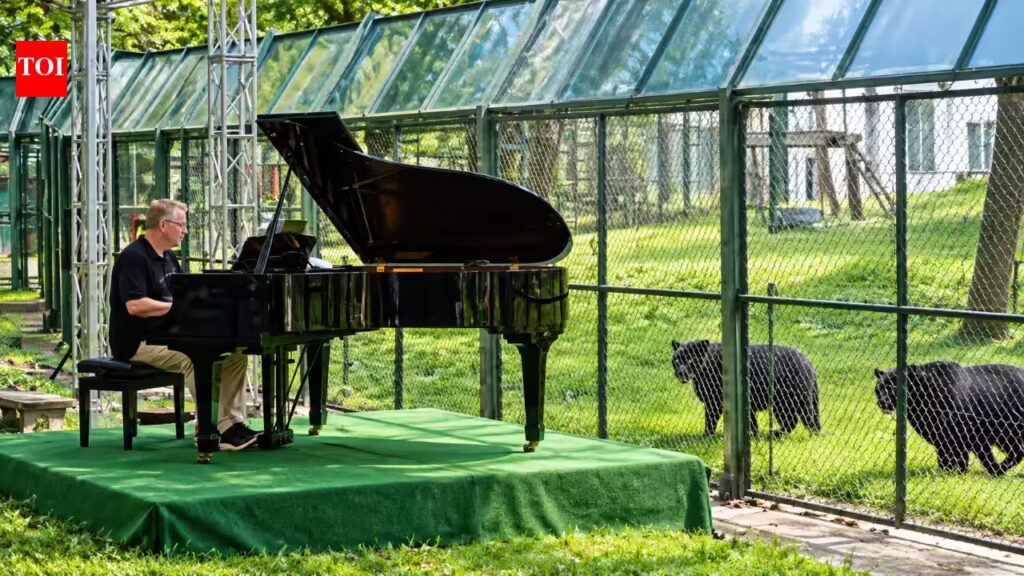
They Spent Decades in Cages on Bile Farms. Then They Heard Piano Music for the First Time.
Millie spent 26 years in a tiny cage. Fern spent 21 years in darkness. Su Su spent 15 years confined before she ever felt grass under her paws. Animals Asia has been rescuing moon bears from the bear bile industry for more than two decades. Around 125 bears are still waiting. This is their story and the campaign to free them.
| 26 yrs Millie spent in a tiny cage before rescue | 21 yrs Fern spent in darkness on a bile farm | ~125 Bears still waiting on bile farms in Vietnam | 100K Messages of hope Animals Asia is collecting to free the final bears |
There is a moment in one of the Animals Asia videos where rescued moon bears hear piano music for the first time. They had spent years, some of them many years, confined in small metal cages on bear bile farms, without grass, without space, without the sensory richness that a bear’s nervous system evolved over millions of years to receive and respond to. And then someone sat down at a piano in their sanctuary enclosure and played. The bears’ reaction, the stilling of movement, the visible attention, the physical turn toward the sound, is one of those pieces of footage that does something to you if you watch it honestly. These are not performing animals. They are not trained to respond to music. They are animals who spent their lives in cages finally being given conditions in which their own aliveness can express itself, and it turns out that when you give a bear the space to be a bear, they notice a piano.
What Bear Bile Farming Is, and What It Does to the Animals Who Survive It
Bear bile farming is the practice of keeping bears, most commonly the Asian moon bear or Asiatic black bear, in small metal cages and extracting bile from their gallbladders for use in traditional medicine markets across Asia. Bile from bears has been used in traditional Chinese medicine for more than two thousand years, valued for the compound ursodeoxycholic acid, which has documented medicinal properties and was historically available only through hunting. The farming of bears to produce bile continuously, without hunting individual animals, was developed in China in the 1980s and spread rapidly across East and Southeast Asia as a commercial industry. Vietnam, along with China, South Korea, and other countries, developed significant bear bile farming operations that at their peak held thousands of bears in conditions that animal welfare organizations have consistently documented as causing severe and chronic physical and psychological harm.
The bears on bile farms spend their lives in cages that are often barely larger than their bodies, unable to stand fully upright, turn around freely, or engage in any of the behavioral repertoire that bears require for their welfare. Moon bears in the wild are active, intelligent animals that roam large territories, forage across diverse food sources, climb trees, and engage in the complex physical and cognitive activities that their bodies and brains evolved to perform. On bile farms, none of those activities are available. The physical space they inhabit is metal bars and concrete. The sensory environment is the sound of other bears in the same facility, the mechanical operations of the extraction process, and whatever ambient conditions the farm provides. What Millie, Fern, Su Su, and the piano bears came from is not a simplified version of a normal bear’s life. It is its categorical opposite.
The Bears Who Heard Piano Music for the First Time
These bears spent years confined to cages on bile farms. Their reaction when the music started says everything.
The enrichment program at Animals Asia sanctuaries is one of the most important and least discussed aspects of what rehabilitation for former bile farm bears actually requires. Physical rescue is the beginning. The bears arrive with bodies that carry the evidence of years of cage confinement: muscle atrophy from lack of space to move, dental damage from stress-related bar-chewing, psychological profiles shaped entirely by an environment that provided nothing but pain and boredom. The sanctuary work is not just providing a larger space. It is the slow, patient, individualized process of reintroducing stimuli that the bear’s nervous system has never encountered, building the neural pathways of curiosity and exploration that should have developed in early life but were foreclosed by the cage, and doing all of that on the bear’s own timeline, at the bear’s own pace, without any form of pressure or deadline.
The piano brings all of that into focus in a single piece of footage. These are animals who had no reason to expect anything from the world except the cage. Then someone introduced something completely novel into their environment: music, played live, with resonance and variation and the physical presence of a human being doing something interesting and unthreatening nearby. The bears’ response, the orienting attention, the visible engagement with the sound, the absence of the defensive or fearful behavioral patterns that years of farm confinement produce, is documentation of recovery in progress. It is what a bear looks like when enough of the fear has lifted that curiosity can return.
Millie: 26 Years in a Cage. Now, a Whole New Life.
While the world moved on, time stood still for her. Now, at Animals Asia’s Bach Ma Bear Sanctuary, a whole new life begins.
Millie spent 26 years in a cage on a bear bile farm before Animals Asia was able to reach her. Twenty-six years is not a number that translates easily into human terms, but it is useful to try: it is longer than most people spend in the house they grew up in, longer than most marriages, longer than many careers. It is the entire adult life of an animal whose expected lifespan in the wild, with freedom and appropriate habitat and the full behavioral repertoire that her species evolved, would have been perhaps 25 to 30 years. Millie spent what should have been her entire life waiting in a space barely large enough to contain her body, for a process that caused her pain, in an environment that provided nothing that her biology was designed to receive. Her rescue, when it finally came, was the beginning of something rather than the resolution of it, because 26 years of cage confinement does not simply reverse when the door opens.
This is the detail about bile farm rescue that the emotional arc of rescue footage can obscure: the cage doors open, and then the real work begins. Bears like Millie arrive with bodies adapted to the cage, with nervous systems shaped by years of chronic stress, with no experience of the sensory environment of a sanctuary, with no learned behaviors appropriate to open space, vegetation, the presence of other bears in contexts other than proximity in adjacent cages. The Animals Asia cooperative care program at Bach Ma Bear Sanctuary in Vietnam is designed to address exactly this: the individualized, long-term rehabilitation that treats rescue not as a single event but as the first chapter of a story that will take years to write and that will look different for every animal depending on what they carried into the sanctuary door with them.
Fern: 21 Years in Darkness. Her First Step Outside Was an Entire Emotional Journey.
When your entire life was spent in a tiny cage, the big world is terrifyingly unfamiliar. Fern’s first step outside was taken entirely at her own pace and on her own terms.
Fern spent 21 years in darkness on a bear bile farm. Not figurative darkness: literal darkness, in a facility where light and day and season had no meaningful presence in her experience of the world. When she arrived at her Animals Asia sanctuary, stepping outside for the first time was not a simple physical act. It was an encounter with an entirely unfamiliar universe: open sky, unfiltered light, variable temperature, the smell of soil and vegetation, sounds from a distance rather than from adjacent cages, ground that was not metal grating. The video of her first steps outside is one of the most honest pieces of wildlife rescue footage available because it does not rush her. Fern moves slowly, hesitantly, repeatedly retreating before trying again, processing each new sensory input at the speed her nervous system can handle.
That hesitation is not a sign of failure. It is a sign of an animal taking a genuinely significant step with appropriate caution given the totality of her prior experience. The world outside the door was not something Fern had any preparation for: not as a cub, not as an adult, not through any gradual exposure that might have made the transition less overwhelming. Animals Asia’s approach to moments like this is patient and non-directive: the door opens, and Fern decides when she’s ready. That approach is not just philosophically sound, it is functionally important for rehabilitation. Forcing an animal that has experienced chronic stress and confinement into a situation that overwhelms their capacity to process it reinforces the anxiety rather than reducing it. The sanctuary’s job in that moment is simply to have opened the door.
Su Su: 15 Years in a Cage. The Healing Takes a Lifetime. So Does the Care.
The cage is gone, but the healing takes a lifetime. At Animals Asia sanctuaries, rescue is only Chapter One.
Su Su spent 15 years in a bile farm cage before her rescue. The Animals Asia description of her rehabilitation is the most direct articulation of what makes their approach different from organizations that treat physical rescue as the terminal goal: rescue is only Chapter One. The physical freedom matters. The door opening matters. But the body and the behavioral profile that Su Su brought through that door carry the entire history of 15 years of cage confinement, and that history does not disappear because the location has changed. Animals Asia’s cooperative care program is built around this reality, providing the medical support, behavioral monitoring, patience, and individualized attention that allows each rescued bear to heal on their own timeline rather than on a schedule that the sanctuary finds convenient.
Lifelong care is not a euphemism in this context. Bears rescued from bile farms are not released into the wild after rehabilitation, because they lack the learned skills that wild-born bears acquire through early development, and because most of them carry physical conditions from their farm confinement that require ongoing veterinary management. What Animals Asia provides for Su Su and the other bears at their sanctuaries in Vietnam and China is precisely what the phrase implies: the commitment to care for each individual animal for the remainder of their natural life, with the quality of that life rather than any operational efficiency as the primary measure of success. That commitment is expensive. It is also the only version of rescue that actually addresses what these animals experienced and what they require.
Around 125 Bears Are Still Waiting. Animals Asia Has a Campaign to Reach the People Who Can Free Them.
The number 125 is the current estimate for bears still held on bile farms in Vietnam awaiting rescue. It is a smaller number than it was: Animals Asia and its partners have been working for more than two decades to negotiate the release of bears from farm operators, working through the Vietnamese government and building the sanctuary infrastructure necessary to receive and care for the animals once released. The number has come down significantly from the thousands that were held at the industry’s peak. The remaining 125 are not simply waiting for a door to open. They are waiting for a political and economic process to conclude, in which farm operators agree to surrender bears, the Vietnamese government maintains its commitment to the phase-out of bear bile farming, and Animals Asia has the resources and capacity to receive each released animal and provide for them permanently.
The Free the Final Bears campaign is Animals Asia’s current public mobilization effort, built around the goal of collecting 100,000 messages of hope from supporters worldwide to present to the decision-makers in Vietnam who have the authority to accelerate the release of the remaining bears. Public pressure campaigns of this type have a documented history of effectiveness in the Vietnamese political context, where government officials have demonstrated responsiveness to international attention on animal welfare issues and have maintained cooperation with Animals Asia over years of sanctuary operations and bear transfers. The 100,000 message target is not symbolic. It is a specific volume of documented international support intended to reinforce the political case for completing the phase-out.
Help Free the Final 125 Bears
Add your name and leave a message of hope for the bears still waiting. Animals Asia is collecting 100,000 messages to present to the Vietnamese decision-makers who can free them. Your message is the specific form of pressure that works in this process. Use it.
Add Your Voice: Free the Final Bears Visit the SAN Rescue NetworkThe bears who are already safe, Millie and Fern and Su Su and the ones who heard piano music for the first time, represent what the remaining 125 can have. Not immediately. Not without the continuing work of negotiation, fundraising, facility expansion, and the patient rehabilitation process that each individual bear will require. But the thing that Fern had when she took her first hesitant steps into an open space, and that Su Su had when she walked outside, and that the piano bears had when they turned toward music they had never heard before, is something that the biology of a moon bear is specifically designed to experience. The remaining 125 bears have that same biology. Their wait has gone on long enough.
Sustainable Action Now Rescue Network
We follow Animals Asia, their work at Bach Ma Bear Sanctuary, and the full network of organizations doing rescue, rehabilitation, and advocacy for animals across the globe. The bears who are safe deserved it. So do the 125 still waiting.
Visit the SAN Rescue Network
