
After Twenty Years in a Cage, a Moon Bear Finally Learns to Choose Freedom on Her Own Terms
Lelly spent two decades in total darkness on a bear bile farm in Vietnam. When rescuers finally opened the door to a sunlit outdoor habitat, she did not walk through it. What happened over the following months says more about real rehabilitation than the viral clip of her first steps outside ever could.
For twenty years, the only world Lelly knew was a rusted cage barely larger than her own body, kept in near total darkness on a bear bile farm in Vietnam. She is an Asiatic black bear, more commonly known as a moon bear for the pale crescent marking across her chest, and like thousands of other moon bears across the region, she spent those two decades enduring the repeated, painful extraction of bile from her gallbladder, a substance still used in some traditional medicine despite the existence of effective synthetic alternatives. When the international animal welfare charity Animals Asia finally shut the farm down, Lelly was transferred to the organization’s newly built Bach Ma Bear Sanctuary, a facility designed to give bears exactly what a bile farm never could, space, sunlight, and time.
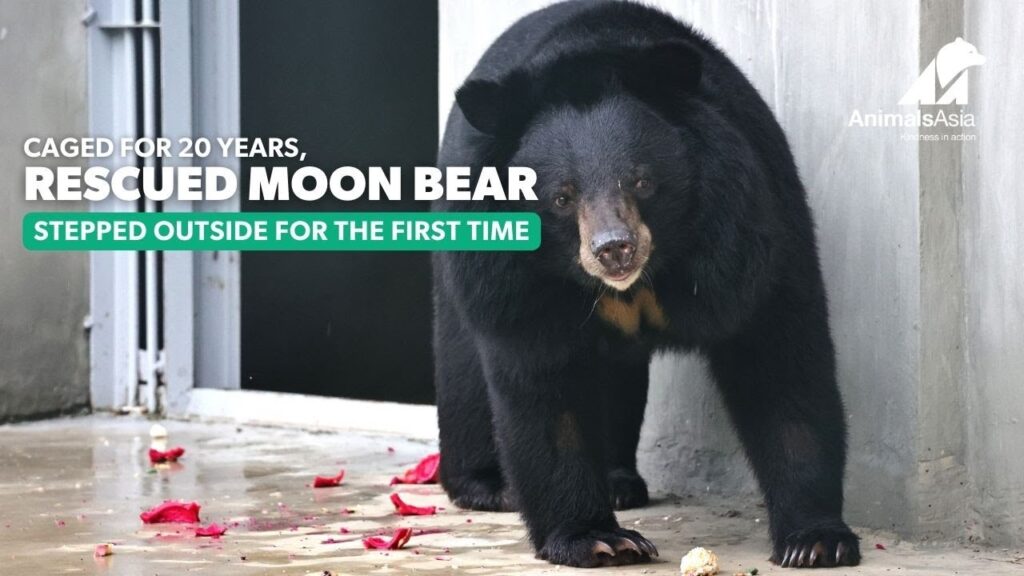
What happened next is the part of her story that has drawn attention well beyond the animal welfare world. Sanctuary staff opened the doors of her enclosure to reveal a lush outdoor habitat, grass, trees, open sky, all of it completely unfamiliar to a bear who had never in her life stood on natural ground. The footage of that moment has circulated widely, not because Lelly walked confidently into her new world, but because she did not.
Freedom That Felt Like a Threat
A bear that has spent twenty years in a metal cage does not experience an open field the way a person watching from home might expect. Lelly approached the grass cautiously, testing the ground repeatedly with one paw before committing any further weight to it. The sheer volume of new sensation, open space, natural light, unfamiliar textures underfoot, appears to have overwhelmed her. Rather than continuing forward, she retreated back into the safety of her indoor den, leaving the outdoor habitat empty.
After twenty years on a bile farm, Lelly’s first encounter with an open, sunlit habitat proved overwhelming, sending her back into her indoor den rather than forward into the grass.
What separates this story from a simple viral moment is what the sanctuary team chose to do next, which was largely nothing. Rather than coaxing, pushing, or gradually forcing Lelly toward the outdoors on any kind of schedule, carers let her set the pace entirely herself. For several months, she chose to remain indoors, slowly investigating an indoor pool that quickly became a favorite spot, wading and playing in the water at her own pace while her leg muscles, weakened by two decades of confinement, gradually strengthened along with her confidence.
That patience eventually paid off. Over the course of the summer, Lelly took what caretakers describe as her true, definitive steps into the outdoor habitat, this time not as a tentative test but as a full commitment to the space. She has since been learning, essentially for the first time in her life, how to walk on natural turf, how to forage for real food rather than whatever was pushed through the bars of a cage, and how to simply sit in direct sunlight without a roof of rusted metal overhead.
Why the Slow Path Is the Point
Sanctuary staff have been deliberate about using Lelly’s story to illustrate a principle that runs through serious wildlife rehabilitation work far beyond her individual case. An animal rescued from decades of trauma cannot simply be handed an open door and expected to understand it as safety rather than another unknown threat. Recovery on those terms has to be paced by the animal, not the calendar, even when that means months of apparent inaction between the rescue itself and any visible sign of progress.
Why bile farming persists despite legal bans: extracting bile from bears has been illegal in Vietnam for years, yet loopholes allowing bears to be kept as registered pets have let many farms continue operating. Animals Asia has spent years working directly with the Vietnamese government and individual farmers to close the remaining farms and transfer their bears into sanctuary care.
Lelly’s recovery arrives at a pivotal moment for bears like her across the country. Animals Asia is in the midst of an intensive push to rescue the remaining caged bears still held on farms in Vietnam, working alongside a national effort to phase out the bile farming industry entirely over the next two years. Every bear rescued in that window will likely face some version of what Lelly experienced, an open door leading to a world their bodies and minds were never given the chance to understand, and a recovery that only works if the humans on the other side of that door are willing to wait as long as it takes.
Lasting rehabilitation depends on patience as much as it depends on funding.
Follow more coverage in the Sustainable Action Now rescue network.