
Rescue Network · Big Cat Welfare
FOUR PAWS Prepares to Return to Malta After Ending Tiger Breeding at a Commercial Big Cat Facility
A three day veterinary mission in June sterilized two male tigers and a male leopard at L-Arka ta’ Noè, a commercial facility on the island. The animal welfare organization now says its teams have been preparing a second visit.
Ending a breeding line is quiet work. It prevents cubs that would otherwise be born into captivity.
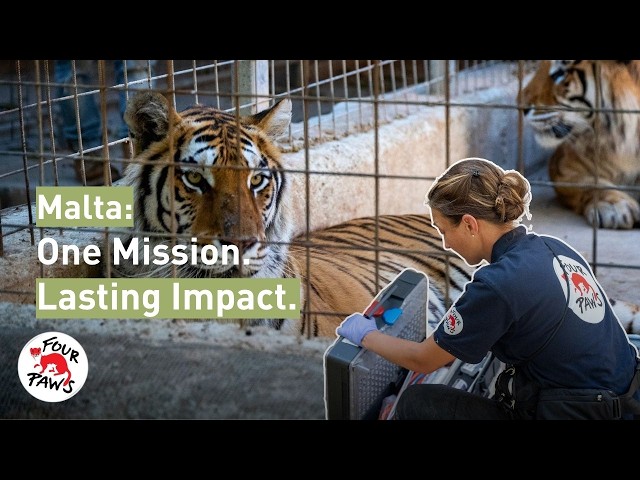
In early June, the international animal welfare organization FOUR PAWS sent a team of veterinarians to Malta with a specific aim: to stop the future breeding of big cats at a commercial facility that had been part of the island’s captive cat trade. According to the organization, the mission succeeded, and the sterilizations it performed ended tiger breeding at the site. FOUR PAWS has now announced that it is time to go back, saying its staff have spent the months since working behind the scenes to prepare for the next visit. The video from the organization is below.
What the First Mission Did
The June operation took place at L-Arka ta’ Noè, a commercial big cat facility in Malta, and was carried out by experienced wildlife veterinarians from the University of Veterinary Medicine Vienna. Over three days, the team sterilized two male tigers and one male leopard. Those three animals and a female tiger also received physical examinations that included blood sampling, ultrasounds and x-rays, although FOUR PAWS said some results were still pending when it announced the work on June 9. Because one was available at the site, the treated tiger pair was also moved into a larger enclosure, a change the organization said would improve their keeping conditions. Anesthetizing and operating on adult big cats away from a dedicated clinic is demanding work, and the mission required a temporary field setup in the Mediterranean summer.
The organization has been careful to describe the facility owner’s role. Maltese law did not require the owner of L-Arka ta’ Noè to stop breeding, yet the owner chose to withdraw from the big cat breeding industry and accepted FOUR PAWS’ offer of help. Patricia Tiplea, who is responsible for rescues and veterinary missions at the organization, welcomed that decision and said she hoped other facilities would follow it. Because the claim that breeding has ended rests on the sterilizations of the male animals, it is the organization’s account of the facility’s situation, and the owner’s own statements were not available in the material reviewed here.
The Legal Backdrop in Malta
The mission followed a change in Maltese law. As FOUR PAWS describes the new rules, private keepers must now sterilize their big cats, which effectively ends private breeding, while commercial and zoological facilities may breed only with special permits. Tiplea called the decision to improve the legislation a major step forward for animal welfare and said it lets the organization concentrate on the animals already living in captivity. She added that if Malta enforces and further strengthens the law, it could reduce the suffering of captive big cats.
Enforcement is the open question. A report on the limits of monitoring wild cats in Malta, published in 2026 by the country’s Commissioner for Animal Welfare, discusses the legal and practical difficulties of inspecting facilities and making sure that no animals are added through breeding or other means, and it notes that FOUR PAWS promoted neutering as a workable alternative to enforcement alone. Public attention to the issue has also come from local advocates. In 2025, activists pressed authorities over lions and a leopard held in an unregistered enclosure near Naxxar, and the animals were later reported to be moving to a site in Rabat, after officials had said they lacked a suitable facility to house them. An online petition has also called for independent inspections of facilities holding big cats on the island, which reflects the position of campaigners and not a finding by the authorities.
The goal in Malta is to stop future breeding and to assess the health and welfare of the animals already there.
The Case for a Positive List
Alongside its veterinary work, FOUR PAWS urges Malta to adopt what is known as a Positive List, a legal approach that names the species people may keep privately and prohibits everything else. The organization contrasts it with a Negative List, which bans particular species only after problems have appeared. In its view, a Positive List would give enforcement officers clearer rules, improve public safety and prevent the exploitation of wild animals whose needs cannot be met in private keeping. The press material does not specify which species would be included, and the proposal has not been adopted in Malta. Regulating exotic animals remains a debated question in many countries, and the Maltese proposal is FOUR PAWS’ recommendation, not government policy.
What Comes Next
FOUR PAWS says it remains committed to working with Maltese authorities and has offered veterinary checks and sterilizations to other big cat and bear owners on the island who want to leave the industry. It has also offered to support relocating other big cats to facilities suited to the species, and it said it would stay in contact with the owner of L-Arka ta’ Noè about further improvements to the animals’ housing. The announcement of a return visit fits that pattern, but the dates, location and scope of the second mission were not given in the information reviewed for this article. Readers who want details should follow the organization’s own channels for announcements.
Nothing about the work is quick. Sterilization prevents future births, but it does not resolve how the adult animals already living at such facilities will be housed for the rest of their lives. That is why the organization pairs surgery with larger enclosures, possible relocations and calls for legal change. FOUR PAWS says it does not breed the big cats it rescues and operates sanctuaries for animals that cannot live in the wild, including the LIONSROCK sanctuary in South Africa and the FELIDA sanctuary in the Netherlands.
How to Support Big Cat Welfare Responsibly
Avoid venues that offer cub petting, bottle feeding or photographs with big cats, since these attractions are often linked to breeding. Look for accredited sanctuaries that do not breed or trade animals. If you wish to donate to FOUR PAWS, the organization asks supporters to give through the national office in their own country where one exists, which helps with local tax deductions. Check that any group you support publishes how it spends funds.
For readers following the story, Malta is a useful case. A small island has become a test of whether new law, voluntary action by an owner and outside veterinary expertise can together close a breeding cycle. The return mission will show whether that approach can reach more facilities. For more reporting on animal rescues and wildlife welfare, visit the Sustainable Action Now rescue network.