
Wildlife Rescue | Feature Report
Twenty-Three Years in a Cage, Then the Sky
Inside the fight to free Vietnam’s last bile bears, and the rescued moon bear whose story is carrying the campaign’s final chapter.
For twenty-three years, a seven-by-seven-centimeter gap in a cage wall was the only version of the outside world a bear named Smokey ever knew. No grass. No sky. Just a small, fixed rectangle of light. Recently, that cage door opened, and Smokey walked out into the sun for the first time in his adult life.
Rescued Moon Bear Steps Outside After 23 Years Caged
Watch on YouTube →
He didn’t run. He didn’t bolt for the open field the way rescue videos sometimes suggest an animal should. He stayed close to his den, stepping out a little at a time, retreating when it felt like too much, then trying again. That hesitation is not a failure of the rescue. It’s the honest, unglamorous shape that freedom actually takes after twenty-three years of confinement. Nobody hands an animal back its sense of safety along with an open door. That part has to be relearned, slowly, on the bear’s own schedule.
Smokey is one of nearly 300 moon bears pulled out of Vietnam’s bile farming industry over the last quarter century by the animal welfare organization Animals Asia. His story is a single, deeply personal thread in a much larger campaign now reaching what may be its final and most difficult stretch: the effort to shut down bear bile farming in Vietnam entirely, for the last time, for good.
300
bears rescued in 25 years
150
bears still on Vietnam’s last farms
28
years Animals Asia has run this fight
What Bile Farming Actually Does to a Bear
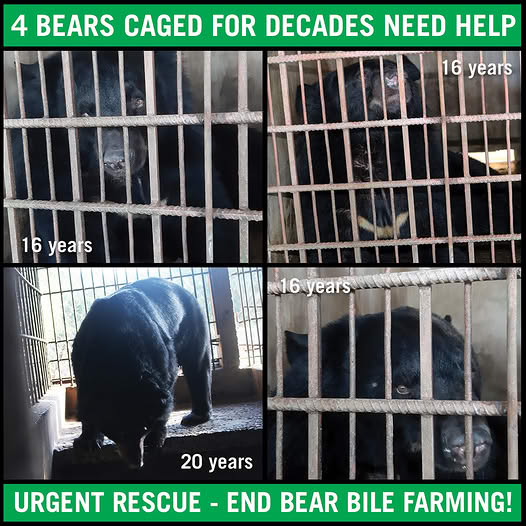
Moon bears, also called Asiatic black bears for the pale crescent marking across their chests, have been farmed across parts of Asia for their bile, a digestive fluid long used in traditional medicine. Extracting it from a living, conscious animal typically means keeping that bear confined for years, often in a cage barely larger than its own body, so small the animal can never fully stand, turn around, or stretch out. Bile is drawn repeatedly over the bear’s lifetime, using methods that range from surgically implanted catheters to more invasive extraction techniques, almost none of which involve anything resembling proper veterinary care.
The physical toll is severe: chronic infection, liver damage, muscle atrophy from decades of immobility, and untreated wounds that never get the chance to heal. The psychological toll is harder to quantify but just as real, visible in the repetitive pacing, self-directed aggression, and withdrawal that rescuers routinely document in bears pulled from these farms. A bear like Smokey isn’t simply moved from one enclosure to another when he’s rescued. He’s being asked, essentially for the first time, to exist in a body and a world that finally has room in it.
Twenty-Five Years of Rescues, and the Chapter That’s Left
Animals Asia has spent twenty-five years building toward this moment. Since the organization began working in Vietnam, close to 300 bears have been removed from bile farms and given permanent homes at purpose-built sanctuaries, places designed around the specific, complicated needs of an animal recovering from years of cage confinement: den space to retreat into, room to roam at their own pace, and staff trained to read the particular signs of stress that come from that kind of history.
Now the organization is heading into what it’s calling its hardest chapter yet. An estimated 150 bears remain on Vietnam’s last operating bile farms, and the plan going forward involves working directly with the Vietnamese government to close those remaining operations and bring every one of those bears into sanctuary care. It’s not a small ask. It means coordinating rescues, transport, and long-term housing for 150 animals, many of whom will need the same slow, patient rehabilitation that Smokey is still going through. It also means continuing the public education work needed to make sure that once the last farm closes, no new one takes its place.
A public letter campaign, Free the Final Bears, has been calling on Vietnam’s government to formally mandate the release of those remaining 150 bears. The letter has drawn support from a notably wide mix of public figures, including actor and comedian Ricky Gervais, actor and writer Stephen Fry, and actress Judi Dench, alongside tens of thousands of ordinary signers. The sanctuaries built over the last twenty-five years already have the space and the trained staff ready to take these bears in. What’s missing is the final policy push to get them there.
Jill Robinson and Jane Goodall, Talking It Through
Animals Asia’s founder, Jill Robinson, recently sat down for a filmed conversation with the primatologist and conservationist Jane Goodall, and the exchange lands differently than a typical campaign video. It’s less a pitch and more two people who have spent their careers doing genuinely difficult conservation work, comparing notes on what keeps that kind of work sustainable across decades. Friendship comes up. So does the specific, stubborn kind of hope required to keep pushing on an issue for twenty-five years before reaching what might finally be its last chapter.
Jill Robinson and Jane Goodall in Conversation
Watch on YouTube →
It’s worth watching not because it announces anything new, but because it’s an honest look at what long-haul advocacy actually feels like from the inside.
Freedom isn’t measured by how far Smokey wanders from his den. It’s measured by the fact that, for the first time in twenty-three years, the choice belongs to him.
Moon Bear Day and Twenty-Eight Years of Showing Up
This year’s Moon Bear Day landed alongside Animals Asia’s twenty-eighth birthday, and the two occasions ended up saying something similar. One marks the animals still waiting. The other marks how long people have been willing to keep working on their behalf. Roughly 150 bears in Vietnam still haven’t felt grass under their paws or had the chance to simply behave like bears instead of livestock kept alive for extraction. More than 53,000 messages of support have already been collected for those remaining bears, a number the organization is now hoping to push past 60,000 as part of its birthday campaign.
Twenty-eight years is a long time to stay focused on one cause. It’s long enough to see a rescued bear go from a single, symbolic first case to nearly 300 individual animals with names, sanctuary homes, and, in Smokey’s case, a slow, ongoing relationship with an open door he’s still learning to trust. That kind of patience is rare in advocacy work, where attention spans tend to move faster than actual progress. Vietnam’s bile farming industry didn’t build itself in a year, and it isn’t going to be dismantled in one either. But 300 bears down and roughly 150 to go is the kind of math that makes an ending feel, for the first time, genuinely within reach.
Why This Moment Matters
There’s a temptation, with campaigns like this one, to treat the finish line as inevitable once it comes into view. It isn’t. The last bears on the last farms are often the hardest to reach, tied up in ownership disputes, remote locations, or farm operators reluctant to give up whatever income the practice still provides. Government follow-through matters just as much as government intention. A law or a pledge that isn’t paired with enforcement and funded sanctuary space can leave animals exactly where they started, a pattern welfare advocates have watched play out in other countries and other industries entirely.
What makes Vietnam’s situation different is that the infrastructure to actually finish the job already exists. The sanctuaries are built. The veterinary and rehabilitation staff are trained and in place. What remains is largely a matter of political will and public pressure, which is precisely the gap that campaigns like Free the Final Bears are designed to close. Every signature, every message of support, and every bit of public attention adds weight to the argument that this industry has run its course and that Vietnam has the credible alternative already standing by.
We’ve been following Animals Asia’s work in Vietnam closely, and our continuing coverage of the campaign to end bear bile farming tracks where the remaining farms stand, what the sanctuary transition actually looks like case by case, and how close the country is to closing this chapter permanently.
Around 150 bears are still waiting for a door that opens.
Add your voice to the letter calling on Vietnam’s government to mandate their release, and help push the count of messages of hope past 60,000. The sanctuaries are ready. The bears are waiting. What’s left is making sure they aren’t forgotten.
#Bear #Rescue #Sanctuary #FreeTheFinalBears