

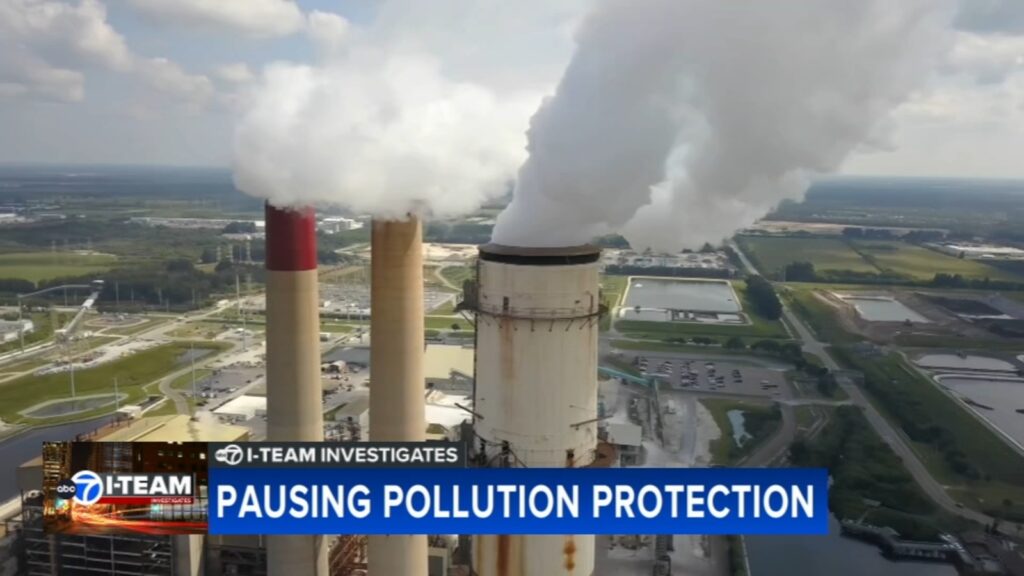
The race to build the world’s most powerful artificial intelligence systems has triggered an energy arms race — and until recently, a dangerous regulatory gap allowed that race to unfold at the expense of public health and environmental protection. In January 2026, the U.S. Environmental Protection Agency moved decisively to close a permitting loophole that had allowed massive gas-burning power installations to operate without proper air-quality oversight. The decision marks a turning point not only for environmental regulation, but for how America balances technological ambition with climate responsibility.
At Sustainable Action Now, we continue tracking the intersection of climate policy, environmental justice, and industrial accountability through our dedicated climate reporting coverage, because progress that poisons communities is not progress at all.
The Loophole That Powered a Supercomputer
The controversy began in Memphis, Tennessee, where xAI constructed a vast data-processing facility to run its “Colossus” supercomputer — an energy-hungry AI system requiring extraordinary electrical supply. Rather than relying solely on the existing power grid, the company installed dozens of trailer-mounted natural gas turbines on-site to generate electricity directly.
These turbines burned methane continuously. Yet they did so without federal Clean Air Act permits.
How? xAI and local health officials classified the turbines as “non-road engines” or “temporary portable sources,” arguing that because the units could be moved before remaining in one place for a full year, they did not qualify as stationary pollution sources under existing federal definitions. This interpretation allowed industrial-scale combustion equipment to operate outside standard environmental review — a loophole environmental advocates warned could be replicated nationwide if left unaddressed.
For nearby residents, the consequences were immediate. The facility sat adjacent to Boxtown, a historically Black neighborhood already burdened by industrial pollution. Local activists, the NAACP, and the Southern Environmental Law Center raised alarms about increased smog, respiratory health risks, and cumulative environmental injustice.
The EPA Draws a Line
On January 15, 2026, the EPA finalized a revision to its New Source Performance Standards — a technical change with sweeping implications. The updated rule explicitly states that portable combustion turbines must be treated as stationary sources, not non-road engines, when used to generate sustained on-site power. In practical terms, large-scale generators can no longer avoid federal permitting simply by being mounted on trailers or labeled “temporary.”
This clarification closed the regulatory escape hatch that had enabled xAI’s rapid deployment of unpermitted turbines. Under the new standard, any company installing significant power-generation infrastructure — even on a short-term basis — must secure Clean Air Act permits, undergo emissions review, and implement pollution-control technology.
The message from regulators was unmistakable: industrial growth cannot come at the cost of unchecked emissions.
What Changed on the Ground in Memphis
At the height of operations, the Memphis facility reportedly ran up to 35 methane turbines without federal permits. Following sustained legal and public pressure, xAI ultimately obtained local authorization for 15 turbines and now operates 12 under permit conditions. These approvals require the installation of selective catalytic reduction systems — advanced emissions controls designed to significantly reduce nitrogen oxide pollution.
While these steps mark progress, community advocates continue to monitor compliance and long-term health impacts. The episode has already reshaped local environmental enforcement strategies and strengthened community-led oversight of industrial expansion.
Expansion Plans Meet New Federal Reality
The new EPA rule has also complicated xAI’s ambitious next phase: a proposed $20 billion data complex known as “MACROHARDRR” in Southaven, Mississippi. Initially, state regulators permitted temporary turbine operations without full federal review. However, in response to the updated EPA standard, xAI has now filed for permits covering 41 turbines — an acknowledgment that the regulatory landscape has fundamentally changed.
This permitting process will require emissions modeling, public comment opportunities, and enforceable pollution controls. For residents near the proposed expansion, it represents the difference between secrecy and transparency, between unchecked emissions and enforceable safeguards.
A Broader Regulatory Crossroads
While the rule strengthens federal oversight, political crosscurrents remain. Current EPA leadership has publicly emphasized a desire to make the United States the global hub of AI innovation by streamlining permitting pathways. That ambition now exists alongside a newly clarified legal obligation to regulate industrial power emissions rigorously.
The next major milestone arrives on March 16, 2026 — the deadline for federal judicial review of the rule. Industry groups may seek to challenge it; environmental and public health advocates are preparing to defend it. The outcome will influence how far environmental law can reach into the rapidly expanding world of AI infrastructure.
Why This Matters Beyond One Facility
The Memphis case exposed a broader truth: as digital infrastructure expands, its physical footprint — power plants, cooling systems, fuel pipelines — increasingly shapes local air quality and global climate emissions. Data centers already consume enormous amounts of electricity. If their supporting energy systems operate without oversight, climate commitments become meaningless.
Closing the turbine loophole sets a national precedent. It affirms that technological innovation must operate within environmental law, not outside it. It reinforces that frontline communities deserve protection, not sacrifice zones for industrial experimentation.
Progress Without Accountability Is Not Progress
Artificial intelligence may define the next era of human development. But its foundations must not be built on pollution, secrecy, or regulatory evasion. The EPA’s January 2026 rule is a reminder that environmental safeguards exist for a reason — to protect real people breathing real air, in real communities.
At Sustainable Action Now, we will continue investigating climate accountability, environmental justice, and industrial transparency. Because a sustainable future requires more than innovation. It requires responsibility.
And when regulators close loopholes that endanger communities, the future becomes just a little more sustainable.