
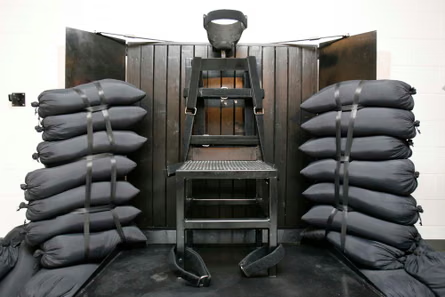
The death penalty in the United States remains one of the most expensive, controversial, and morally fraught elements of the criminal justice system. In 2025, states from Florida to Utah have continued to administer executions, tweak legal frameworks, and confront the deep inequities that define the machinery of death. While headlines often focus on the raw numbers of executions, a closer look reveals profound systemic flaws—legal, social, and financial—that demand urgent attention from citizens, policymakers, and advocates alike.
The Hidden Costs of Capital Punishment
One of the least discussed but most pressing issues surrounding the death penalty is its extraordinary financial burden on taxpayers. Studies consistently show that pursuing a death sentence costs significantly more than sentencing a defendant to life without parole. In Maryland, for example, a 2008 Urban Institute study found that an average death penalty case cost $3 million—almost three times the $1.1 million spent on non-capital cases. California routinely spends upwards of $90,000 more per year to house a single death row inmate compared to general population prisoners, and Texas estimates each capital case costs roughly $2.3 million—three times the cost of high-security life imprisonment. Nationwide, securing a death sentence costs an average of $1 million more per case than life imprisonment.
These costs are driven by a combination of factors:
- Legal complexity: Capital cases demand extensive pre-trial investigation, expert witnesses, and rigorous jury selection, adding substantial expenditures for courts, attorneys, and investigators.
- Extended trials: Death penalty trials can last up to four times longer than non-capital trials, increasing the workload for judicial personnel and the associated costs of court administration.
- Mandatory appeals: Multiple layers of automatic appellate review are built into the system, further prolonging proceedings and inflating costs.
- Specialized housing: Death row inmates require heightened security, often in solitary confinement, with annual costs far surpassing those of the general prison population.
- State-provided defense and prosecution: Many inmates cannot afford private attorneys, so the state covers dual defense counsel and prosecutions, often totaling millions per case.
These economic realities underscore a fundamental question: in a country that spends vast sums pursuing executions, could those resources be better used to prevent crime, support victims, and rehabilitate individuals? For more in-depth research and ways to take action, visit Sustainable Action Now.
Systemic Flaws: Race, Religion, and Inequity in Jury Selection
Beyond financial costs, the death penalty exposes deep racial, religious, and gender inequities in the judicial system. The American Civil Liberties Union (ACLU) recently released a report titled Fatal Flaws: Revealing the Racial and Religious Gerrymandering of the Capital Jury, which highlights how “death qualification”—the requirement that jurors be willing to impose a death sentence in order to serve on a capital case—systematically excludes Black prospective jurors, women, and people of faith from participating in some of the most consequential trials in the nation. This exclusion skews juries toward perspectives that are more punitive and less representative of community values, undermining fairness at the very foundation of capital litigation.
Such bias is not theoretical. Across the country, courts have long struggled with the consequences of racial and procedural inequities in death penalty trials. Landmark decisions, like Batson v. Kentucky (1986), established that excluding jurors on the basis of race violates the Equal Protection Clause of the Constitution. Yet decades later, reports and research show that systemic discrimination persists, affecting who sits in judgment—and ultimately, who lives or dies.
November 2025: Death Penalty Developments Across the States
Even as Florida dominates headlines with its unprecedented execution pace, states from New Hampshire to Utah continue to adjust and experiment with the machinery of death. Legal scholars and advocacy groups have been closely monitoring these changes, highlighting the need for vigilance and public engagement. Some key developments include legislative tweaks, judicial rulings, and procedural innovations that, while subtle, have far-reaching implications for fairness, transparency, and the risk of wrongful convictions.
For example, New Jersey recently became the first state to bar the admission of Shaken Baby Syndrome (SBS/AHT) theory in criminal trials, rejecting what experts increasingly recognize as junk science. Across Texas and other states, cases like that of Robert Roberson have illustrated the dangers of relying on unproven forensic theories to condemn individuals, sometimes leading to death row sentences for the innocent.
Reflections on Abolition Strategies
Amid these ongoing challenges, scholars continue to explore the pathways to ending the death penalty. William W. Berry III, writing in the Richmond Law Review, argues in Rethinking Strategies for Abolition that although the death penalty “appears to be experiencing a renaissance,” the reality is that new death sentences are actually declining in 2025. Berry emphasizes that this trend demonstrates a growing societal awareness that capital punishment is increasingly incompatible with justice, fairness, and public values.
Similarly, Thomas Ward Frampton revisits the significance of Batson v. Kentucky, explaining how this landmark decision reshaped jury selection and highlighted the Equal Protection Clause as a tool against systemic bias in capital cases. Together, these perspectives underscore the importance of both legal vigilance and strategic advocacy to curtail the death penalty while preserving constitutional safeguards.
Why This Matters
The combination of exorbitant costs, systemic bias, and human tragedy paints a stark picture of the death penalty as both inefficient and morally untenable. Each case represents not only the potential for irreversible error but also a misuse of public resources that could be redirected toward preventive and restorative justice initiatives. Advocacy, education, and legislative reform remain the most effective tools for citizens committed to ending the death penalty.
By staying informed and engaged, individuals can help ensure that justice is not sacrificed for speed, ideology, or cost. For those seeking actionable steps, research, and ways to contribute to the abolition movement, Sustainable Action Now provides comprehensive resources to support advocacy at both the state and national levels.
Moving Forward
As we reflect on 2025 and anticipate the years ahead, the challenge is clear: dismantle a system that perpetuates inequity, consumes excessive resources, and takes human life in a manner that fails justice. Through informed advocacy, public witness, and collective action, we can shift the conversation, curb the machinery of death, and create a more equitable system that honors life, fairness, and the principles of justice.
The time for action is now. Each legal reform, public awareness campaign, and personal act of engagement brings us closer to a society where justice is measured not by the number of executions, but by the protection of human rights, constitutional fairness, and the recognition of human dignity.
In 2025, Florida has emerged as the deadliest state in America, executing 17 individuals with two more scheduled before the year ends, a pace that eclipses any in recent history. This relentless march toward state-sanctioned death highlights not only moral and ethical questions but also staggering economic costs that weigh heavily on taxpayers. Beyond the headlines and political rhetoric lies a system that devastates families, traumatizes communities, and diverts enormous resources—all in the name of punishment.
The economic burden of the death penalty is staggering. Taxpayers bear the brunt of costs that far exceed those of incarcerating someone for life. A multitude of factors drive these expenses. Capital cases require complex legal proceedings: pre-trial investigations, expert testimony in forensics and mental health, and drawn-out jury selection processes. Trials often last four times longer than non-capital cases, inflating costs for court personnel, attorneys, and jurors alike. Following sentencing, mandatory appeals create layers of review that prolong litigation for years, if not decades, increasing costs exponentially.
Death row inmates require specialized housing with heightened security, often in solitary confinement, at a fraction of the cost that dwarfs general population housing. For example, in California, annual housing for a single death row inmate can exceed $90,000 more than standard incarceration, while in other states, costs per inmate may reach $60,000–$70,000 compared with $37,000 for other prisoners. Prosecution and defense costs further compound these expenditures. Inmates unable to afford private counsel are provided with two state-appointed attorneys, while the state covers extensive prosecution costs.
Case studies underscore these financial realities. In Maryland (2008), the average death penalty case cost $3 million versus $1.1 million for non-capital cases. Texas spends roughly $2.3 million per capital case—three times the cost of high-security life imprisonment. Nationwide, pursuing the death penalty costs about $1 million more per case than life without parole. The death penalty is not just a moral issue—it is an economic one. For deeper insight, visit Sustainable Action Now.
Yet the economic burden is only part of the story. Behind each statistic lies a human life—shaped by trauma, injustice, and systemic failure. Consider the case of Malik Abdul-Sajjad (born Richard Barry Randolph), a U.S. Army veteran executed by Florida this year for the 1988 murder of Minnie Ruth McCollum. Malik’s early life was defined by neglect, abuse, and systemic failure. Adopted by a family that inflicted severe physical and emotional trauma, he spent childhood believing he was unloved and unwanted. It was only decades later, in 2022, that Malik reconnected with his biological mother, discovering the truth about his birth and the loving family he had lost.
Malik’s adulthood reflected his attempts at healing: he served honorably in the Army and sought structure and purpose, yet untreated trauma and addiction led to the crime for which he was condemned. His trial was marred by racial and procedural bias: tried in a rural Florida courthouse flanked by a Confederate monument, he received a minimal defense that omitted critical context about his abusive upbringing. Despite four jurors voting for life, the state imposed the death penalty. On death row, Malik converted to Islam, mentored younger inmates, and maintained exemplary conduct. His execution, one of Florida’s 17 this year, reflects a system prioritizing retribution over redemption.
Other cases illustrate the persistent systemic failures that plague the machinery of death. Mark Allen Geralds, scheduled for execution on December 9, waived all remaining appeals—a so-called “volunteer.” Yet such waivers often arise from trauma, hopelessness, and long-term neglect, not informed consent. Geralds’ case is riddled with unresolved constitutional issues, forensic discrepancies, and evidence pointing to other suspects that was never fully disclosed. Executing him would not deliver justice but rather expedite state-sanctioned death over rigorous review. Similarly, Frank Walls, scheduled for execution on December 18, faces execution despite clear evidence of intellectual disability, which should categorically bar the state from carrying out his death sentence. His case underscores the tension between procedural rules and constitutional protections, and the moral cost of prioritizing speed over fairness.
The death penalty also fails as a societal deterrent. Florida, in its quest to execute 19 people in a single year, demonstrates that state-sanctioned killing neither restores victims’ families nor rehabilitates offenders. It creates additional victims: families who must endure repeated executions, communities traumatized by state violence, and individuals denied the opportunity for redemption. Across the country, from Tremane Wood in Oklahoma, spared only by a last-minute gubernatorial clemency, to Tommy Zeigler in Florida, blocked for decades from accessing DNA evidence, the narrative is consistent: procedural technicalities and bureaucratic expediency often override truth, fairness, and human dignity.
Even the legal foundations of capital punishment are flawed. ACLU reports reveal that death qualification in jury selection disproportionately excludes Black jurors, women, and people of faith, embedding bias in cases where the stakes are literally life and death. The New Jersey Supreme Court recently banned the Shaken Baby Syndrome hypothesis in criminal trials, recognizing the dangers of pseudo-scientific theories that can condemn innocent individuals. Cases like Robert Roberson’s in Texas highlight how flawed science and inadequate representation can place innocent people on death row.
Despite these sobering realities, activism and advocacy provide hope. Across Florida, vigils, petition drives, and public witnessing efforts have amplified the voices of those facing execution and those demanding justice. Events such as the Tallahassee Cities for Life service, featuring speakers like Sister Helen Prejean and Dr. Susan Recinella, emphasize moral accountability and collective action. Across the state, volunteers and supporters work tirelessly to support families, document injustices, and challenge the political calculus that prioritizes executions as a pathway to office.
This movement is anchored in historical perspective. The late Rev. James Lawson, a civil rights leader and founding board member of Death Penalty Focus, reminded us that awareness and action can transform societal norms. Today, we confront the same challenge: exposing the barbarity of the death penalty while advocating for a justice system that embodies compassion, fairness, and humanity.
The death penalty is costly—financially, socially, and morally. Florida’s 2025 execution spree has not delivered justice; it has amplified suffering and squandered public resources. Each death row case represents millions of dollars spent and decades of missed opportunities for rehabilitation and restorative justice. Yet this reality is not immutable. Sustained public pressure, education, advocacy, and legislative reform can shift the trajectory toward abolition.
As the year closes, Florida stands poised to execute two more individuals. Mark Geralds and Frank Walls represent both the human cost of state-sanctioned killing and the urgency of collective action. Every petition signed, every vigil attended, and every voice raised challenges a system that treats hopelessness as consent and procedural expedience as justice.
The question is no longer whether the death penalty works—it is clear that it does not. Instead, the question is whether we, as a society, will continue to fund, legitimize, and condone a system that is economically extravagant, morally bankrupt, and fatally flawed.
For those committed to action, this is the moment to stand. Support, advocate, and bear witness. Visit Sustainable Action Now to learn more, sign petitions, and join the fight against the death penalty. Each life spared, each injustice prevented, and each dollar redirected from state violence to human-centered programs represents a step toward a more humane and just society.
The cost of death is high—in money, in humanity, and in moral integrity. Together, we can ensure that justice does not come at the price of our conscience.