
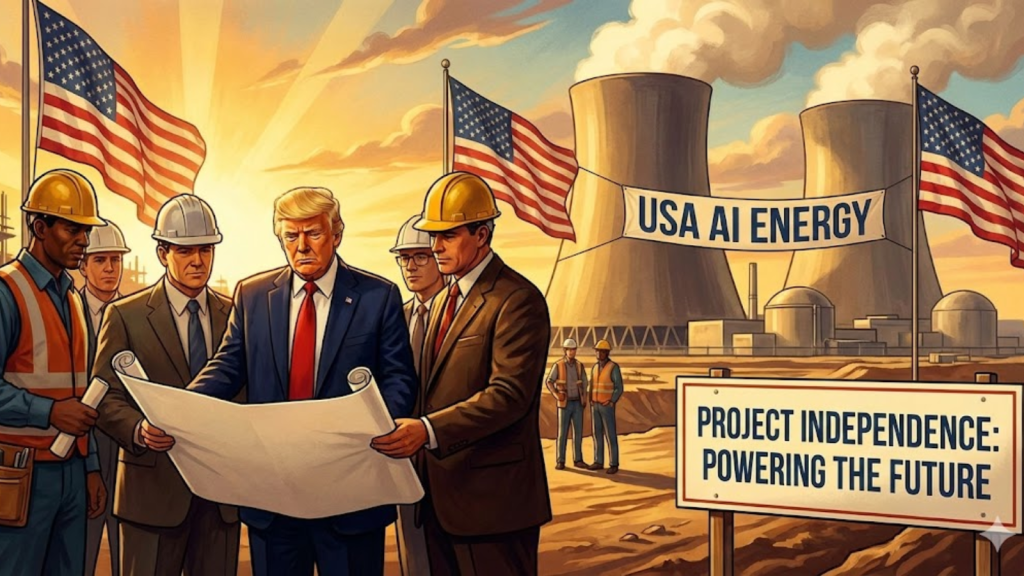
The race to define the next era of clean energy took a sharp and unexpected turn in December 2025, when Trump Media & Technology Group, the parent company of Truth Social, announced a sweeping all-stock merger with California-based nuclear fusion firm TAE Technologies. Valued at more than $6 billion, the deal instantly vaulted fusion energy into the political and financial spotlight, underscoring how climate, technology, and power are becoming inseparable in the modern energy debate.
At its core, the merger represents one of the boldest bets yet on nuclear fusion — a long-promised energy source that has captivated scientists and investors for decades but has yet to deliver commercial electricity to the grid. By aligning a politically connected media company with a fusion startup that claims major scientific breakthroughs, the deal reframes fusion not just as a research ambition, but as a strategic response to surging global energy demand.
That demand is being driven in large part by the explosive growth of artificial intelligence. Data centers, advanced computing clusters, and AI-driven infrastructure require enormous and continuous power, placing unprecedented strain on existing electric grids. Executives involved in the merger argue that fusion energy, if successfully commercialized, could offer a near-limitless, carbon-free solution capable of supporting this digital expansion without worsening the climate crisis.
According to the companies, the combined entity intends to move quickly. Plans call for construction of what is described as the world’s first utility-scale fusion power plant — a 50-megawatt facility — potentially beginning as early as 2026. Leadership has pointed to a commercial operations target around 2031, a timeline that would dramatically accelerate fusion’s arrival compared to traditional forecasts that place it several decades away.
To support this vision, Trump Media & Technology Group is restructuring itself as a diversified holding company. In addition to maintaining control of Truth Social, the new structure would incorporate TAE Technologies and related subsidiaries, including energy storage businesses designed to serve data centers and other high-demand users. Supporters describe this vertical integration as a way to bridge the gap between experimental energy science and real-world deployment.
Financially, the merger dramatically reshapes the identity of Trump Media. Long criticized for sustained losses tied to its social media platform, the company is pivoting toward energy and infrastructure as a potential growth engine. As part of the agreement, Trump Media committed to providing up to $200 million in immediate cash to TAE, with additional funding tied to regulatory milestones. Ownership of the combined company is expected to be split evenly between shareholders of both firms once the deal closes, anticipated in mid-2026.
Leadership of the new entity will be shared by Trump Media CEO Devin Nunes and TAE Technologies CEO Michl Binderbauer, signaling an attempt to balance political influence with scientific credibility. Yet that balance has also fueled controversy. President Trump, currently the largest shareholder in Trump Media, would see his stake reduced but still retain significant ownership in a company operating in a sector heavily influenced by federal energy policy, research funding, and regulation.
Ethics experts have raised concerns about potential conflicts of interest, noting that fusion energy development intersects with government-backed initiatives and long-term climate strategy. The overlap between political power, public policy, and private investment has intensified scrutiny of the deal, particularly as fusion research increasingly relies on public-private partnerships.
Beyond governance questions, the technological risks remain substantial. Despite recent advances, no fusion company has yet demonstrated sustained, grid-ready net energy production at commercial scale. Critics caution that claims of having “solved the science” should be treated carefully, given fusion’s long history of optimism followed by delay. Even incremental setbacks could push timelines back years, if not decades.
Still, the merger reflects a broader trend in climate and energy politics: growing impatience with incremental solutions. As fossil fuel volatility, grid instability, and climate impacts converge, investors and policymakers alike are searching for transformative answers. Fusion energy, once relegated to laboratory experiments, is now being framed as a potential cornerstone of future energy independence and emissions reduction — a narrative increasingly visible in debates shaping energy and political policy.
Whether this particular gamble succeeds remains uncertain. What is clear, however, is that the fusion conversation has shifted. No longer confined to scientists and engineers, it now sits at the intersection of politics, media, artificial intelligence, and climate strategy. If fusion delivers, it could redefine global energy systems. If it falls short, it may serve as a cautionary tale about the risks of mixing political ambition with unproven technology in the race for sustainable power.