
As climate instability accelerates and drought becomes a permanent feature of life across much of the United States, a new wave of climate-technology startups is stepping into an increasingly politicized and emotionally charged space: weather modification.
One of the most visible—and controversial—players is Rainmaker Technology Corporation, a young California company that has rapidly moved from niche agricultural pilot projects to national headlines, congressional lobbying, and widespread online misinformation.
At Sustainable Action Now, we examine climate solutions through a systems lens—looking not only at whether a technology works, but also at how it shapes policy, public perception, and long-term climate responsibility.
This report breaks down who Rainmaker Technology really is, how its cloud-seeding platform works, why the company became a political lightning rod after catastrophic flooding in Texas, and why even its supporters describe the technology as a tactical adaptation tool—not a climate cure.
For broader coverage on climate mitigation, adaptation, and climate policy, visit our climate reporting hub: 👉 https://sustainableactionnow.org/category/climate/
Who Is Rainmaker Technology?
Rainmaker Technology (officially Rainmaker Technology Corporation) is an American weather-modification startup founded in 2023 by Augustus Doricko and headquartered in El Segundo.
The company’s stated mission is straightforward but ambitious:
to use advanced aviation, sensors, and artificial intelligence to make cloud seeding more precise, scalable, and economically viable—especially in regions facing worsening water scarcity.
Rainmaker positions itself as part of the growing climate-adaptation economy, rather than the carbon-reduction sector.
In other words, the company does not claim to stop climate change. It claims to help communities survive its impacts.
How Rainmaker’s Cloud-Seeding System Actually Works
Rainmaker’s platform differs significantly from the older, more manual cloud-seeding programs that have existed since the mid-20th century.
Instead of relying primarily on piloted aircraft or ground-based generators, the company operates a modern, tightly integrated technology stack.
Unmanned aircraft (in-cloud drones)
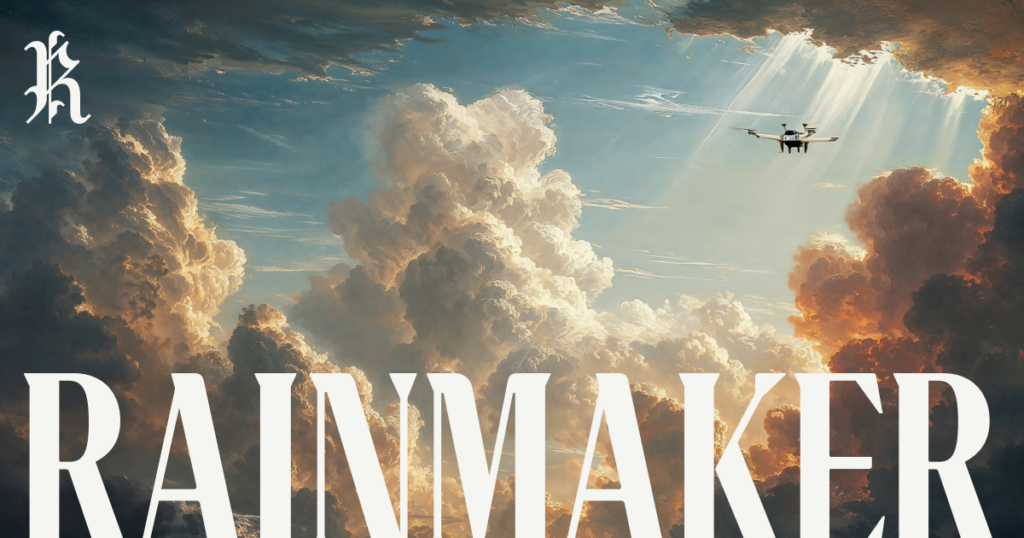
Rainmaker uses proprietary, weather-hardened unmanned aircraft known as the Elijah quadrotor, designed to fly directly into cloud systems and operate under cold, icy, and turbulent conditions.
These drones disperse silver iodide, a long-established cloud-seeding agent that encourages ice crystal formation inside suitable clouds.
Real-time radar and environmental sensing
The company deploys its own mobile radar and sensor infrastructure—called Eden units—to measure:
- humidity
- pressure
- cloud structure
- air quality
- and storm evolution
The goal is to verify whether precipitation increases actually follow seeding operations rather than relying on long-term statistical averages alone.
AI-driven weather modeling and targeting
Through its proprietary Stratus software platform and a 2025 partnership with an AI-meteorology firm, Rainmaker runs high-resolution simulations to determine:
- which cloud systems are physically “seedable”
- when intervention is likely to be effective
- and how flight paths should be optimized in real time
The company argues that this software-first approach dramatically improves targeting accuracy and reduces unnecessary flights.
Funding and Commercial Momentum
As of May 2025, Rainmaker Technology had raised approximately $25 million in Series A funding, with backing from climate-focused investors including Lowercarbon Capital.
The company’s early commercial deployments focused largely on agricultural regions and water districts struggling with declining reservoir levels and increasingly unreliable rainfall patterns.
The Texas Floods Controversy: How Misinformation Took Over
In July 2025, massive flash floods devastated parts of Texas, killing residents, destroying infrastructure, and triggering widespread public anger.
Soon after, online conspiracy narratives began circulating claiming that Rainmaker’s cloud-seeding operations had caused—or amplified—the storms.
The claims spread rapidly across social platforms and talk-radio channels.
However, experts and government officials were unequivocal:
Cloud seeding cannot generate a storm of that scale.
The United States Environmental Protection Agency and independent atmospheric scientists publicly stated that cloud seeding can only influence precipitation in already-existing, highly specific cloud conditions—and only at relatively small margins.
Put simply:
cloud seeding does not create storm systems, does not generate hurricanes, and does not produce catastrophic rainfall events.
The controversy nevertheless revealed something deeper about the current climate landscape:
public anxiety around climate disasters is increasingly being redirected toward visible technologies rather than toward the structural drivers of climate risk.
From Farmers to Capitol Hill: Rainmaker’s Lobbying Push
In early 2026, Rainmaker began formal lobbying in Washington, D.C., focused on:
- federal drone certification standards
- aviation regulatory pathways for in-cloud unmanned systems
- and national drought-response frameworks
The company has reportedly spent hundreds of thousands of dollars on federal lobbying and highly visible advertising campaigns—including premium, gold-framed placements in major transit corridors.
Rainmaker’s pitch to lawmakers is clear:
cloud seeding should be treated as part of the nation’s climate-adaptation infrastructure, alongside wildfire management, water recycling, and drought-response planning.
Important Clarification: Not All “Rainmaker” Companies Are the Same
The name “Rainmaker” is shared by several unrelated companies, which has contributed to public confusion.
To be clear, Rainmaker Technology Corporation is not affiliated with:
- Rainmaker Worldwide Inc. – a Canadian-founded company working on atmospheric water generation and wastewater treatment
- Rainmaker Cloud – a Salesforce consulting business
- Rainmaker Technologies – a startup developing solar-powered desalination drone concepts
Only Rainmaker Technology Corporation operates cloud-seeding drones.
Tactical Fix or Climate Solution?
Even among climate-technology advocates, Rainmaker’s approach is widely described as a tactical intervention, not a structural solution.
Whether cloud seeding is “good” or “bad” depends largely on the scale at which you evaluate climate risk.
The “Good” Case: Cloud Seeding as Climate Adaptation
Supporters frame cloud seeding as a practical climate-adaptation tool.
Drought mitigation
As climate change destabilizes historic rainfall patterns, cloud seeding can help:
- modestly increase snowpack and rainfall
- stabilize agricultural production
- supplement reservoir replenishment
Unlike large-scale desalination plants, cloud seeding carries a far lower energy footprint and can be deployed rapidly.
Wildfire risk reduction
In theory, increasing moisture in vulnerable regions—especially in mountainous watersheds and forested zones—can help dampen fuel loads and slightly reduce wildfire intensity.
While cloud seeding cannot stop wildfires, proponents argue it may contribute to broader fire-mitigation strategies.
The “Bad” Case: Ecological and Political Risks
Critics raise several serious concerns.
“Robbing Peter to pay Paul”
A longstanding concern in atmospheric science is whether inducing precipitation in one region reduces natural rainfall downwind.
In water-stressed regions, this raises fears of future political conflict between jurisdictions competing over shared atmospheric moisture.
Chemical footprint
Silver iodide is widely used and generally considered low-toxicity at seeding concentrations, but long-term accumulation in soil and groundwater remains under-studied at large operational scales.
Environmental groups argue that widespread deployment should be paired with mandatory ecological monitoring programs.
Moral hazard
Perhaps the most profound critique is political rather than chemical.
Some environmental advocates warn that highly visible climate-tech interventions can create a false sense of progress, allowing governments to delay the much harder work of:
- reducing fossil fuel use
- restructuring transportation systems
- modernizing electrical grids
- and cutting industrial emissions
The “Doesn’t Matter” Case: Scientific Skepticism
A large segment of the meteorological community remains cautious.
Most peer-reviewed assessments suggest that cloud seeding increases precipitation by roughly 5% to 15%, and only under very specific cloud conditions.
From a global climate perspective, that margin is small.
In the context of planetary-scale warming, sea-level rise, and systemic hydrological disruption, cloud seeding is often described as a localized optimization tool, not a transformative intervention.
Where Rainmaker Fits in the Climate Policy Landscape
Rainmaker Technology represents a growing category of climate adaptation startups attempting to make environmental risk more manageable without confronting its root causes.
That distinction matters.
Cloud seeding does not:
- decarbonize energy systems
- reduce methane emissions
- eliminate fossil fuel infrastructure
- or stabilize global temperature rise
What it can do—at best—is help specific communities cope with water shortages under worsening climate conditions.
This makes Rainmaker’s lobbying campaign especially significant.
It reflects a broader shift in U.S. climate policy discourse—from mitigation toward resilience and adaptation.
For ongoing reporting on how technology, policy, and environmental risk are intersecting, follow our climate coverage here: 👉 https://sustainableactionnow.org/category/climate/
A Sustainable Action Now Perspective
Rainmaker Technology did not cause the Texas floods.
But its sudden visibility highlights a deeper challenge facing climate governance.
As climate impacts intensify, public demand for rapid, visible solutions will grow.
Technologies like cloud seeding offer something politically attractive:
a tangible action that appears to address climate risk without forcing difficult economic or structural change.
Cloud seeding may play a limited role in future drought-management strategies.
But it cannot replace the urgent need for emissions reduction, energy transition, and environmental justice.
In climate policy terms, Rainmaker is not a cure.
It is a tactical tool—useful in narrow circumstances, potentially risky if scaled carelessly, and ultimately incapable of solving the climate crisis on its own.
And that distinction is exactly what lawmakers—and the public—must clearly understand.